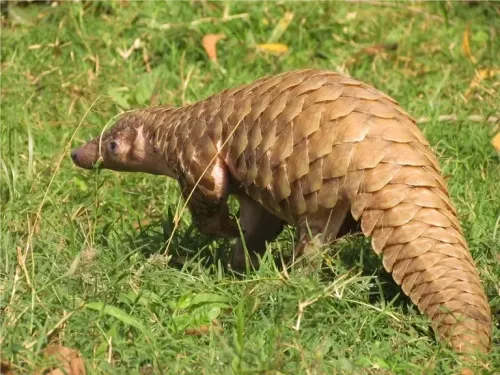
Chinese Pangolin spotted near Shillong in WII camera trap first

Synopsis
For the first time in its study area, the Wildlife Institute of India has captured the critically endangered Chinese Pangolin on camera near Shillong — in urban-fringe forests that are routinely overlooked but are proving to be surprise biodiversity strongholds. The find sharpens the case for protecting small, city-edge forest patches in India's northeast.
Key Takeaways
The Wildlife Institute of India (WII) recorded the Chinese Pangolin on camera traps near Shillong, Meghalaya — a first for the institute's study area.
The sighting occurred in the Riat Laban and Laitkor reserve forests on the urban fringe of Shillong, as part of WII's ongoing mammalian assemblage study.
The Chinese Pangolin has been listed as Critically Endangered on the IUCN Red List since 2014 .
Cameras also captured Large Indian Civet , Leopard Cat , Masked Palm Civet , Yellow-throated Marten , Indian Crested Porcupine , and Kalij Pheasant .
Poaching and illegal scale trafficking remain the species' greatest threats; forest officials note that trafficking kingpins 'seldom get caught.'
The Wildlife Institute of India (WII) has recorded the critically endangered Chinese Pangolin on camera traps near Shillong, Meghalaya — the first time the species has appeared in the institute's study area. The sighting, captured during an ongoing mammalian survey in the Riat Laban and Laitkor reserve forests on the urban fringe of Shillong, has been described by researchers as a landmark conservation find.
What the Cameras Captured
The footage emerged from WII's project titled 'Assessment of Mammalian Assemblages in Meghalaya', which focuses on peri-urban forest patches bordering Shillong. Alongside the Chinese Pangolin, the camera traps documented a surprisingly rich suite of wildlife, including the Large Indian Civet, Leopard Cat, Masked Palm Civet, Yellow-throated Marten, Indian Crested Porcupine, and Kalij Pheasant.
'These peri-urban city forests harbour a remarkably unique and diverse assemblage of wildlife,' WII stated, noting that such forest patches on urban edges are frequently overlooked in conservation planning.
Why Urban-Fringe Forests Matter
Researchers highlighted that city-fringe forests often serve as critical ecological refuges for species threatened by habitat fragmentation and unchecked urban expansion. WII said the discovery of a critically endangered animal sharing habitat with carnivores and small mammals 'proves that these urban forest patches are invaluable biodiversity strongholds that must be strictly protected and preserved.'
The find adds urgency to calls for tighter protection of small but ecologically significant forest covers on the peripheries of major urban centres in India's northeast.
About the Chinese Pangolin
The Chinese Pangolin is native to the northern Indian subcontinent, northern Southeast Asia, and southern China. Since 2014, it has been listed as Critically Endangered on the IUCN Red List. Poaching remains its greatest threat — millions of pangolins have been killed over recent decades for their meat and scales, the latter used in traditional Chinese medicine despite no scientific evidence of medicinal efficacy.
India's northeastern states once harboured a sizeable population of the species, but poaching and illegal trafficking of scales to Southeast Asian countries have drastically reduced numbers.
The Trafficking Problem
Wildlife and forest officials say enforcement remains a persistent gap even as strong legal protections exist on paper. 'Those caught are normally couriers, who are let off after some time. The kingpins behind the trafficking syndicates seldom get caught. They succeed in shielding their networks that are worth hundreds of crores,' a forest official said.
Experts believe that systematic camera-trap documentation by government bodies like WII could strengthen the evidence base for conservation action and help pull the Chinese Pangolin back from the brink of extinction.
Point of View
But it also exposes a troubling irony: a critically endangered species is surviving in a sliver of urban-fringe forest precisely because larger habitat has been lost or become unsafe. The fact that Riat Laban and Laitkor are on the edges of a state capital underscores how little wild space remains — and how easily these patches could be erased by development pressure. India's enforcement gap on pangolin trafficking is well-documented; kingpins operate with near-impunity while courier-level arrests create the illusion of action. WII's camera evidence is a conservation asset, but without deterrent prosecution at the syndicate level, documentation alone will not save the species.
NationPress
21 Oct 2026
Frequently Asked Questions
Where was the Chinese Pangolin spotted in Meghalaya?
The Chinese Pangolin was recorded by WII camera traps in the Riat Laban and Laitkor reserve forests on the urban fringe of Shillong, Meghalaya. This is the first time the species has been documented within WII's designated study area in the region.
Why is the Chinese Pangolin critically endangered?
The Chinese Pangolin has been on the IUCN Red List as Critically Endangered since 2014, primarily due to large-scale poaching for its meat and scales. The scales are used in traditional Chinese medicine, though no scientific evidence supports their efficacy against any known disease.
What other wildlife did WII cameras capture near Shillong?
Alongside the Chinese Pangolin, WII cameras documented the Large Indian Civet, Leopard Cat, Masked Palm Civet, Yellow-throated Marten, Indian Crested Porcupine, and Kalij Pheasant — reflecting the biodiversity richness of urban-edge forests.
Why are peri-urban forests significant for wildlife conservation?
Urban-fringe forests act as critical ecological refuges for species threatened by habitat fragmentation and urban development. WII researchers say these patches are 'invaluable biodiversity strongholds' that are often overlooked in conservation planning despite their importance.
How serious is pangolin trafficking in northeast India?
Pangolin trafficking in northeast India is reportedly widespread, with scales illegally trafficked to Southeast Asian countries. Forest officials note that enforcement targets mostly low-level couriers while syndicate kingpins — running networks reportedly worth hundreds of crores — rarely face prosecution.