Bhupender Yadav Plants Sapling at Isha Foundation Under Ek Ped Maa Ke Naam

Synopsis
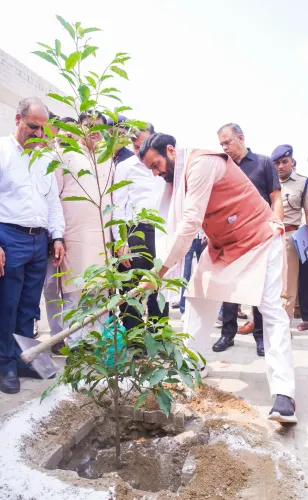
Union Environment Minister Bhupender Yadav planted a Mahilam sapling at Isha Foundation's Coimbatore campus on 10 July 2026 under the Ek Ped Maa Ke Naam campaign, praising the Foundation's ecological restoration work and calling tree plantation an investment in a sustainable future.
Key Takeaways
Bhupender Yadav participated in the Ek Ped Maa Ke Naam campaign at Isha Foundation , Coimbatore , on 10 July 2026 .
He planted a Mahilam flower sapling, calling each plantation 'an investment in a greener, healthier, and more sustainable future.' The minister praised Isha Foundation 's 'sustained efforts towards ecological restoration and environmental conservation.' The campaign is part of India's broader afforestation push under the Green India Mission targeting 10 million hectares of forest cover expansion.
India's Bonn Challenge pledge commits the country to restoring 21 million hectares of degraded land by 2030 .
Plantation data is expected to be reported ahead of the next UNFCCC COP as part of India's climate commitments.
Union Environment Minister Bhupender Yadav planted a Mahilam flower sapling at the Isha Foundation campus in Coimbatore, Tamil Nadu, on 10 July 2026, participating in the government's flagship tree-plantation drive, Ek Ped Maa Ke Naam. The minister commended the Foundation's ecological restoration work and called the initiative an investment in a 'greener, healthier, and more sustainable future.'
Context
The Ek Ped Maa Ke Naam (One Tree in Mother's Name) campaign was launched by the Ministry of Environment, Forest and Climate Change to mobilise citizens and institutions into voluntary tree plantation by framing each sapling as a tribute to one's mother. The campaign draws on emotional resonance to drive mass participation, positioning afforestation as both a civic duty and a personal act. Yadav's visit to the Isha Foundation headquarters in Coimbatore extends that outreach to one of India's most prominent civil-society conservation organisations.
In his post, the minister wrote: 'Every sapling planted is an investment in a greener, healthier, and more sustainable future,' adding that he commends Isha Foundation's 'sustained efforts towards ecological restoration and environmental conservation, which continue to inspire collective action.'
Policy Backdrop
The plantation drive sits within a broader policy architecture that includes the Green India Mission, launched in 2014 under the National Action Plan on Climate Change, which targets expansion of forest cover and improved ecosystem services across 10 million hectares. India also committed in 2015 to the Bonn Challenge, pledging to restore 21 million hectares of degraded land by 2030 through afforestation and landscape restoration.
Citizen-facing campaigns such as Ek Ped Maa Ke Naam serve a dual purpose: they generate grassroots momentum for plantation targets while allowing the government to report measurable progress against these international commitments. Ministerial participation at civil-society venues amplifies both the symbolic and the numerical weight of such drives.
Stakeholders and Impact
The Isha Foundation, established by Sadhguru Jaggi Vasudev, has built a significant track record in ecological restoration, particularly through river-basin rejuvenation and large-scale afforestation in Tamil Nadu and adjoining states. Its organisational network and volunteer base make it a high-leverage partner for government conservation programmes. The Foundation's involvement signals the Environment Ministry's strategy of widening its stakeholder base beyond conventional forestry agencies to include spiritual and yoga-linked organisations with large public followings.
Local communities in and around Coimbatore — a city that sits at the edge of the Nilgiri Biosphere Reserve — stand to benefit directly from sustained afforestation efforts that can improve air quality, water retention, and biodiversity in the region.
What's Next
The Environment Ministry is expected to publish cumulative plantation data under Ek Ped Maa Ke Naam in the run-up to the next UNFCCC COP, where India will be required to demonstrate progress on its nationally determined contributions. Parliamentary questions on the Ministry's annual afforestation budget are also anticipated, making field visits such as this one part of a broader communications strategy around India's climate credentials. Continued engagement between the government and organisations like Isha Foundation is likely as India seeks to scale voluntary plantation beyond state forestry departments.
Point of View
Politically cross-cutting volunteer base. The choice of the Mahilam sapling, a native species, subtly reinforces the campaign's ecological credibility beyond mere optics. This pattern of ministerial field visits to high-profile NGO campuses has become a consistent tool for the BJP government to demonstrate climate action without relying solely on state machinery. With UNFCCC COP reporting cycles approaching, such events also serve as data points in India's international climate diplomacy narrative.
NationPress
10 Oct 2026
Frequently Asked Questions
What is the Ek Ped Maa Ke Naam campaign?
Ek Ped Maa Ke Naam, meaning 'One Tree in Mother's Name,' is a government tree-plantation campaign run by the Ministry of Environment, Forest and Climate Change that encourages citizens and institutions to plant saplings as a tribute to their mothers, aiming to boost public participation in India's afforestation goals.
What did Bhupender Yadav do at Isha Foundation on 10 July 2026?
Union Environment Minister Bhupender Yadav planted a Mahilam flower sapling at the Isha Foundation campus in Coimbatore under the Ek Ped Maa Ke Naam campaign and praised the Foundation's ecological restoration and environmental conservation efforts.
What is Isha Foundation's role in environmental conservation?
Isha Foundation, founded by Sadhguru, is a non-profit organisation known for large-scale ecological restoration projects including river-basin rejuvenation and afforestation drives, primarily in Tamil Nadu and surrounding states.
What is the Mahilam plant?
Mahilam is a native flowering plant species used in afforestation and ecological restoration efforts in southern India, valued for its biodiversity contribution and cultural significance in the region.
How does India's tree plantation campaign connect to international climate commitments?
India's afforestation campaigns feed into its Bonn Challenge pledge to restore 21 million hectares of degraded land by 2030 and its Green India Mission targeting 10 million hectares of forest cover, both of which are reported as part of India's nationally determined contributions under the UNFCCC Paris Agreement.