CM Yogi: UP Women's Workforce Share Triples Since 2017

Synopsis
The Chief Minister's Office of Uttar Pradesh says female labour-force participation has tripled from 12% in 2017 to over 37–38%, driven by Mission Shakti, mandatory 20%-plus women's share in government recruitments, and new Shramjeevi Hostels in major cities.
Key Takeaways
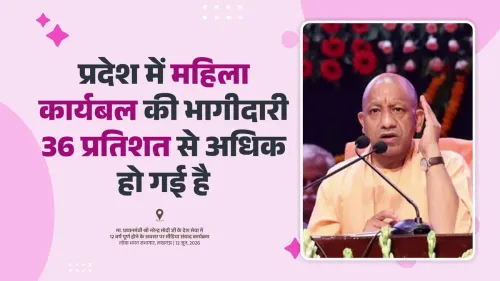
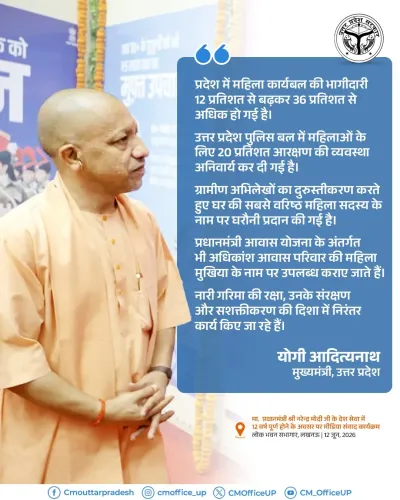
Female labour-force participation in Uttar Pradesh has risen from approximately 12 percent in 2017 to over 37–38 percent , according to CM Yogi Adityanath.
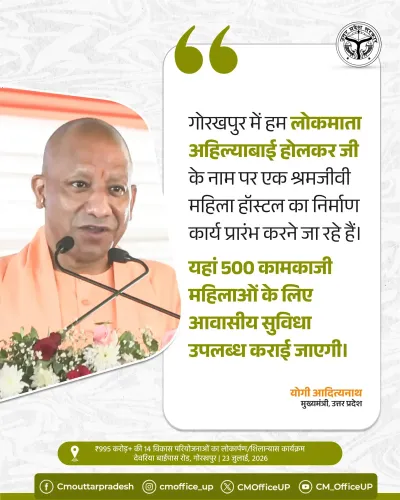
The state is constructing Shramjeevi Hostels for working women in all major metropolitan cities to reduce commute distances and provide safe housing.
Mission Shakti drives the government's three-pronged agenda of women's security, self-reliance, and dignity across UP's 75 districts.
Every state government recruitment now mandates more than 20 percent women's participation, which the government says sets new records.
The 'double-engine government' framing ties the state-level push to aligned BJP policy at the Centre, presenting a unified women's empowerment agenda.
From roughly one in eight to more than one in three — that is the arc Uttar Pradesh claims to have drawn for women in its workforce over less than a decade. The Chief Minister's Office of Uttar Pradesh quoted Chief Minister Yogi Adityanath on Monday, 3 August 2026, saying female labour-force participation in the state has surged from approximately 12 percent in 2017 to over 37–38 percent today.
Hostels in every major city, a commute problem solved
The government's response to a rising female workforce is not just statistical — it is structural. The 'double-engine government' (डबल इंजन की सरकार), as the CM's Office describes the aligned BJP administrations in Lucknow and New Delhi, is building Shramjeevi Hostels (working women's hostels) in all major metropolitan centres of the state. The stated aim is direct: cut commute distances, provide safe residential options, and remove one of the most stubborn barriers keeping women from taking up urban jobs.
The hostel push is part of a wider infrastructure bet — that proximity to workplaces, not just job openings, determines whether women actually enter and stay in the formal economy.
Mission Shakti's three-pillar approach
Mission Shakti, the state's flagship women-centric programme, anchors the government's narrative around three pillars: women's security (महिला सुरक्षा), self-reliance (महिला स्वावलंबन), and dignity (महिला सम्मान). Launched under the current administration, the scheme has driven a range of interventions from safety infrastructure to skill-development and livelihood support across Uttar Pradesh's 75 districts — home to more than 240 million people, making it India's most populous state.
Over 20 percent women in every government recruitment
The sharpest policy lever cited is a mandatory quota: the state government says it has ensured more than 20 percent women's participation in every government recruitment drive it has conducted, setting what it calls new records. In a state the size of UP, where public-sector employment carries outsized social weight, that floor in hiring translates into tens of thousands of women entering government service each cycle.
Taken together — the participation numbers, the hostel programme, Mission Shakti, and the recruitment mandate — the government is presenting a layered argument: that supply-side skilling and demand-side quotas must be backed by physical infrastructure if the gains are to stick.
Whether the hostel construction timelines hold and whether the participation rate continues its climb will be the real test of that argument.
Point of View
Where women voters have been a decisive bloc. The Shramjeevi Hostel programme signals a shift from purely welfare-oriented women's policy toward infrastructure-led economic integration, a more durable but harder-to-deliver commitment. Mission Shakti's three-pillar framing also allows the government to address both safety concerns (which dominate opposition narratives on UP) and economic ones in a single policy umbrella. The key question analysts will watch: whether the participation-rate gains reflect sustained formal employment or a surge in informal and agricultural work that inflates the headline number.
NationPress
17 Sept 2026
Frequently Asked Questions
What is the current female labour force participation rate in Uttar Pradesh?
According to Chief Minister Yogi Adityanath, female labour-force participation in Uttar Pradesh now stands at over 37–38 percent, up from approximately 12 percent in 2017.
What is Mission Shakti in Uttar Pradesh?
Mission Shakti is a Uttar Pradesh government initiative focused on three pillars — women's security, self-reliance, and dignity — covering safety infrastructure, skill development, and livelihood support across the state's 75 districts.
What are Shramjeevi Hostels and who are they for?
Shramjeevi Hostels are working women's hostels being built by the Uttar Pradesh government in major metropolitan cities to provide safe, affordable accommodation and reduce long commutes for employed women.
What is the women's reservation in UP government jobs?
The Uttar Pradesh government has mandated that more than 20 percent of candidates in every state government recruitment drive must be women, a policy the government says has set new records in female public-sector hiring.
What is the 'double-engine government' referred to in the UP CM's statement?
The 'double-engine government' is a BJP phrase describing the alignment between the party-led state government in Uttar Pradesh and the BJP-led central government in New Delhi, implying coordinated policy support for schemes like women's empowerment.