Alibaba signs AI and chip pact with Guangdong, China's richest province
Synopsis
Alibaba has signed a landmark strategic deal with Guangdong — China's richest province — to deploy AI models, expand semiconductor infrastructure including its Zhenwu AI chips, and boost cross-border e-commerce, signalling a major government-backed bet on domestic tech self-sufficiency.
Key Takeaways
Alibaba Group Holding and Guangdong province signed a strategic cooperation framework agreement on Thursday, 14 August 2026 , in Guangzhou .
The deal covers investments in computing power , AI models , semiconductors, and digital public services, according to state media Nanfang Daily .
Provincial party secretary Huang Kunming called for Alibaba to 'step up efforts in technology innovation, research development and investment' in the region.
CEO Eddie Wu Yongming described Guangdong as 'always a core region' in Alibaba 's strategic development, citing its economic scale and consumer market.
Alibaba 's T-Head Zhenwu AI chips and logistics arm Cainiao are among the key assets expected to be deployed under the agreement.
Huang flagged synergies with energy and telecoms firms to strengthen Guangdong 's computing power capacity.
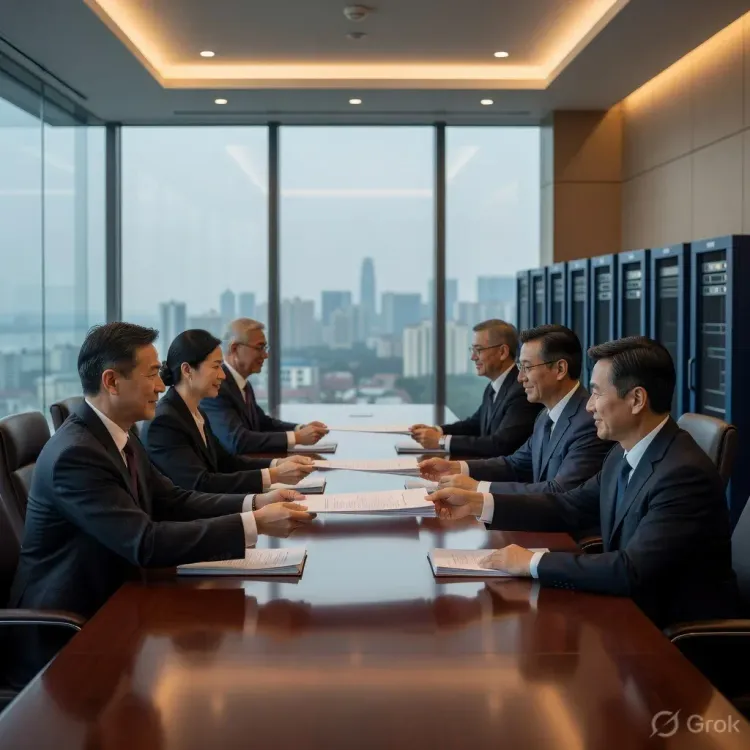
Alibaba Group Holding has formalised a sweeping strategic cooperation agreement with Guangdong, China's wealthiest province, targeting investments in artificial intelligence, semiconductors, and smart public services. The framework deal was signed on Thursday, 14 August 2026, in Guangzhou, Guangdong's provincial capital, with both sides pledging to deepen ties across computing infrastructure, AI model deployment, and digital commerce.
What was agreed
Under the strategic cooperation framework, the Hangzhou-based tech giant plans to expand its investments in computing power, AI models, and digital services across the province, according to local state media Nanfang Daily. The agreement covers a broad sweep of sectors, from consumer electronics and manufacturing equipment to healthcare, where AI model deployment is expected to be prioritised.
Provincial party secretary Huang Kunming thanked Alibaba 'for its long-standing support of Guangdong's economic and social development' and urged the company to 'step up efforts in technology innovation, research development and investment' in the region, according to the report.
Semiconductors and computing power in focus
Huang specifically highlighted potential synergies with energy and telecommunications companies to bolster computing power capacity within Guangdong. The province has been positioning itself as a national hub for chip design and advanced manufacturing, and the deal signals that Alibaba's semiconductor ambitions — including its T-Head Zhenwu AI chips — could find a significant deployment ground here.
The emphasis on computing infrastructure aligns with Beijing's broader push to reduce reliance on foreign chips amid ongoing export restrictions from the United States. Domestic AI chip alternatives are increasingly being woven into provincial digital strategies.
E-commerce and cross-border trade angle
Huang also noted that locally manufactured goods could be further promoted through Alibaba's online shopping and cross-border e-commerce platforms, a nod to Guangdong's status as one of China's premier export manufacturing bases. The logistics arm Cainiao is expected to play a role in facilitating this cross-border push.
Why it matters
Guangdong 'has always been a core region' in Alibaba's strategic development, CEO Eddie Wu Yongming said at the signing ceremony, citing the province's economic clout, vibrant innovation ecosystem, and vast consumer market. The province contributes roughly 10% of China's total GDP, making it a bellwether for national tech adoption trends.
For Alibaba, the deal reinforces its pivot toward cloud and AI revenue streams at a time when domestic competition from Huawei, ByteDance, and emerging AI startups is intensifying. Securing a long-term government-backed partnership in China's richest province provides both revenue visibility and political goodwill.
What's next
Analysts will be watching for concrete procurement announcements, particularly around Zhenwu AI chips and cloud contracts tied to Guangdong's smart city and industrial AI programmes. The pace at which Alibaba translates this framework into billable infrastructure deals will be a key indicator of how effectively the company is monetising its government partnerships in the post-regulatory-crackdown era.
Point of View
And Guangdong's imprimatur is the clearest signal yet that the company's rehabilitation is complete. The explicit mention of Zhenwu AI chips and computing-power synergies with telecoms and energy firms maps directly onto Beijing's chip-war playbook: build domestic silicon capacity through provincial demand aggregation rather than waiting for a single national champion. What mainstream coverage tends to miss is that framework agreements like this rarely specify dollar values — the real test is whether Alibaba Cloud wins the procurement tenders that follow, or whether Huawei's Ascend ecosystem quietly captures the same contracts. Investors should watch Alibaba's next two quarterly cloud revenue disclosures for evidence that Guangdong-linked deals are moving the needle.
NationPress
28 Sept 2026
Frequently Asked Questions
What did Alibaba agree to with Guangdong province?
Alibaba Group Holding signed a strategic cooperation framework agreement with Guangdong on 14 August 2026 in Guangzhou , committing to expand investments in computing power, AI models, semiconductors, and digital services across the province. The deal also covers AI deployment in consumer electronics, manufacturing, and healthcare, as well as cross-border e-commerce promotion for local goods.
Why is the Guangdong-Alibaba deal significant?
Guangdong is China 's wealthiest province, contributing roughly 10% of national GDP, making it a critical proving ground for domestic AI and chip adoption. The deal also signals Alibaba 's continued reintegration into state-backed industrial strategy following years of regulatory scrutiny.
What role do Alibaba's Zhenwu AI chips play in this agreement?
Alibaba 's T-Head Zhenwu AI chips are expected to be a key technology deployed under the framework, particularly as Guangdong seeks to build out domestic computing power capacity. This aligns with China 's broader push to reduce dependence on foreign semiconductors amid US export restrictions.
Who are the key figures involved in the Alibaba-Guangdong agreement?
Provincial party secretary Huang Kunming represented Guangdong at the signing ceremony and called on Alibaba to intensify its innovation and investment efforts in the region. Alibaba CEO Eddie Wu Yongming attended and described Guangdong as 'always a core region' in the company's strategic plans.
How does this deal affect Alibaba's competition with Huawei and other Chinese tech firms?
Securing a government-backed partnership in China 's richest province gives Alibaba a competitive edge in the race for provincial cloud and AI infrastructure contracts, where rivals including Huawei and ByteDance are also active. The outcome of subsequent procurement tenders will determine whether Alibaba 's framework deal translates into tangible market share gains.