Dongfang Suanxin exits stealth with 3D stacking AI chips to beat US curbs
Synopsis
Dongfang Suanxin, a stealth Chinese AI chip start-up led by a China Semiconductor Industry Association vice-president, went public on 5 July 2026 with a radical 3D stacking architecture built entirely on domestic components — its most striking claim is that it needs no foreign supply chain at all.
Key Takeaways
Dongfang Suanxin emerged from stealth on 5 July 2026 , marking its first public communication since being founded in 2024 .
The company is led by Wei Shaojun , vice-president of the China Semiconductor Industry Association .
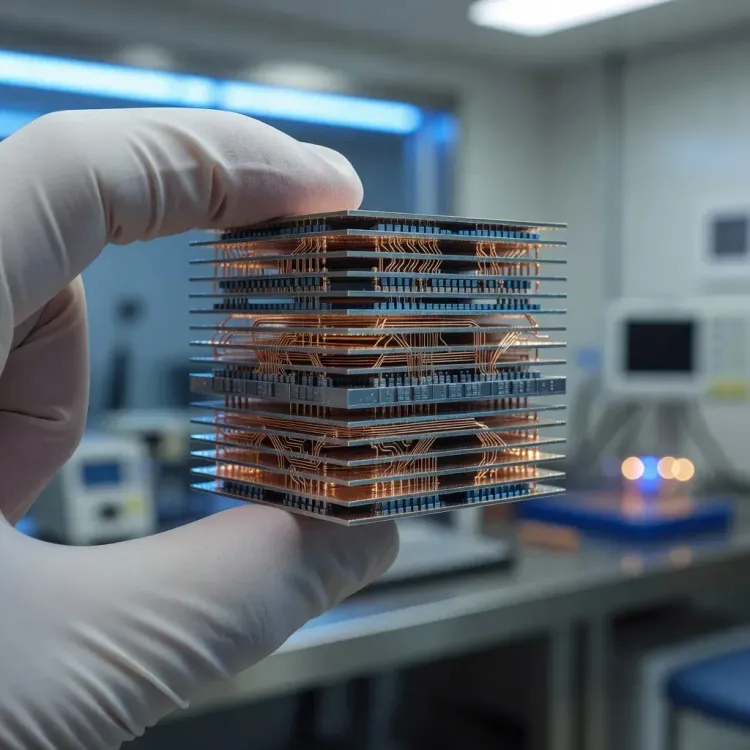
Its chips are built on two core technologies: 'software-defined chips' and '3D stacked near-memory computing' .
The company states its technology relies entirely on a domestic supply chain , with no dependence on foreign-restricted components.
Huawei Technologies proposed the related 'Tau Scaling Law' in late May 2026 , framing 3D architectural innovation as the new scaling paradigm for Chinese chipmakers.
The start-up operates in a landscape shaped by sustained US tech export controls targeting China's access to advanced semiconductors.
Dongfang Suanxin, a Chinese AI chip start-up founded in 2024 and led by semiconductor industry veteran Wei Shaojun, emerged from stealth mode on Wednesday, 5 July 2026, launching a corporate website and social media presence as it bets on 3D stacked near-memory computing to build high-performance AI chips entirely from a domestic supply chain — a direct response to US tech export controls.
What Dongfang Suanxin is building
The Shanghai-based company says it relies on two proprietary technologies: 'software-defined chips' and '3D stacked near-memory computing', which it claims deliver ultra-high-performance computing without dependence on restricted foreign components. The company stated its technology relies entirely on a domestic supply chain, positioning it as a self-sufficient alternative to chip designs that require access to advanced foreign fabrication nodes or equipment.
Wei Shaojun, who also serves as vice-president of the China Semiconductor Industry Association, is helming the venture — lending it significant institutional credibility within China's state-aligned chip ecosystem.
Why it matters: 3D stacking as China's workaround
The emergence of Dongfang Suanxin signals a broader strategic pivot in China's chip industry. Faced with sustained US export controls that restrict access to leading-edge chips and chipmaking equipment, Chinese firms are increasingly turning to architectural innovation — specifically 3D stacking — as a pathway to competitive AI compute performance.
This approach gained fresh momentum in late May 2026, when tech giant Huawei Technologies proposed the 'Tau Scaling Law', a new engineering principle designed to achieve transistor-density gains through 3D architectural innovation rather than traditional lithographic shrinkage. Dongfang Suanxin's launch follows squarely in that conceptual lineage.
The competitive backdrop
The post-Moore's Law era has pushed semiconductor giants globally toward 3D chip architecture as conventional transistor scaling approaches physical limits. In China, the urgency is compounded by geopolitical pressure: companies like Huawei Technologies have already demonstrated that domestically engineered architectures can partially substitute for denied foreign technology.
Dongfang Suanxin enters a crowded but still-forming domestic AI chip landscape, competing for talent, government contracts, and enterprise adoption against established players and a wave of better-funded start-ups backed by vehicles such as the National AI Industry Investment Fund.
What's next
Wednesday's public debut is the company's first communication since its founding — meaning product specifications, performance benchmarks, and customer traction remain undisclosed. The critical next steps will be demonstrating that its 3D stacking approach can match or exceed the compute density of restricted chips at scale, and securing foundry partnerships within China's still-maturing domestic fabrication ecosystem.
As Beijing continues to prioritise semiconductor self-reliance, watch for Dongfang Suanxin to surface in government procurement pipelines and cloud-infrastructure partnerships — the clearest early indicators of whether its architectural bet translates into commercial traction.
Point of View
With Huawei's Tau Scaling Law providing the ideological scaffolding. What mainstream coverage underweights is the institutional dimension — having the China Semiconductor Industry Association's own vice-president lead a start-up this early-stage suggests state alignment and likely preferential access to domestic foundry capacity and government procurement. The real test is not the architecture itself, which is globally validated, but whether China's mature-node fabs can manufacture 3D-stacked dies at the yield rates and volumes needed for frontier AI training workloads. If they can, the US export-control regime faces a structural, not merely incremental, challenge.
NationPress
5 Oct 2026
Frequently Asked Questions
What is Dongfang Suanxin and what does it do?
Dongfang Suanxin is a Chinese AI chip start-up founded in 2024 that publicly launched on 5 July 2026. It develops high-performance AI computing chips using 'software-defined chip' and '3D stacked near-memory computing' technologies, and says its entire supply chain is domestic.
How does 3D stacking help China bypass US chip export controls?
3D stacking improves computing performance by layering chip components vertically rather than shrinking transistors further — a technique that does not necessarily require the most advanced foreign lithography equipment subject to US export restrictions. This allows Chinese firms to pursue performance gains through architectural innovation rather than process-node advancement.
Who is Wei Shaojun and why does his involvement matter?
Wei Shaojun is the head of Dongfang Suanxin and also serves as vice-president of the China Semiconductor Industry Association, the country's principal industry body for semiconductors. His dual role gives the start-up strong institutional credibility and likely close ties to government policy and procurement channels.
What is Huawei's Tau Scaling Law and how does it relate to this story?
Huawei Technologies proposed the 'Tau Scaling Law' in late May 2026 as a new engineering principle that seeks to achieve transistor-density improvements through 3D architectural innovation rather than traditional lithographic scaling. Dongfang Suanxin's technology is aligned with this doctrine, reflecting a wider industry shift in China toward architectural workarounds for export-control constraints.
What are the next milestones to watch for Dongfang Suanxin?
The company has yet to disclose product specifications, performance benchmarks, or customer relationships. Key indicators to monitor include government or cloud-infrastructure procurement contracts, foundry partnerships within China's domestic fabrication ecosystem, and any published performance data comparing its chips against restricted foreign alternatives.