China eyes 15,000 abandoned coal mines for underground farming
Synopsis
Chinese researchers propose converting up to 15,000 decommissioned coal mines into underground farms by 2030, leveraging existing tunnel infrastructure, power grids, and groundwater to build climate-resilient food production systems — a concept that could redefine land use at industrial scale.
Key Takeaways
Chinese scientists from the Shanxi Province Coal-based Resources Green and High-efficiency Development Engineering Centre published the underground farming proposal in China Mining Magazine in late August 2026 .
An estimated 15,000 abandoned mines in China are expected to close by 2030 , providing the physical infrastructure base for the initiative.
Existing mine assets — including tunnels, power grids, ventilation systems, and groundwater — could be repurposed for agricultural use, according to the researchers.
The paper evaluates whether key variables — light, temperature, and water — can support viable underground crop production.
The researchers cite intensifying climate change as a key driver, arguing that underground closed-environment farming offers stability that surface agriculture cannot guarantee.
The proposal remains at the research and feasibility stage, with no confirmed pilot projects announced as of September 8, 2026 .
Chinese scientists have put forward a proposal to convert abandoned coal mine tunnels into functional underground agricultural spaces, framing the initiative as a cornerstone of a green, circular economy for China's vast mining sector. The concept, outlined in China Mining Magazine in late August 2026, was authored by a research team based in Shanxi, one of the country's most prolific coal-producing provinces.
The Scale of the Opportunity
An estimated 15,000 abandoned mines across China are projected to cease operations by 2030, leaving behind extensive subterranean infrastructure. The researchers, affiliated with the Shanxi Province Coal-based Resources Green and High-efficiency Development Engineering Centre, argue that these spaces offer a ready-made physical framework — including existing tunnels, power grids, ventilation systems, and groundwater reserves — that could be repurposed for agricultural production at relatively low marginal cost.Why It Matters
The proposal directly addresses mounting pressure on conventional farming systems. "With climate change intensifying globally, the stability and sustainability of traditional land agricultural systems are facing severe challenges," the research team wrote, adding that there was "a lot of practical value" in developing "closed-environment farming." Underground spaces are naturally insulated from surface weather volatility and natural disasters, giving them a structural resilience that open-air farmland cannot match.Technical Feasibility Under Review
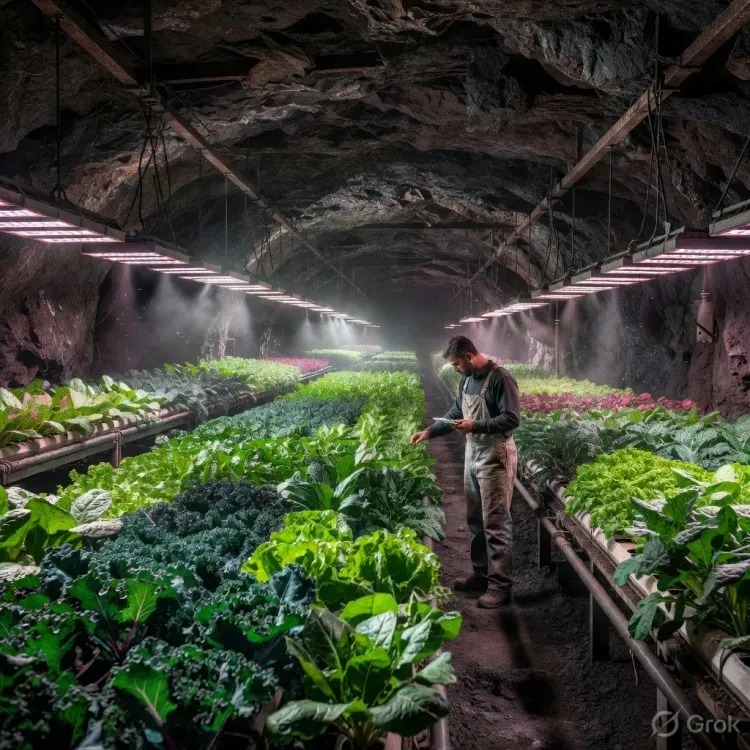
The paper systematically assesses whether critical environmental factors — including light, temperature, and water — can be adequately managed to sustain viable farming operations underground. Controlled-environment agriculture technologies, including artificial lighting and hydroponic systems, are increasingly cost-competitive, lending practical credibility to the concept. The researchers suggest the existing ventilation infrastructure in mine tunnels could be adapted to regulate air quality and humidity for crop growth.The Competitive Backdrop
The idea is not without international precedent. Underground farming projects have been piloted in former tunnel networks in the United Kingdom, with ventures in North Yorkshire and elsewhere demonstrating that subterranean crop production is commercially viable. China's proposal, however, operates at a categorically different scale, given the sheer number of mines scheduled for decommissioning. If even a fraction of the 15,000 sites are converted, the aggregate agricultural footprint could be substantial.What's Next
The research remains at the conceptual and assessment stage, with no confirmed pilot projects announced as of September 8, 2026. The viability of the proposal will hinge on the economics of retrofitting mine infrastructure with lighting and climate-control systems, as well as regulatory frameworks governing the repurposing of decommissioned industrial sites. Policymakers in Shanxi and at the national level will be closely watched for any signals of formal backing or pilot funding.Point of View
Reframing decommissioning as transformation rather than decline. What mainstream coverage tends to underplay is the infrastructure arbitrage at the heart of the idea: the sunk costs of tunnelling, electrification, and ventilation have already been paid, making the marginal cost of conversion far lower than building equivalent controlled-environment facilities from scratch. The concept also slots neatly into Beijing's broader push for food security self-sufficiency, a priority that has intensified amid geopolitical tensions affecting global supply chains. The real test will be whether the economics of artificial lighting and climate control can be made competitive with surface-level vertical farming, which itself is still struggling to achieve profitability at scale.
NationPress
24 Oct 2026
Frequently Asked Questions
What did Chinese scientists propose about abandoned coal mines?
Chinese scientists proposed converting abandoned coal mine tunnels into underground agricultural spaces, a concept they term 'underground agriculture.' The research team, based in Shanxi province, published the idea in China Mining Magazine in late August 2026, suggesting that existing mine infrastructure could support crop production.
How many coal mines in China are being abandoned?
An estimated 15,000 mines in China are expected to close by 2030. This large-scale decommissioning is what prompted the researchers to explore alternative uses for the subterranean infrastructure left behind.
Why would underground farms be better than surface farms?
Underground spaces are naturally insulated from surface weather events and natural disasters, offering greater climate resilience. The researchers argue this stability is increasingly valuable as climate change disrupts traditional land-based agricultural systems.
Is underground farming already being done anywhere?
Yes, underground farming has been piloted in former tunnel networks in the United Kingdom, including in North Yorkshire, demonstrating commercial viability. However, China's proposal operates at a significantly larger scale given the volume of mines scheduled for closure.
What are the main technical challenges for underground coal mine farming?
The researchers identify light, temperature, and water as the three critical factors that must be adequately managed for underground farming to work. Retrofitting mine tunnels with artificial lighting and climate-control systems represents the primary cost and engineering challenge.