China's Hubei quartz deposit matches US Spruce Pine purity: study

Synopsis
Chinese geologists say a newly found deposit near Shiyan, Hubei produces quartz with properties 'highly similar' to Spruce Pine — the near-monopoly US mine underpinning global chip and solar manufacturing — a finding that could reshape a critical strategic supply chain.
Key Takeaways
Researchers from the China University of Geosciences , Wuhan Centre of China Geological Survey , and Hubei Geological Bureau identified the Xiaohuaguo deposit near Shiyan, Hubei .
Purified quartz from the deposit was found to be 'highly similar' to Unimin's IOTA-CG type high-purity quartz sand , according to the study published in Earth Science in August 2026 .
High-purity quartz requires silica purity above 99.9 per cent and is essential for semiconductor crucibles, optical fibres, and solar panels.
Spruce Pine, North Carolina — operated by Sibelco — currently holds a near-monopoly on this material grade, making it a global supply-chain chokepoint.
The discovery is part of a broader Chinese push to reduce reliance on US quartz imports amid escalating resource rivalry and China 's own rare earth export restrictions.
The deposit remains at the exploration stage; commercial viability has not yet been established.
A newly identified high-purity quartz deposit in central China has been found to produce material with properties 'highly similar' to those of Spruce Pine, North Carolina — the world's most critical source of ultra-pure quartz for semiconductor and solar-panel manufacturing. The findings, published in the peer-reviewed Chinese-language journal Earth Science in August 2026, were produced by researchers from the China University of Geosciences, the Wuhan Centre of China Geological Survey, and the Hubei Geological Bureau.
The Xiaohuaguo Discovery
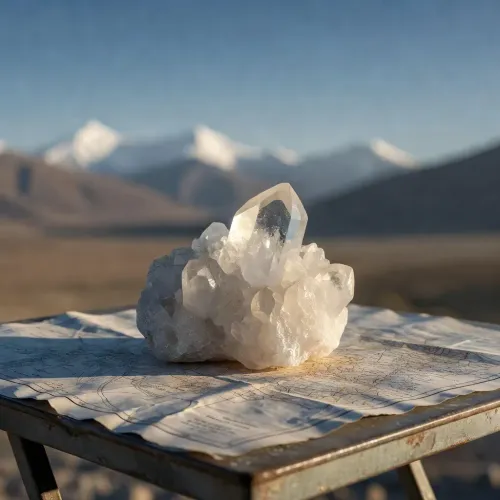
The deposit, named Xiaohuaguo, is located near Shiyan in Hubei province, situated within the South Qinling geological belt. According to the research team, the deposit represents a hydrothermal vein-type quartz resource — the same geological class responsible for Spruce Pine's exceptional purity. The paper states that purified quartz sand from Xiaohuaguo showed characteristics 'highly similar' to Unimin's IOTA-CG type high-purity quartz sand, one of the most sought-after grades in advanced manufacturing.
Why It Matters
High-purity quartz — defined by silica purity above 99.9 per cent — is indispensable in the fabrication of semiconductor crucibles, optical fibres, and photovoltaic components. While quartz is the second most abundant mineral in the Earth's continental crust, deposits meeting this extreme purity threshold are exceptionally rare globally. Spruce Pine, operated by Sibelco (formerly through Unimin), has long held a near-monopoly on this grade, making it a strategic chokepoint in global chip and clean-energy supply chains.
The Competitive Backdrop
The discovery arrives amid intensifying resource rivalry between China and the United States. Industry voices in the US have reportedly been pushing to leverage high-purity quartz as a strategic counter to China's restrictions on rare earth exports. Meanwhile, China has been actively cataloguing domestic quartz resources — including deposits in Tibet and other regions — to reduce dependence on imports. The Xiaohuaguo find is described by the researchers as 'a new prospective area' for hydrothermal vein-type high-purity quartz exploration across the country.
What's Next
The study stops short of commercial viability claims, framing the deposit as a prospective exploration target rather than a production-ready resource. Further assay work, large-scale purification trials, and infrastructure assessments will be needed before Xiaohuaguo can be positioned as a genuine alternative to Spruce Pine. Comparable global deposits — including those near Kyshtym in Russia and Quest Metals sites in Norway — have taken years to reach commercial scale, underscoring the gap between geological promise and industrial supply. Analysts and policymakers in both Washington and Beijing will be watching subsequent exploration results closely, as any credible domestic Chinese supply of semiconductor-grade quartz would materially alter the current strategic calculus.
Point of View
Lithium, and gallium supply chains before export controls became geopolitical weapons. What mainstream coverage often underplays is how long the gap between 'geologically promising' and 'industrially deployable' actually is: Spruce Pine's dominance persists not just because of purity, but because of decades of purification know-how, logistics infrastructure, and customer qualification cycles that no paper can replicate overnight. The more immediate strategic signal may be less about Xiaohuaguo itself and more about the message it sends to Washington — that China is actively closing the asymmetry that made Spruce Pine a credible counter-leverage card. If even one or two of China's emerging quartz deposits reach commercial scale, the semiconductor industry's quiet dependence on a single North Carolina mountain will finally be forced into boardroom risk registers.
NationPress
24 Oct 2026
Frequently Asked Questions
What is the Xiaohuaguo quartz deposit and where is it located?
The Xiaohuaguo deposit is a newly identified high-purity quartz resource located near Shiyan in Hubei province , central China. It is a hydrothermal vein-type deposit within the South Qinling geological belt, the same geological class associated with the world-leading Spruce Pine mine in the United States .
Why is Spruce Pine quartz so important for semiconductors?
Spruce Pine, North Carolina produces high-purity quartz with silica purity above 99.9 per cent , which is essential for manufacturing the crucibles used in silicon wafer production, as well as optical fibres and solar panel components. Operated by Sibelco , it holds a near-monopoly on this ultra-pure grade, making it a critical and largely irreplaceable node in global chip supply chains.
How does the Chinese deposit compare to Spruce Pine quality?
According to the research paper published in Earth Science in August 2026 , purified quartz sand from Xiaohuaguo showed particle size, morphology, and residual fluid inclusion characteristics that were 'highly similar' to Unimin's IOTA-CG type high-purity quartz sand — one of the benchmark grades used in high-end technology manufacturing.
Is China's Xiaohuaguo deposit ready for commercial production?
Not yet. The study frames Xiaohuaguo as a prospective exploration target, not a production-ready resource. Large-scale purification trials, infrastructure development, and customer qualification processes — steps that took decades at Spruce Pine — will be required before the deposit can serve as a commercial alternative.
How does this discovery fit into the US-China tech rivalry?
The finding is part of China's broader effort to reduce dependence on US quartz imports, running parallel to Beijing 's restrictions on rare earth exports. Industry voices in the US have reportedly been exploring high-purity quartz as a strategic counter-leverage tool, and a viable domestic Chinese supply would significantly reduce the effectiveness of that approach.