China erects 100-metre South China Sea observation tower
Synopsis
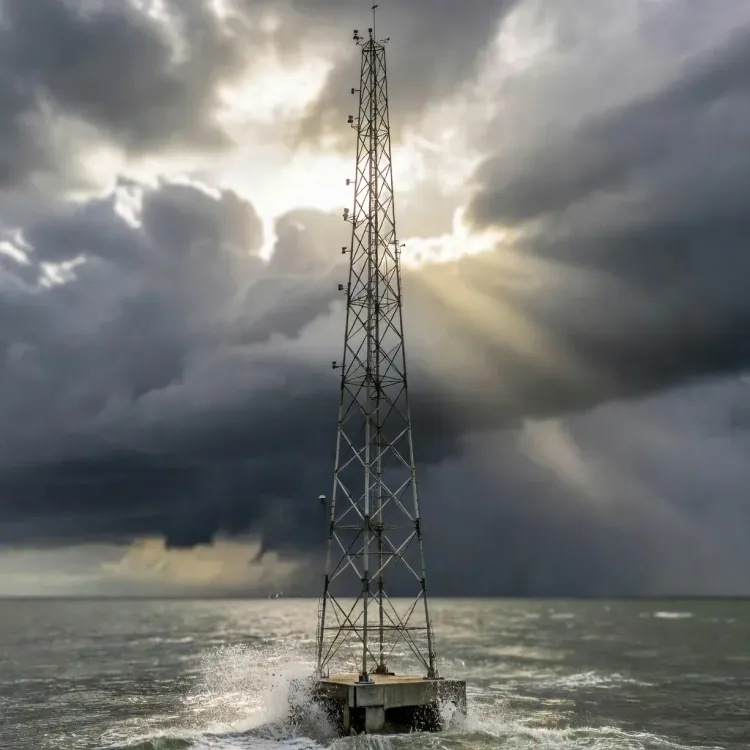
China has built a record-breaking 100-metre environmental observation tower in the South China Sea — nearly three times taller than any previous structure there — capable of surviving super typhoons and collecting real-time atmospheric data at multiple altitudes, closing a long-standing gap in regional weather monitoring.
Key Takeaways
China's meteorological administration confirmed the completion of a 100-metre ( 330-foot ) environmental observation tower in the South China Sea on 23 June 2026 .
The tower is nearly three times taller than the previous tallest structure in the region.
It is engineered to withstand super typhoons with wind speeds exceeding 200 km/h ( 125 mph ), heavy waves, high humidity, and high salinity.
Onboard sensors collect real-time, round-the-clock data on wind speed, temperature, humidity, and air pressure at varying altitudes.
Meteorologists previously lacked the ability to monitor atmospheric conditions at different altitudes over the South China Sea , limiting extreme-weather data collection.
The tower is expected to strengthen typhoon forecasting for southern China , including Hainan , Guangdong , and Yangjiang .
China has completed construction of the tallest environmental observation tower in the South China Sea, standing at 100 metres (330 feet) — nearly three times the height of the previous record-holder in the region, China's meteorological administration announced on Tuesday, 23 June 2026. The structure is designed to withstand super typhoons with wind speeds exceeding 200 km/h (125 mph), along with heavy waves, high humidity, and extreme salinity.
Engineering feat built for extreme conditions
The tower is fitted with an array of sensors capable of collecting round-the-clock, real-time data on wind speeds, temperatures, humidity, and air pressure across multiple altitudes. Its structural specifications are calibrated to survive the most punishing weather events the South China Sea can produce. The region's semi-enclosed geography — bordered by land on multiple sides — makes it a natural funnel for typhoons tracking toward southern China, including Guangdong province and the Leizhou Peninsula.
Why it matters: closing a critical data gap
Meteorologists had previously lacked the infrastructure to monitor atmospheric conditions at varying altitudes over the South China Sea, according to the administration. That gap significantly constrained the quality of data available on extreme weather events such as typhoons and thunderstorms. Scientists note that rising ocean and atmospheric temperatures are driving a higher frequency of extreme weather events globally, making dense, real-time monitoring networks increasingly essential.
What the administration said
China Meteorological News, the administration's official newspaper, quoted officials as saying: 'The implementation of this project further strengthens the … monitoring and protection network in the South China Sea, providing important support for marine meteorological observation in the South China Sea.' The tower forms part of a broader push to reinforce maritime meteorological infrastructure across the region, which also encompasses the South China Sea Mooring Array and research programs linked to institutions such as the Ocean University of China.
The competitive backdrop
The South China Sea is among the world's most strategically contested maritime zones, and environmental monitoring infrastructure in the area carries significance beyond weather forecasting. Enhanced atmospheric and oceanic data collection at altitude feeds into models such as the SCS Trident Model, improving typhoon track prediction for communities across Hainan, Guangdong, and Yangjiang. The tower's data streams are also expected to benefit regional shipping lanes and offshore energy operations.
What's next
The administration has not disclosed a timeline for additional towers or expansion of the monitoring network, but the commissioning of this structure signals a clear intent to build denser observational coverage across the South China Sea. As climate-driven typhoon intensification accelerates, the pressure on regional governments to invest in early-warning infrastructure will only grow — and China's latest deployment sets a new engineering benchmark for the region.
Point of View
But the dual-use potential of high-altitude, real-time atmospheric and oceanic data over the South China Sea — feeding military weather models as readily as civilian typhoon forecasts — is the story beneath the story. The tower also fits a consistent pattern: China is methodically layering civilian scientific infrastructure across the South China Sea, each installation incrementally normalising a permanent operational presence. As climate change makes extreme-weather prediction a hard national-security requirement, the country that owns the best sensor network in a contested sea owns a significant informational advantage — one that no rival currently matches at this altitude.
NationPress
22 Sept 2026
Frequently Asked Questions
What is China's new South China Sea observation tower?
It is a 100-metre ( 330-foot ) environmental observation tower completed in the South China Sea in June 2026 , confirmed by China's meteorological administration . It is the tallest such structure ever built in the region, standing nearly three times higher than its predecessor, and is equipped with sensors for real-time atmospheric monitoring at multiple altitudes.
Why did China build this observation tower in the South China Sea?
Meteorologists previously could not monitor atmospheric conditions at varying altitudes over the South China Sea , limiting data collection on typhoons and thunderstorms. Rising ocean and atmospheric temperatures are increasing the frequency and intensity of extreme weather events, making better monitoring infrastructure critical for southern China 's coastal regions.
What can the tower withstand and measure?
The tower is built to withstand super typhoons with wind speeds exceeding 200 km/h ( 125 mph ), heavy waves, high humidity, and extreme salinity. Its sensors collect round-the-clock, real-time data on wind speed, temperature, humidity, and air pressure at different altitudes.
Which areas will benefit from the South China Sea weather tower?
The tower is expected to improve typhoon forecasting and early-warning capabilities for southern China , particularly Hainan , Guangdong , and Yangjiang . Regional shipping lanes and offshore energy operations in the South China Sea are also expected to benefit from enhanced atmospheric data.
How does this tower compare to previous structures in the South China Sea?
At 100 metres , the new tower is almost three times the height of the previous tallest structure in the South China Sea , according to China's meteorological administration . No comparable altitude-capable environmental observation structure currently exists in the region built by any other nation.