China's Xingshu 'Star Hub' to deploy 1,000 satellites for orbital AI computing

Synopsis
China unveiled Xingshu, a planned 1,000-satellite network that will run AI workloads directly in orbit and sell compute power by the hour — the country's most commercially ambitious orbital computing project yet, and a direct challenge to Western space infrastructure dominance.
Key Takeaways
China unveiled the Xingshu ('Star Hub') orbital AI computing network at the World Artificial Intelligence Conference in Shanghai on 24 July 2026 .
The constellation will eventually comprise around 1,000 satellites , according to Chi Nan , optical communications professor at Fudan University .
Xingshu is jointly developed by Fudan University and Shanghai Xingshu Tiansuan Space Technology Co. , offering compute-by-the-hour services to governments and enterprises.
Target sectors include energy , shipping , finance , disaster response, meteorology, and natural resource management.
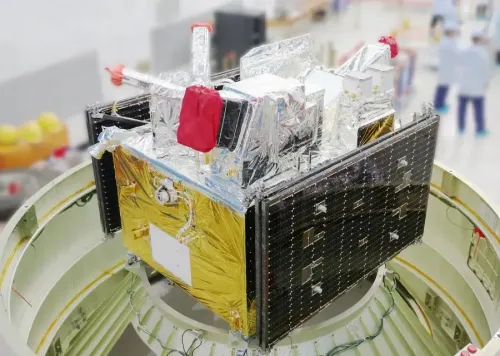
China 's competing orbital compute programmes — the 300-satellite Tiansuan constellation (8 satellites launched) and Zhejiang Lab 's 1,000-satellite Three-Body Computing Constellation (first dozen deployed last year) — are already underway.
China has announced Xingshu — meaning 'Star Hub' — a planned 1,000-satellite space-based computing network designed to process satellite data directly in orbit using artificial intelligence, before transmitting results to Earth. The project was unveiled at the World Artificial Intelligence Conference in Shanghai on Saturday, 24 July 2026, marking one of the country's most ambitious orbital computing initiatives to date.
What Xingshu Is and How It Works
The network is being jointly developed by Fudan University and Shanghai Xingshu Tiansuan Space Technology Co., according to Chi Nan, an optical communications professor at Fudan University. Rather than relaying raw data to ground stations, Xingshu will perform AI-driven computation in orbit, reducing latency and bandwidth demands on Earth-based infrastructure.
The platform will offer on-demand, time-based computing services, allowing governments, researchers, and companies in sectors such as energy, shipping, and finance to rent computing power by the hour, Chi said at the conference.
Key Applications Across Industries
Xingshu will combine satellite observations with AI to deliver a broad range of services: weather forecasts, disaster warnings, port and shipping monitoring, power grid inspections, and remote-sensing support for emergency responders, meteorological agencies, and natural resource authorities. The subscription-style model — billed by the hour — signals an intent to commercialise orbital computing infrastructure across both public and private sectors.
The Competitive Backdrop
China has been accelerating its space-computing ambitions across multiple fronts. Xingshu follows the 300-satellite Tiansuan constellation led by the Beijing University of Posts and Telecommunications, which has launched eight satellites so far. State-backed Zhejiang Lab is also building its Three-Body Computing Constellation, targeting 1,000 satellites, with its first dozen satellites deployed last year.
Together, these programmes reflect a coordinated national strategy to establish sovereign, AI-enabled orbital infrastructure — a domain where SpaceX's Starlink currently holds a commanding lead in satellite count and operational scale.
Why It Matters
Processing data in orbit rather than on the ground reduces the volume of information that must be transmitted back to Earth, which is particularly valuable for time-sensitive applications such as disaster response and maritime surveillance. By embedding AI at the edge — in this case, in space — operators can act on insights in near real time without depending on ground-based data pipelines.
The commercialisation angle is equally significant: offering compute-by-the-hour in orbit could open a new revenue model for space infrastructure, positioning China as a provider of orbital computing services to global clients.
What's Next
No launch timeline for the full 1,000-satellite Xingshu constellation has been disclosed. As Tiansuan and Three-Body continue their own deployment schedules, the pace at which China can scale orbital AI processing will be closely watched by space agencies, defence analysts, and commercial operators worldwide.
Point of View
Suggesting China is positioning this as exportable infrastructure, not just a domestic capability. The real test will be whether Xingshu can achieve the satellite economics and latency benchmarks needed to compete with terrestrial cloud alternatives for non-defence clients.
NationPress
24 Jul 2026
Frequently Asked Questions
What is China's Xingshu satellite network?
Xingshu, meaning 'Star Hub', is a planned Chinese orbital computing network of around 1,000 satellites that will process satellite data in orbit using AI before sending results to Earth. It is being jointly developed by Fudan University and Shanghai Xingshu Tiansuan Space Technology Co., and was announced at the World Artificial Intelligence Conference in Shanghai on 24 July 2026.
How will Xingshu's orbital computing work?
Xingshu will perform AI-driven data processing directly on satellites, eliminating the need to transmit raw data to ground stations first. Customers — including governments, researchers, and companies in energy, shipping, and finance — will be able to rent computing power in orbit by the hour, according to Chi Nan of Fudan University.
How does Xingshu compare to other Chinese space-computing projects?
China already has two comparable initiatives underway: the 300-satellite Tiansuan constellation led by the Beijing University of Posts and Telecommunications, which has launched eight satellites, and Zhejiang Lab's 1,000-satellite Three-Body Computing Constellation, which deployed its first dozen satellites last year. Xingshu adds a third, commercially oriented programme to this growing portfolio.
What services will Xingshu provide?
Xingshu will support weather forecasting, disaster warnings, port and shipping monitoring, power grid inspections, and remote-sensing services for emergency responders, meteorological agencies, and natural resource authorities, according to Chi Nan. The platform targets both public-sector agencies and private enterprises.
Why is China investing in orbital AI computing?
Processing data in orbit reduces latency and bandwidth demands compared to routing raw satellite data through ground stations, which is critical for time-sensitive use cases like disaster response and maritime surveillance. The move also aligns with China's broader strategy to build sovereign, AI-enabled space infrastructure as competition with Western space programmes — particularly SpaceX's Starlink — intensifies.