Europe fights for humanoid robotics foothold as China and US lead
Synopsis
At Paris's inaugural Machina summit, European physical AI firms admitted they are trailing China and the US — with most speakers on the main stage headquartered in America, and industry leaders warning that regulatory overreach could lock Europe out of the next industrial revolution entirely.
Key Takeaways
Machina , Europe 's first dedicated physical AI and humanoid robotics summit, was held in Paris on 8 July 2026 , with the majority of main-stage presenters based in the United States .
Schaeffler Technologies , a Bavaria -based industrial components maker, entered the humanoid robotics sector in January 2026 via a partnership with UK start-up Humanoid .
David Kehr , president of Schaeffler 's Humanoid Robotics division, warned that excessive regulation must not 'stifle' the European physical AI market.
Industry insiders cautioned that Europe faces accelerated deindustrialisation if it fails to build a competitive domestic humanoid robotics industry.
China and the US are regarded as the current leaders in physical AI, with firms including AgiBot , Unitree Robotics , and Apptronik among the front-runners.
European companies are scrambling to establish a competitive position in physical AI — the fusion of artificial intelligence with robotics and industrial machinery — as China and the United States consolidate early leads in the sector. Industry insiders have warned that failure to build a viable continental industry could accelerate Europe's deindustrialisation, compounding economic pressures already weighing on the region.
A continent playing catch-up
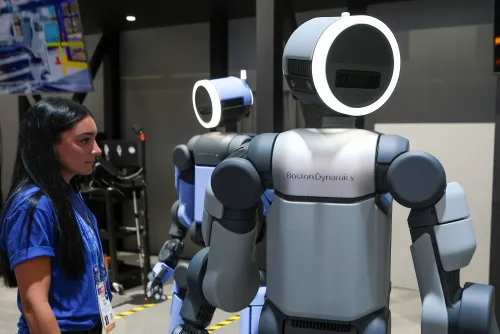
The scale of the challenge was on full display at Machina, an inaugural one-day summit held in Paris on Tuesday, 8 July 2026, billed as Europe's leading dedicated event for the physical AI and humanoid robotics industry. The main stage told its own story: the majority of presenting companies were headquartered in the United States, with European firms accounting for only a small fraction of the speaker line-up.
'You see China and the US … because of AI … typically they are considered the leaders, but do not count out Europe,' said David Kehr, president of Humanoid Robotics, a division of German firm Schaeffler Technologies.
Schaeffler's strategic pivot into physical AI
Traditionally a supplier of automotive and industrial components, Bavaria-based Schaeffler Technologies entered the humanoid robotics sector in January 2026 through a partnership with UK start-up Humanoid. Under the arrangement, Schaeffler supplies actuators — the mechanical joints and motors that drive a robot's movement — while planning to deploy Humanoid's AI models across its own manufacturing facilities.
The move signals a broader pattern among legacy European industrials seeking relevance in an AI-driven manufacturing era, leveraging deep hardware expertise to compensate for relative software and model-training deficits.
Why it matters: deindustrialisation risk
Industry insiders at the summit warned that Europe risks further deindustrialisation if it cannot build a self-sustaining physical AI ecosystem. The concern is structural: without competitive domestic humanoid and robotics firms, European manufacturers may become dependent on systems developed in China or the US, ceding both economic value and strategic autonomy.
The stakes extend beyond individual companies. Physical AI is increasingly viewed as foundational infrastructure for next-generation manufacturing, logistics, and industrial automation.
The regulatory tightrope
Speaking at Machina, Kehr identified safety standards and faster training speeds as the sector's primary technical hurdles. He argued that Europe has a genuine opportunity to shape global safety frameworks — a domain where the continent has historically wielded outsized regulatory influence. However, he cautioned that policymakers must strike a careful balance, warning that overly burdensome regulation must not 'stifle' the European humanoid and physical AI market.
What's next
The Machina summit underscores a growing consensus that the window for Europe to carve out a meaningful role in physical AI is narrowing. Partnerships like Schaeffler–Humanoid represent one model — marrying established hardware supply chains with agile AI start-ups — but scaling such collaborations to match the state-backed momentum of Chinese players such as AgiBot and Unitree Robotics, or well-capitalised US firms like Apptronik, remains the central challenge. How European regulators respond to industry calls for a lighter-touch framework will likely determine whether the continent becomes a meaningful competitor or a captive market.
Point of View
Not merely rhetorically cautious. What mainstream coverage underplays is that this is not simply a technology gap but a capital-allocation gap; Chinese state-backed players like AgiBot and Unitree Robotics are scaling at a pace that private European markets cannot match organically. Schaeffler's actuator-plus-AI-model partnership model is pragmatic, but it positions Europe as a hardware sub-supplier rather than a full-stack competitor — a familiar and uncomfortable role. The regulatory debate is real, but the deeper risk is that Europe regulates a market it never fully enters.
NationPress
7 Oct 2026
Frequently Asked Questions
What is physical AI and why is Europe concerned about it?
Physical AI refers to the integration of artificial intelligence into robotics and physical machinery. Europe is concerned because China and the US have taken early leads in the sector, and industry insiders warn the continent risks further deindustrialisation if it cannot build a competitive domestic industry.
What is the Machina summit?
Machina is an inaugural one-day summit held in Paris on 8 July 2026 , positioning itself as Europe 's leading dedicated event for the physical AI and humanoid robotics industry. The majority of main-stage presenters at the event were headquartered in the United States .
What is Schaeffler Technologies doing in humanoid robotics?
Schaeffler Technologies , a Bavaria -based industrial components firm, entered humanoid robotics in January 2026 through a partnership with UK start-up Humanoid . Under the deal, Schaeffler supplies actuators — mechanical joints and motors — and plans to deploy Humanoid 's AI models across its own factories.
Who are Europe's main competitors in humanoid robotics?
China and the United States are considered the current leaders in physical AI and humanoid robotics. Key players include Chinese firms AgiBot and Unitree Robotics , and US company Apptronik , all of which have been scaling rapidly.
What regulatory challenges does Europe face in physical AI?
David Kehr of Schaeffler 's Humanoid Robotics division argued that Europe could lead on global safety standards but warned that regulation must not become so heavy that it 'stifles' the European humanoid and physical AI market. Striking the right balance between safety and innovation is seen as a critical policy challenge.