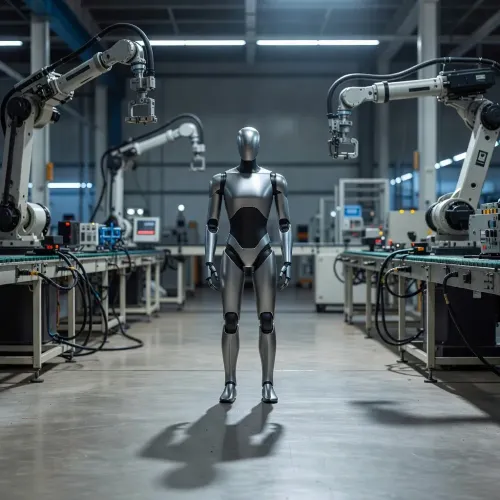
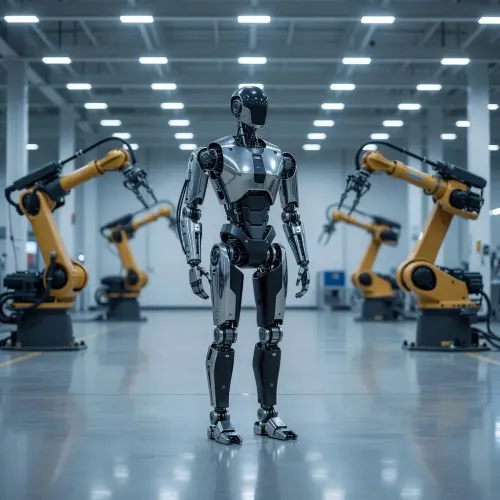
China assigns digital IDs to all humanoid robots under new lifecycle platform
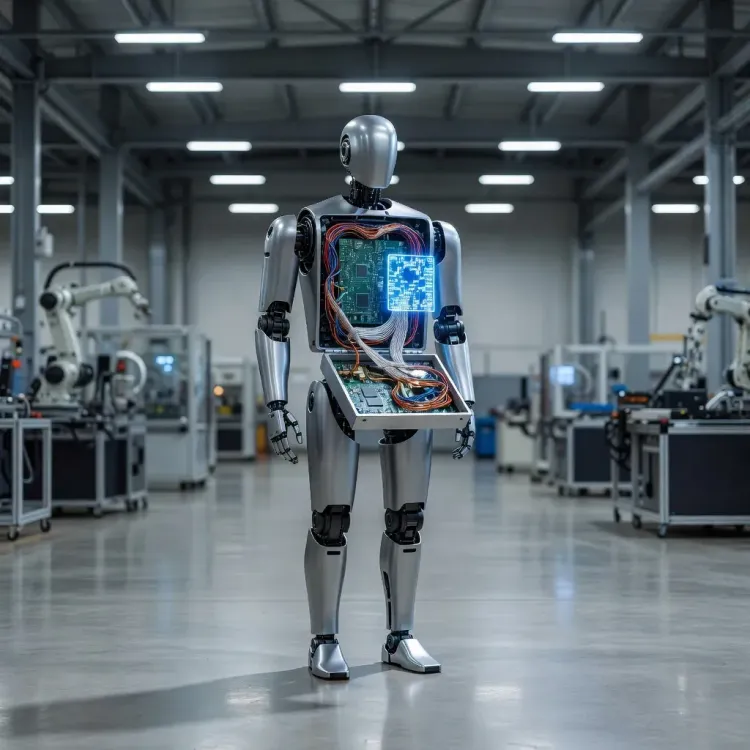
Synopsis
China has launched a national platform to give every humanoid robot a unique digital ID traceable from production to recycling — a sweeping regulatory first that could set the global template for governing AI-driven bipedal machines.
Key Takeaways
China launched the Humanoid Full Lifecycle Management Service Platform on Friday, 25 May 2026 to assign unique digital IDs to all domestically manufactured humanoid robots.
The programme is led by the Humanoid Robotics and Embodied Intelligence Standardization (HEIS) committee under China's Ministry of Industry and Information Technology .
Digital IDs will track robots from production through to recycling, enabling risk monitoring and product traceability.
Yu Xiuming , deputy head of the China Electronics Standardization Institute (CESI) , confirmed the guidelines cover manufacturers, service providers, sellers, users, and recycling facilities.
Accompanying lifecycle management guidelines and ID-usage instructions were released alongside the platform launch.
China has launched a national programme to assign unique digital identities to every humanoid robot manufactured in the country, marking a significant regulatory step in the world's fastest-growing bipedal robotics sector. The initiative, announced on Friday, 25 May 2026, establishes a standardised tracking framework covering the full lifespan of AI-driven, human-shaped robots — from factory floor to recycling facility.
What the platform does
The scheme, formally named the Humanoid Full Lifecycle Management Service Platform, will assign each humanoid robot a unique identification code used to monitor the machine across every stage of its existence. The system is designed to enable traceability and risk monitoring as the industry scales rapidly, according to state broadcaster CCTV. Alongside the platform launch, authorities also released formal guidelines governing lifecycle management and specifying how the digital ID must be applied.
Who leads it and who is covered
The programme is led by the Humanoid Robotics and Embodied Intelligence Standardization (HEIS) committee, which operates under China's Ministry of Industry and Information Technology. Yu Xiuming, deputy head of the China Electronics Standardization Institute (CESI), confirmed the guidelines apply to all stakeholders across the entire humanoid supply chain — including manufacturers, service providers, sellers, end users, and recycling facilities.
Why it matters
The move signals Beijing's intent to institutionalise oversight of humanoid robotics before the industry reaches mass-market scale, rather than scrambling to regulate retroactively. A traceable ID system gives regulators a direct mechanism to identify fault sources, enforce product recalls, and monitor deployment environments — capabilities that become critical as humanoids enter workplaces and public spaces. It also creates a de facto compliance barrier that could shape how foreign robotics firms operate within China.
The competitive backdrop
China has positioned humanoid robotics as a strategic industrial priority, with domestic players racing to commercialise bipedal robots for manufacturing, logistics, and elder care. The standardisation push mirrors earlier regulatory playbooks used in electric vehicles and semiconductors, where China used standards-setting to simultaneously protect domestic champions and signal industrial maturity to global partners. The timing also coincides with intensifying competition from US-based robotics firms, adding a geopolitical dimension to what is framed as a domestic quality-control measure.
What's next
With the platform now live and guidelines published, the immediate question is enforcement: how quickly manufacturers will be required to comply, and whether the ID framework will extend to imported humanoid robots operating on Chinese soil. Industry observers will watch whether CESI and the HEIS committee move to internationalise these standards through bodies like ISO, which would amplify their influence well beyond China's borders.
Point of View
Beijing ensures that any company — domestic or foreign — operating in this market must plug into a state-visible data architecture. This mirrors the playbook used in EVs, where homegrown standards became de facto export templates. What mainstream coverage underplays is the compliance asymmetry this creates: Chinese manufacturers build to the standard from day one, while foreign entrants face a costly retrofit. As the humanoid sector approaches commercial scale, the country that controls the identity and traceability stack will have outsized influence over global safety norms — and that leverage is now being quietly locked in.
NationPress
9 Oct 2026
Frequently Asked Questions
What is China's Humanoid Full Lifecycle Management Service Platform?
It is a national initiative launched by China on 25 May 2026 to assign unique digital identification codes to every humanoid robot manufactured in the country. The platform tracks each robot from production through to recycling, enabling authorities to monitor risks and enforce traceability across the industry.
Which government body oversees the humanoid robot digital ID programme?
The programme is led by the Humanoid Robotics and Embodied Intelligence Standardization (HEIS) committee, which operates under China's Ministry of Industry and Information Technology . The China Electronics Standardization Institute (CESI) is also centrally involved in setting and publishing the accompanying guidelines.
Who does the humanoid robot ID regulation apply to?
According to Yu Xiuming , deputy head of CESI , the guidelines apply to all stakeholders across the humanoid supply chain — including manufacturers, service providers, sellers, end users, and recycling facilities. The scope effectively covers every entity that interacts with a humanoid robot during its operational life.
Why is China introducing digital IDs for robots now?
Authorities said the system is designed to ensure products can be traced in order to monitor for risks as the humanoid robotics industry develops rapidly. The move also reflects Beijing's broader strategy of establishing regulatory standards early in a strategic technology sector, before scale makes oversight more difficult.
How could China's humanoid robot standards affect global competitors?
By setting the traceability and lifecycle management standards domestically, China creates a compliance framework that foreign robotics firms must meet to operate in the market. If these standards are later adopted by international bodies, they could give Chinese manufacturers a first-mover advantage in global regulatory alignment.