E20 petrol myths debunked: Govt rejects social media misinformation on ethanol fuel
Synopsis
The Ministry of Petroleum & Natural Gas has issued a point-by-point rebuttal of viral social media claims targeting E20 ethanol-blended petrol — from insect attraction to engine damage to water wastage. A joint study by Indian Oil, ARAI, and SIAM found CO emissions drop by up to 50%, and SIAM has confirmed warranties remain valid. The Government's pushback signals how misinformation is becoming a live threat to India's flagship fuel transition programme.
Key Takeaways
The Ministry of Petroleum & Natural Gas on 3 July dismissed viral social media claims about E20 ethanol-blended petrol as 'false, baseless, and scientifically unfounded.' A joint study by Indian Oil, ARAI, IIP-Dehradun, and SIAM found carbon monoxide emissions fell by 50% in two-wheelers and 30% in four-wheelers with E20.
SIAM confirmed vehicle warranties remain valid for cars and bikes running on E20 fuel meeting required specifications.
The claim that 1 litre of ethanol requires 10,000 litres of water was rejected; only surplus or broken rice unfit for consumption is used for ethanol production.
The Government is promoting maize as a preferred ethanol feedstock due to its substantially lower water requirement compared to paddy.
Any blending level beyond E20 will be introduced only after ARAI validation and stakeholder consultation; impact assessment is due next year.
The Ministry of Petroleum & Natural Gas on Thursday, 3 July categorically rejected a wave of social media claims alleging that ethanol-blended petrol (E20) damages vehicles, increases pollution, and wastes water in crop cultivation. The Ministry called the viral posts 'fear-mongering claims' that are 'false, baseless, scientifically unfounded and inconsistent with extensive technical studies conducted by leading automotive research institutions.'
What the Government Said
The Ministry issued a detailed factsheet addressing each circulating claim point by point. On pollution, it clarified that E20 actually reduces carbon tailpipe emissions significantly, and that carbon molecules in ethanol are biogenic — meaning they do not cause any net increment in atmospheric carbon at the vehicle tailpipe level.
One particularly viral claim — that ants and bees are attracted to fuel tanks because of E20 — was examined by Bharat Petroleum Corporation Limited (BPCL). The company confirmed that fuel-grade ethanol undergoes fermentation and distillation processes that eliminate residual sugars, and that fuel ethanol contains denaturants which are repellent to insects.
Key Technical Findings
A joint study by Indian Oil, the Automotive Research Association of India (ARAI), IIP-Dehradun, and the Society of Indian Automobile Manufacturers (SIAM) found that carbon monoxide emissions decreased by approximately 50 per cent in two-wheelers and 30 per cent in four-wheelers when using E20. Unburnt hydrocarbon emissions fell by roughly 20 per cent compared to normal gasoline across both vehicle categories.
The factsheet also cited scientific evidence that E20 delivers better acceleration, improved ride quality, and approximately 30 per cent lower carbon emissions compared to E10 fuel. RON 95 blended with 20 per cent ethanol offers superior anti-knocking properties, and ethanol's higher heat of vaporisation boosts volumetric efficiency by reducing intake manifold temperatures.
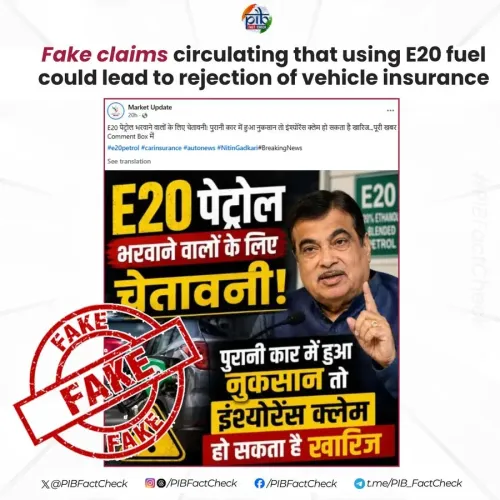
Claims of a 'drastic' drop in mileage were rejected as misplaced. The factsheet further stated that SIAM, speaking on behalf of the Indian automobile industry, has confirmed that warranty coverage for gasoline vehicles will continue to be honoured for vehicles running on E20 fuel meeting required specifications — dismissing fears of voided warranties or denied insurance claims.
The Water Consumption Claim
A widely shared claim that producing 1 litre of ethanol consumes 10,000 litres of water was addressed directly. The Ministry clarified that paddy and wheat cultivation in India is driven primarily by the Minimum Support Price (MSP) mechanism and assured procurement by the Food Corporation of India (FCI) for food security — not by ethanol demand. Only surplus or broken rice unfit for human consumption is diverted for ethanol production.
In the case of sugarcane, only surplus quantities beyond sugar requirements are channelled into ethanol. The Government also highlighted maize as a preferred ethanol feedstock, noting it requires only partial irrigation on roughly 29 per cent of its acreage — making it a more climate-resilient option in semi-arid zones.
Broader Impact of the Ethanol Programme
The Ministry's factsheet described the Ethanol Blended Petrol (EBP) Programme as a 'transformative intervention' for Indian agriculture, citing timely payments to sugarcane farmers, improved farm incomes, an assured market for surplus produce, and a push to shift paddy cultivation to maize. The programme has also contributed to reduced greenhouse gas emissions, according to the statement.
The Government added that any future enhancement of the base ethanol blending level beyond E20 will be undertaken only after detailed testing and validation of higher blends by ARAI across vehicle categories, in consultation with automobile manufacturers and other stakeholders. The impact of the current 20 per cent blending level is set to be assessed next year.
Point of View
It means the misinformation has reached a scale that risks derailing behavioural adoption of E20. India's ethanol blending programme is one of the more credible pieces of its energy transition story, having crossed the 15% blending milestone ahead of schedule. What the Government has not addressed, however, is why the communication vacuum existed long enough for these myths to go viral in the first place. A proactive consumer education campaign — not a reactive factsheet — is what a programme of this scale requires. The absence of one is a policy gap dressed up as a misinformation problem.
NationPress
3 Jul 2026
Frequently Asked Questions
Is E20 petrol harmful for vehicles?
No. The Ministry of Petroleum & Natural Gas has categorically stated that E20 petrol is not harmful to vehicles. A joint study by Indian Oil, ARAI, IIP-Dehradun, and SIAM found no issues across parameters including drivability, startability, and metal and plastic compatibility.
Does E20 fuel reduce mileage drastically?
Claims of a drastic mileage drop are rejected by the Government as misplaced. Scientific evidence cited in the Ministry's factsheet shows E20 delivers better acceleration, improved ride quality, and approximately 30 per cent lower carbon emissions compared to E10 fuel.
Will using E20 petrol void my vehicle warranty?
No. SIAM has confirmed on behalf of the Indian automobile industry that warranty coverage for gasoline vehicles will continue to be honoured for vehicles running on E20 fuel that meets required specifications.
Does ethanol production waste large amounts of water?
The Government rejects the claim that 1 litre of ethanol requires 10,000 litres of water. Only surplus or broken rice unfit for human consumption is used for ethanol production, and maize — which requires far less water than paddy — is being actively promoted as a feedstock.
What happens after E20 — will blending go higher?
Any increase in the base ethanol blending level beyond 20 per cent will be undertaken only after detailed testing and validation by ARAI across vehicle categories, in consultation with automobile manufacturers and other stakeholders. The Government plans to assess the impact of current E20 blending next year before deciding on any further enhancement.