Has India’s Nuclear Generation Achieved an All-Time High This Year?
Synopsis
India's nuclear energy sector has made remarkable strides, achieving unprecedented electricity generation this year. Discover the significant milestones reached by NPCIL and the impactful initiatives taken in the field of nuclear energy and healthcare.
Key Takeaways
NPCIL sets a new record with 56,681 million units of electricity generated.
49 million tonnes of CO2 emissions avoided.
Foundation stone laid for Mahi Banswara NPP in Rajasthan.
Inauguration of Homi Bhabha Cancer Hospital in Bihar.
Development of high Residual Resistivity Ratio Niobium materials.
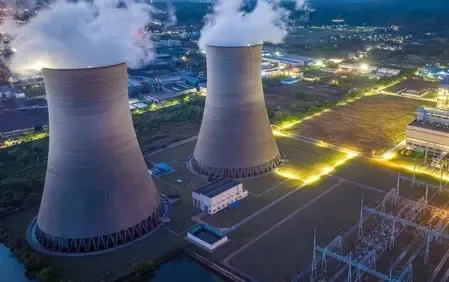
New Delhi, Dec 10 (NationPress) The Nuclear Power Corporation of India Limited (NPCIL) has recorded its highest electricity generation to date, reaching 56,681 million units in FY 2024-25, effectively preventing approximately 49 million tonnes of CO2 emissions. This information was disclosed in a year-end review from the Department of Atomic Energy on Wednesday.
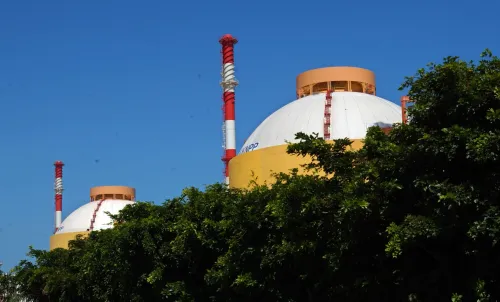
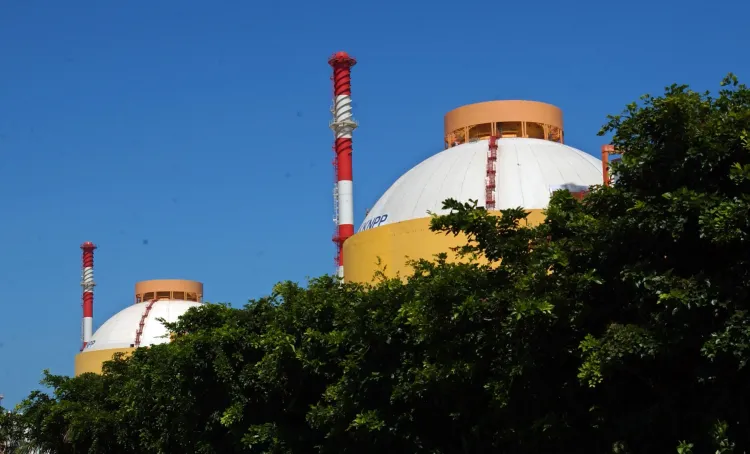
This year, the continuous operation of nuclear plants surpassed previous records, noted the government, with Tarapur Atomic Power Station (TAPS) exceeding its former record of 521 days and Kudankulam Nuclear Power Plant (KKNPP) also operating for more than a year.
The Department of Atomic Energy (DAE) has remained committed to its role in producing nuclear energy, enhancing nuclear power capacity, and overseeing the operation of research reactors and particle accelerators for the production of radio-isotopes and radio-pharmaceuticals. They have also applied radiation technology to tackle societal challenges, notably in healthcare, food security, and water and waste management.
This year, Prime Minister Narendra Modi laid the foundation stone for the 4-unit Mahi Banswara NPP in Rajasthan in September, which will be developed by the NPCIL-NTPC joint venture known as ASHVINI.
NPCIL also marked a significant milestone by generating over 50 billion Units (BUs) in a financial year for the first time in its history. The Atomic Energy Commission (AEC) has approved pre-project activities for an additional 10 units of 700 MWe PHWRs, complementing the planned 22.5 GW capacity by 2032.
The Homi Bhabha Cancer Hospital and Research Centre in Muzaffarpur, Bihar, was inaugurated by the Prime Minister this year, enhancing healthcare services in the region.
This year also saw the release of an indigenously developed Certified Reference Material (CRM) named ‘Ferrocarbonatite (FC) – (BARC B1401), marking India's first CRM in this category and the fourth globally, which is vital for REEs ore mining.
The DAE has established the first electronics-grade (99.8% purity) Boron-11 Enrichment Facility at Talcher, particularly beneficial for semiconductor applications.
Additionally, the electron beam sterilization facility in Indore, Madhya Pradesh, has consistently provided e-beam sterilization services to medical device manufacturers, adhering to ISO standards. In September, the facility successfully completed sterilization for 1.53 crore medical devices. A new High-Intensity Gamma Irradiator, ISOMED 2, was completed in May 2025, designed for the terminal sterilization of healthcare products, and it is currently the only High Intensity Land Based Stationary Gamma Irradiator worldwide.
The Nuclear Fuel Complex (NFC) has successfully developed technology for producing high Residual Resistivity Ratio Niobium ingots and sheets, crucial for advanced accelerator programs, thereby enhancing India’s capabilities in materials research for essential applications.
In terms of internal security, ECIL has developed, integrated, and installed a Chemical, Biological, Radiological and Nuclear (CBRN) System to protect vital installations from various threats. Furthermore, the first production module for the Akash-Prime system, capable of 360-degree engagement against multi-directional attacks from enemy aircraft and drones, has been integrated.
Point of View
This remarkable achievement in nuclear power generation highlights India's commitment to sustainable energy solutions. The advancements made by NPCIL and the initiatives taken by the government demonstrate a progressive approach towards energy security and environmental conservation, aligning with national interests.
NationPress
19 Sept 2026
Frequently Asked Questions
What is the significance of NPCIL's electricity generation?
NPCIL's achievement signifies a major milestone in India's energy sector, highlighting advancements in nuclear technology and its role in reducing carbon emissions.
How does nuclear energy contribute to India's sustainability goals?
Nuclear energy is a low-carbon energy source that helps in achieving sustainability goals by significantly reducing greenhouse gas emissions.
What initiatives has the government undertaken in the nuclear sector this year?
This year, the government laid the foundation for new nuclear plants, inaugurated healthcare facilities, and developed advanced materials for nuclear applications.
What are the future plans for India's nuclear power capacity?
India plans to expand its nuclear power capacity by adding new units and increasing the overall generation capabilities to meet future energy demands.
How does the DAE support healthcare through nuclear technology?
The DAE utilizes nuclear technology for medical applications, such as sterilization of medical devices and production of radio-pharmaceuticals.