MoS Kirti Vardhan Singh leads India at UN AI Governance Dialogue in Geneva
Synopsis
India sent a minister-level delegation to the inaugural UN Global Dialogue on AI Governance in Geneva — a forum born out of the 2024 Global Digital Compact. With the first independent scientific assessment of AI risks set to be tabled and developing-country capacity-building on the agenda, the Geneva meeting is less a talking shop and more a foundational moment for how the world governs its most consequential technology.
Key Takeaways
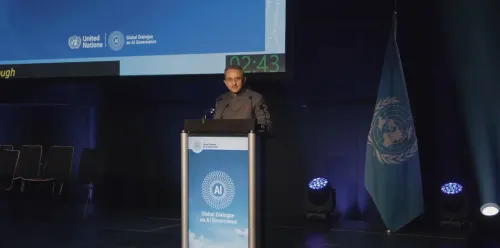
MoS Kirti Vardhan Singh arrived in Geneva on 5 July to lead India's delegation at the inaugural UN Global Dialogue on AI Governance .
The dialogue runs on 6–7 July 2026 in Geneva, established under UNGA Resolution 79/325 following the Global Digital Compact of September 2024 .
The forum will receive the first annual report of the Independent International Scientific Panel on AI (IISPA) — the first independent scientific assessment of AI capabilities and risks.
Discussions span four clusters : social and economic implications, bridging AI divides, safe and trustworthy AI, and human rights.
India hosted a pre-dialogue stakeholder consultation at the AI Impact Summit in New Delhi in February 2026 .
The second session is scheduled for May 2027 in New York .
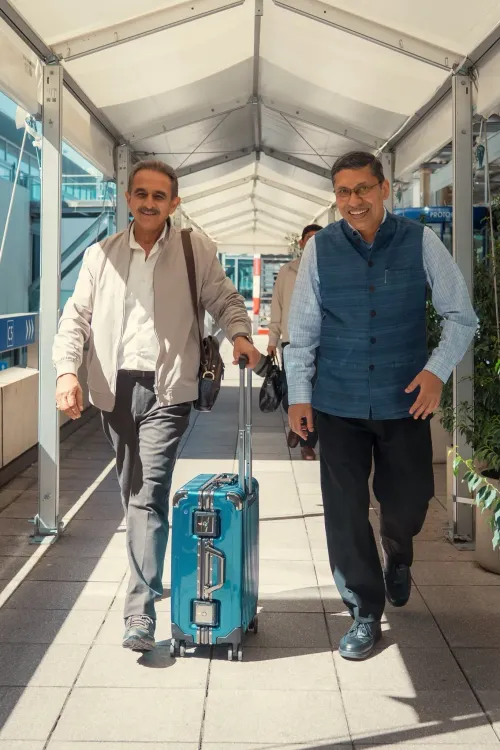
Minister of State for External Affairs Kirti Vardhan Singh arrived in Geneva, Switzerland on Sunday, 5 July to lead India's delegation at the inaugural United Nations Global Dialogue on AI Governance, a landmark multilateral forum convened to shape international frameworks for artificial intelligence. India's Permanent Representative to the UN in Geneva, Arindam Bagchi, received the minister at the airport.
India's Presence at the Inaugural Dialogue
Singh will head the Indian delegation for the two-day event scheduled for 6–7 July in Geneva. The Permanent Mission of India at the United Nations in Geneva confirmed the minister's arrival, stating that 'India looks forward to the global conversation on AI governance that keeps people at its centre.'
Singh holds the dual portfolio of Minister of State for External Affairs and Environment, Forest and Climate Change, signalling the cross-cutting significance India attaches to AI governance — spanning diplomacy, sustainability, and development.
What the Global Dialogue on AI Governance Is
The forum was established under UN General Assembly Resolution 79/325, following the adoption of the Global Digital Compact as part of the Pact of the Future in September 2024. It is designed as a universal, multi-stakeholder platform that complements international, regional, national, and multi-stakeholder AI governance efforts, according to the Ministry of External Affairs (MEA).
Notably, the dialogue will receive the first annual report of the Independent International Scientific Panel on AI (IISPA) — the first independent scientific assessment of AI capabilities, emerging opportunities, and risks. The IISPA is intended to promote scientific understanding, transparency, accountability, and robust human oversight of AI systems.
Key Themes and Structure
Discussions will be organised around four thematic clusters: AI's social and economic implications, bridging AI divides, safe and trustworthy AI, and human rights in the AI context. The MEA underscored that the dialogue aims to build capacities — particularly in developing countries — to direct AI systems toward sustainable development goals.
The co-chairs of the 2026 AI Dialogue are Egriselda Lopez, El Salvador's Representative to the UN, and Rein Tammsaar, Permanent Representative of Estonia to the UN, both appointed by UN General Assembly President Annalena Baerbock. In the lead-up to this session, co-chairs held several stakeholder consultations, including an in-person meeting on the sidelines of the AI Impact Summit held in New Delhi in February 2026.
India's Broader AI Diplomacy
India's active participation reflects its growing role in shaping global technology governance. The New Delhi consultation in February 2026 placed India at the centre of pre-dialogue stakeholder engagement, and Singh's ministerial-level representation in Geneva reinforces that positioning. This comes amid intensifying global debate over AI safety standards, regulatory divergence between major powers, and concerns that developing nations risk being left behind in the AI transition.
What Comes Next
The second session of the Global Dialogue on AI Governance is scheduled for May 2027 in New York, according to the UN. The outcomes of the Geneva dialogue — including the IISPA's inaugural scientific report — are expected to inform that session and feed into broader UN-level AI policy frameworks.
Point of View
Not retrofitted. The inclusion of the AI Impact Summit consultation in New Delhi as a formal pre-dialogue event is a quiet but meaningful win for Indian diplomatic positioning. The harder question is whether the UN dialogue can produce binding or even convergent frameworks, given the sharp regulatory divergence between the US, EU, and China. For developing countries, the 'bridging AI divides' cluster is the most consequential — and the most underfunded. India's dual role as an emerging AI power and a voice for the Global South gives it unusual leverage here, but only if it moves beyond symbolic participation to concrete proposals.
NationPress
5 Oct 2026
Frequently Asked Questions
What is the UN Global Dialogue on AI Governance?
It is a universal, multi-stakeholder forum established under UN General Assembly Resolution 79/325, following the Global Digital Compact adopted in September 2024. It aims to advance international AI governance in ways that complement existing national, regional, and multilateral efforts, with a focus on sustainable development and human rights.
Why is India participating in the Geneva AI Governance Dialogue?
India is participating to contribute to global frameworks for artificial intelligence governance. MoS Kirti Vardhan Singh is leading the delegation, reflecting India's interest in shaping AI policy that is inclusive of developing nations and centred on people.
What is the Independent International Scientific Panel on AI (IISPA)?
The IISPA is an independent body that promotes scientific understanding, transparency, accountability, and human oversight of AI systems. The Geneva dialogue will receive its first annual report, which provides the inaugural independent scientific assessment of AI capabilities, opportunities, and risks.
When and where is the next session of the UN AI Governance Dialogue?
The second session of the Global Dialogue on AI Governance is scheduled for May 2027 in New York, according to the UN.
Who are the co-chairs of the 2026 UN AI Governance Dialogue?
The co-chairs are Egriselda Lopez, El Salvador's Representative to the UN, and Rein Tammsaar, Permanent Representative of Estonia to the UN, both appointed by UNGA President Annalena Baerbock.