Have Indian Scientists Discovered the Missing Link in Cell Therapy for Alzheimer’s and Cancer?
Synopsis
Discover how Indian researchers have unveiled a vital component in the autophagy process, which could revolutionize therapies for debilitating diseases like Alzheimer's, Parkinson's, and cancer. This groundbreaking finding highlights the complexities of cellular waste management and its implications for future medical advancements.
Key Takeaways
Autophagy is essential for cellular health.
Defects in autophagy are linked to neurodegenerative diseases and cancers.
The exocyst complex plays a vital role in autophagy.
Understanding this process could lead to new therapies.
Research was conducted by JNCASR in India.
New Delhi, Dec 19 (NationPress) A team of researchers at the Jawaharlal Nehru Centre for Advanced Scientific Research (JNCASR) has made a groundbreaking discovery in the field of autophagy, the process by which cells eliminate damaged components. This revelation could significantly enhance treatment options for diseases like Alzheimer’s, Parkinson's, and cancer.
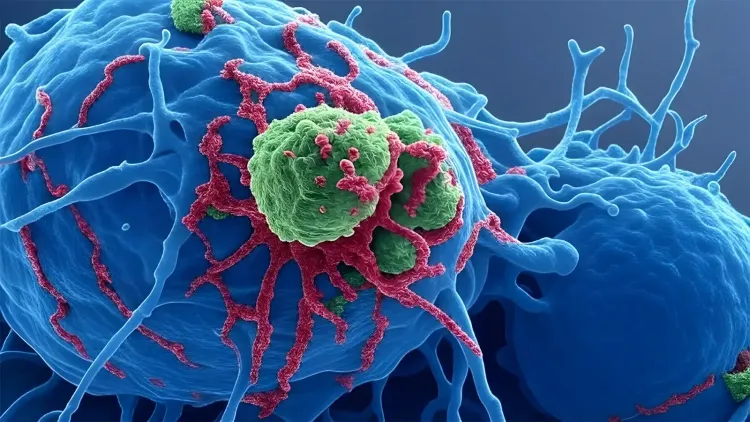
Autophagy is a vital biological mechanism where cells purge damaged and unnecessary materials. When this process falters, it adversely affects cellular health, particularly in long-lived neurons. In conditions such as Alzheimer’s and Huntington’s, the autophagy pathway is disrupted, leading to detrimental effects.
In the context of cancer, autophagy presents a paradoxical nature. Initially, it serves as a protective barrier against cancer development; however, it can later facilitate tumor growth. Autophagy functions as a tumor suppressor by ensuring genome integrity and cellular balance, effectively clearing cellular waste like protein aggregates and damaged mitochondria.
Interestingly, certain cancer cells exploit autophagy to thrive and proliferate. Therefore, understanding its regulation is essential for crafting effective therapies.
The JNCASR team discovered that a group of proteins known as the exocyst complex, typically responsible for transporting vital molecules to the cell's surface, also plays a crucial role in autophagy.
This complex consists of eight proteins; notably, seven of these proteins are essential for the cell to develop the necessary structures to encapsulate waste effectively. The absence of this complex leads to dysfunction in the cell's waste-processing capabilities.
Led by Prof. Ravi Manjithaya, the researchers employed simple yeast cells to shed light on the formation of autophagosomes (cellular waste containers). Their findings provide valuable insights into the autophagy process in more complex organisms.
The mechanism by which the exocyst protein complex aids the autophagy pathway has been elucidated, highlighting its importance in maintaining cellular health.
As defects in autophagy are associated with various neurodegenerative diseases and cancers, the results published in the Proceedings of the National Academy of Sciences are expected to open new pathways for modulating this mechanism to restore cellular equilibrium and develop potential therapies.
Point of View
I believe this discovery by Indian scientists is a significant advancement in our understanding of cellular processes. The implications for treating neurodegenerative diseases and cancer are profound, demonstrating the importance of ongoing research in the field of biotechnology.
NationPress
29 Sept 2026
Frequently Asked Questions
How does autophagy relate to diseases?
Defects in autophagy are linked to several diseases, including neurodegenerative disorders like Alzheimer’s and various cancers.
What is the exocyst complex?
The exocyst complex is a group of proteins that facilitate the transport of molecules to the cell surface and play a role in autophagy.
Why is this discovery significant?
This discovery can lead to new therapeutic approaches for managing diseases like Alzheimer’s, Parkinson's, and cancer by modulating the autophagy process.
Where was this research published?
The findings were published in the Proceedings of the National Academy of Sciences.