World Bank chief Ajay Banga: India's digital, agri models can guide global development
Synopsis
World Bank President Ajay Banga, speaking at the G20 Finance Ministers' meeting in Asheville, declared that India's digital stack — from Aadhaar to bank accounts — and its tech-driven agricultural cooperatives are now mature enough to serve as blueprints for other nations. It is a rare multilateral endorsement that reframes India not just as a development success story, but as an active exporter of development solutions.
Key Takeaways
World Bank President Ajay Banga said India has development learnings — in digital infrastructure and agriculture — ready to share with other countries.
Banga cited India's digital public infrastructure, from Aadhaar to bank accounts, as a transferable global model.
He observed Uttar Pradesh cooperatives working with Google and the World Bank to give small farmers access to inputs at scale.
Banga said India's Viksit Bharat 2047 goal depends on both domestic growth and its stature in global economics and politics.
The World Bank's India engagement now spans infrastructure, education, skills, healthcare, regulatory reform, tourism, and MSMEs .
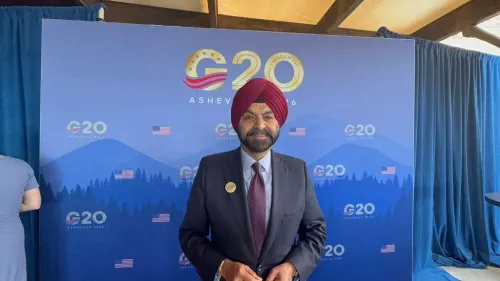
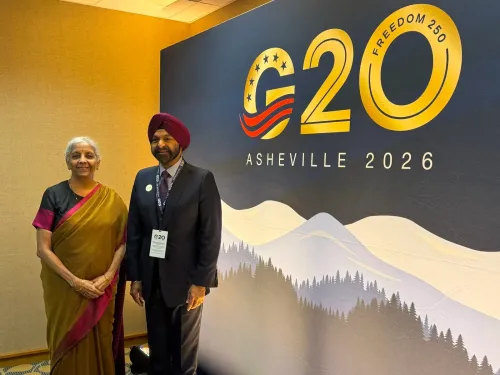
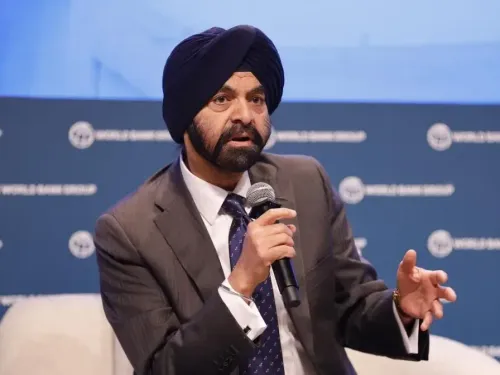
World Bank President Ajay Banga has said that India has arrived at a point in its development journey where its experiences — spanning digital public infrastructure and technology-driven agriculture — hold transferable lessons for other nations. Banga made the remarks on the sidelines of the G20 Finance Ministers' meeting in Asheville on 2 September.
India's Development Experience as a Global Template
'I think India has reached a stage of development where India has learnings that can be shared elsewhere,' Banga said. He specifically highlighted India's digital public infrastructure stack — stretching from Aadhaar to bank accounts — as a model that other countries could study and adapt. Technology adoption in the agricultural sector was cited as a second area of potential knowledge transfer.
'You look at your digital public infrastructure starting from Aadhaar all the way to bank accounts, the work you're now doing in agriculture. These are things that others can learn from,' he said. The remarks reflect a broader recognition within multilateral institutions that India's low-cost, high-scale digital architecture — built over roughly a decade — has outpaced comparable efforts in many emerging economies.
Viksit Bharat 2047: Beyond Domestic Growth
Banga noted that India's trajectory toward its Viksit Bharat 2047 ambitions would hinge not only on the pace of domestic economic expansion but equally on the stature India commands in global economic and political forums. 'The way that India will become a Viksit Bharat by 2047, you know, economy of that size is not just from its own growth, of course, but also the stature it occupies in world economics and in world politics,' he said.
He added that both dimensions were central to where India's leadership intended to take the country over the next 15 years. This framing positions India's international standing — its role in bodies such as the G20 and its growing bilateral economic ties — as a co-determinant of its long-term development outcomes, not merely a byproduct of them.
On-Ground Example: UP Cooperatives and Google Partnership
Banga pointed to a firsthand example from his most recent visit to India, when he observed agricultural cooperatives in Uttar Pradesh working alongside Google and the World Bank to give small farmers access to inputs and support at scale. 'When I was in India last time I was in UP and I got a chance to see cooperatives working in UP with technology from Google and us trying to enable small farmers to get access to the inputs and stuff they need at scale,' he said.
He also described how digital connectivity could link decentralised primary healthcare clinics with doctors and regional hospitals — an approach he framed as combining local delivery systems with technology to extend reach without proportionally increasing cost.
World Bank's Expanding India Engagement
The World Bank's current engagement with India spans physical infrastructure, education, skills development, healthcare, regulatory reform, and efforts to mobilise private investment. Banga said the institution was also exploring opportunities in tourism and support for micro, small and medium enterprises (MSMEs). The breadth of the partnership signals that the World Bank views India not merely as a borrower but as a co-producer of development knowledge.
On Leadership and India's Progress
Asked about the role of political leadership in India's economic progress, Banga declined to separate leadership from the people it represents. 'I mean, I think people and leadership are intertwined. People get the leader they deserve,' he said. 'And I think that's what India should feel proud about, that they've got leadership that is taking them in the right direction.'
As the World Bank deepens its knowledge-exchange framework with India, Banga's remarks at Asheville signal that New Delhi's development playbook is increasingly being studied — and potentially replicated — well beyond its own borders.
Point of View
India was primarily a recipient of multilateral advice; the explicit framing of India as a knowledge exporter, particularly on digital public infrastructure, reflects how far the DPI stack has moved from a domestic policy experiment to an internationally studied template. Yet the endorsement also carries a quiet caveat: the Uttar Pradesh cooperative model Banga praised depends on a confluence of state capacity, corporate partnership, and World Bank capital that is difficult to replicate wholesale. The Viksit Bharat 2047 framing is equally worth scrutinising — linking India's development success to its geopolitical stature is a double-edged argument, since global standing is far harder to measure or hold accountable than GDP growth rates.
NationPress
2 Sept 2026
Frequently Asked Questions
What did World Bank President Ajay Banga say about India's development experience?
Banga said India has reached a stage where its development learnings — particularly in digital public infrastructure and technology-driven agriculture — can be shared with other countries. He made the remarks on the sidelines of the G20 Finance Ministers' meeting in Asheville on 2 September.
Which specific Indian models did Banga highlight as globally transferable?
Banga highlighted India's digital public infrastructure stack, running from Aadhaar to bank accounts, and the country's use of technology in agriculture. He also cited a Uttar Pradesh cooperative model involving Google and the World Bank as an example of scalable agri-tech delivery for small farmers.
What is Viksit Bharat 2047 and why did Banga reference it?
Viksit Bharat 2047 is India's national ambition to become a developed economy by the centenary of its independence. Banga referenced it to argue that achieving this goal will depend not only on domestic growth but also on the international economic and political stature India builds over the next 15 years.
What areas is the World Bank currently working on with India?
The World Bank's engagement with India spans physical infrastructure, education, skills development, healthcare, regulatory reform, private investment mobilisation, tourism, and support for micro, small and medium enterprises (MSMEs).
Where did Ajay Banga make these remarks?
Banga made the remarks in an interview on the sidelines of the G20 Finance Ministers' meeting held in Asheville on 2 September.