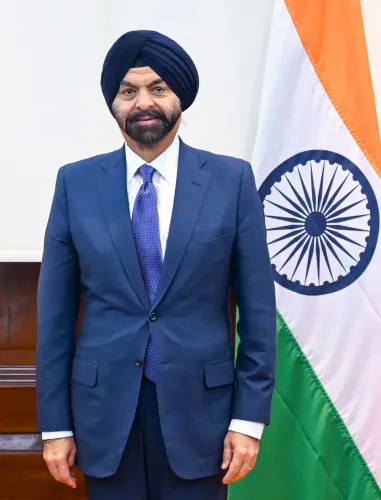
PM Modi Highlights Ajay Banga's Endorsement of India's Job-Centric Development Model

Synopsis
Discover how World Bank President Ajay Banga praises India's cooperative development model, emphasizing job creation as essential for sustainable growth. His insights reveal a strategic approach to tackling employment challenges on a global scale.
Key Takeaways
Job creation is vital for sustainable development according to Ajay Banga.
India’s cooperative model serves as a successful example of scalable growth.
Investment in infrastructure is crucial for boosting employment.
Key sectors like agriculture and tourism are essential for job creation.
Failure to create jobs could lead to social instability globally.
New Delhi, April 10 (NationPress) - The Prime Minister's Office of India on Friday drew attention to an IANS article featuring World Bank President Ajay Banga, who endorsed the idea of job creation as the foundation of a successful development strategy. He referred to India’s cooperative model as a prime example of scalable growth.
The narrative shared by PMO India on the social media platform X emphasizes the significance of employment-driven growth and the worldwide acknowledgment of India's developmental philosophy.
Banga asserted that development initiatives should transcend individual projects, focusing instead on broader outcomes like job creation and economic prospects.
"Development is not a form of charity; it is a strategic approach," he remarked, stressing that generating employment is crucial for maintaining growth and stability.
As he spoke prior to the World Bank and IMF Spring Meetings in Washington, Banga highlighted an impending demographic challenge, predicting that approximately 1.2 billion young individuals will enter the job market in the next 15 years, while job creation may struggle to keep up.
He proposed a three-pronged strategy to enhance employment opportunities, which includes investing in infrastructure, implementing business-friendly governance reforms, and improving access to financing.
Banga identified key sectors such as infrastructure, agriculture, healthcare, manufacturing, and tourism as significant contributors to job creation.
Reflecting on his own experiences, he noted India’s dairy cooperative model as a successful case study, illustrating how technology and organization can elevate rural livelihoods and broaden market access for small producers.
"I was raised in India," he mentioned. The World Bank chief indicated that cooperative frameworks, particularly in the dairy sector, enable small producers to access superior markets and pricing.
He cautioned that failing to create sufficient employment opportunities could result in escalating migration pressures and social unrest globally.
"Consider the consequences… if 800 million people... lack hope and dignity," he remarked, connecting job shortages to larger global issues.
Point of View
It’s imperative to recognize the significance of Ajay Banga's endorsement of India’s cooperative model. This approach prioritizes job creation, presenting a sustainable pathway for development in both India and globally. It's a call to action for policymakers to focus on employment opportunities to avert future socio-economic challenges.
NationPress
16 Oct 2026
Frequently Asked Questions
What did Ajay Banga say about job creation?
Ajay Banga emphasized that job creation is central to development strategies, and it must focus on broader economic outcomes rather than just individual projects.
How does India's cooperative model contribute to job creation?
India's cooperative model, particularly in the dairy sector, illustrates how technology and organization can enhance rural livelihoods and improve market access for small producers.
What demographic challenge did Banga highlight?
Banga noted that approximately 1.2 billion young people are expected to enter the workforce in the next 15 years, which poses a significant challenge for job creation.
What sectors did Banga identify as key for job creation?
He identified infrastructure, agriculture, healthcare, manufacturing, and tourism as major sectors that can drive job creation.
Why is job creation important according to Banga?
Banga warned that inadequate job creation could lead to rising migration pressures and social instability, linking employment shortages to broader global issues.