Ajay Banga Advocates for Job Creation, Highlights India's Cooperative Model
Synopsis
World Bank President Ajay Banga advocates for a global strategy centered on job creation and economic opportunity, citing India's cooperative sector as a prime example. He emphasizes the urgent need for scalable solutions as 1.2 billion young people are expected to enter the workforce over the next 15 years.
Key Takeaways
Job creation is central to global development strategies.
India's cooperative sector serves as a scalable growth model.
A three-part framework for job creation includes infrastructure, governance reforms, and financing.
1.2 billion young people are set to enter the workforce in the next 15 years.
Transparency and accountability are essential in development efforts.
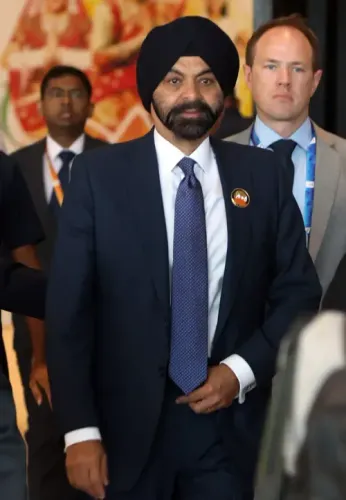
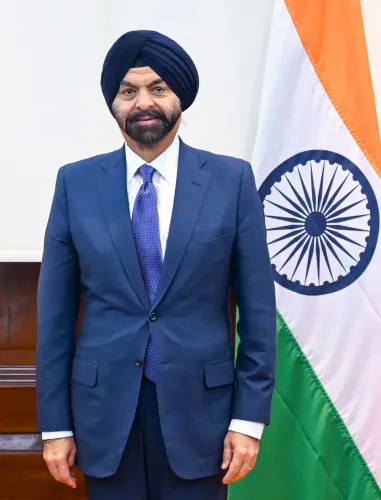
Washington, April 10 (NationPress) Emphasizing the importance of job creation as a fundamental element of global development strategy, World Bank President Ajay Banga has highlighted India's cooperative sector as a model for scalable growth solutions.
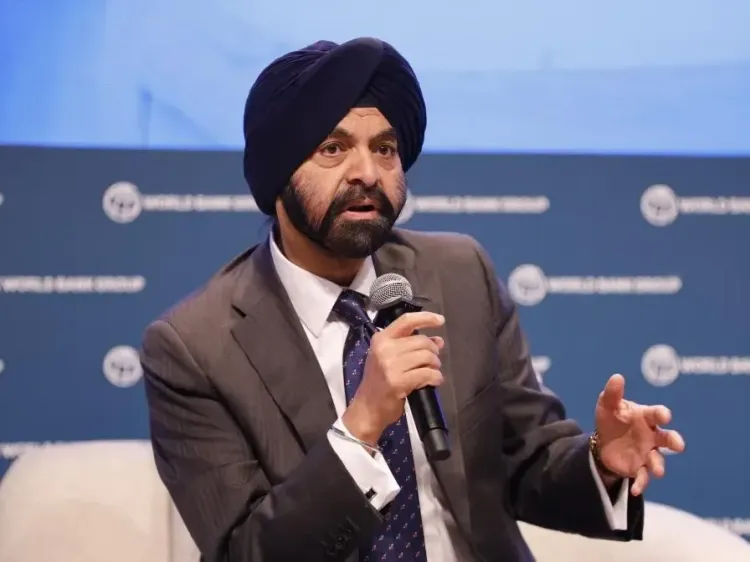
Addressing the Atlantic Council prior to the annual Spring meeting of the World Bank and International Monetary Fund, Banga stressed that development initiatives should transition from isolated projects to comprehensive outcomes focused on employment and economic prospects.
“Development is not merely charity; it’s a calculated strategy,” he asserted, underlining that job creation is pivotal for fostering growth and stability.
Banga pointed out a significant demographic challenge, with an estimated 1.2 billion young people set to enter the workforce in the next 15 years, while the number of jobs likely to be available falls short.
“Providing job opportunities for young individuals is crucial; dignity and hope stem from the chance to work,” he remarked.
He proposed a triadic framework designed to enhance job creation, which includes infrastructure development, reforms promoting business-friendly governance, and improved access to catalytic finance.
The initial pillar concentrates on both physical and human infrastructure, incorporating roads, energy, education, and healthcare. The second focuses on reforms that allow businesses of varying sizes to thrive and grow. The third emphasizes innovative financing instruments like blended capital and insurance mechanisms to stimulate investment.
Additionally, he pinpointed five vital sectors for job generation: infrastructure, agriculture, primary healthcare, value-added manufacturing, and tourism.
Drawing from personal experiences, Banga cited India's dairy cooperative model as a successful illustration of how technology and organization can uplift rural communities.
“Having grown up in India,” he recounted, “cooperative frameworks in the dairy sector enabled small producers to access improved markets and pricing.”
He cautioned that failing to create adequate job opportunities could lead to severe repercussions, including increased migration and social unrest.
“Consider the consequences if 800 million individuals lack access to hope and dignity,” he warned, connecting job scarcity to larger global issues.
Banga emphasized that development strategies must be customized to suit the conditions of individual countries, especially those in fragile or conflict-affected regions. Nevertheless, he maintained that the overall framework remains constant.
He noted the essential role of governments in fostering an environment conducive to business while upholding necessary regulatory measures.
The World Bank is pivoting its focus from input metrics like project counts and funding amounts to measurable outcomes. “I aim to transition… from inputs… to outcomes, specifically jobs and growth,” Banga stated.
Moreover, he highlighted the necessity for transparency and accountability in development initiatives, making it clear that results should be evident and quantifiable.
Point of View
World Bank President Ajay Banga's insights resonate deeply. His call for a strategic shift towards scalable growth models, particularly drawing from India’s cooperative successes, reflects a nuanced understanding of global economic challenges and solutions. The emphasis on tailored strategies for diverse national contexts underscores a thoughtful approach to development.
NationPress
17 Oct 2026
Frequently Asked Questions
What is the main focus of Ajay Banga's speech?
Ajay Banga emphasized the importance of job creation as a central element of global development strategy, advocating for scalable solutions drawn from models like India's cooperative sector.
What demographic challenge did Banga highlight?
Banga pointed out that 1.2 billion young people are expected to reach working age in the next 15 years, while the number of available jobs may not meet this demand.
What three-part framework did Banga propose for job creation?
Banga's framework includes infrastructure development, business-friendly governance reforms, and access to innovative financing tools.
Which sectors did Banga identify as crucial for employment generation?
He identified infrastructure, agriculture, primary healthcare, value-added manufacturing, and tourism as key sectors for job creation.
What shift is the World Bank making in its approach?
The World Bank is moving its focus from inputs like project counts to measurable outcomes, particularly jobs and economic growth.