BHAVYA scheme: ₹33,660 crore push to build 100 industrial parks across India
Synopsis
India's ₹33,660 crore BHAVYA scheme isn't just another industrial policy — it's a structural reset. By replacing supply-driven allocation with a competitive, state-driven model and targeting 100 plug-and-play industrial parks, the Centre is betting that inter-state rivalry and investment-ready infrastructure can finally move India's manufacturing needle.
Key Takeaways
The Union government has notified guidelines for the ₹33,660 crore BHAVYA Central Sector Scheme on 13 June .
The scheme will select 50 proposals and provide financial assistance for 100 industrial parks with world-class infrastructure.
ICEA described it as a shift from fragmented, supply-driven development to a demand-responsive, competitive framework .
Parks will feature pre-approved land, ready infrastructure, and integrated services to reduce setup timelines for manufacturers.
Colliers India expects the scheme to strengthen logistics and supply chains and promote balanced economic development nationwide.
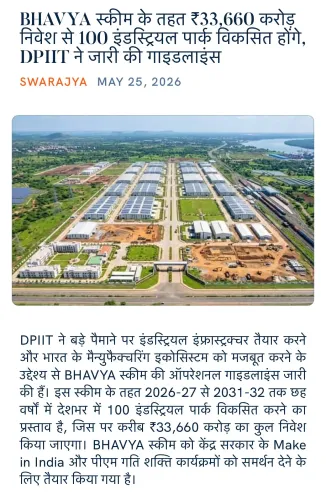
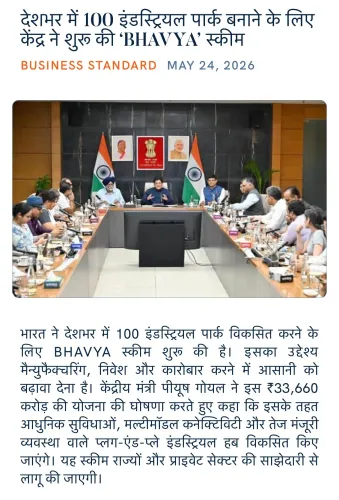
The Union government has notified the guidelines of the ₹33,660 crore Bharat Audyogik Vikas Yojana (BHAVYA) Central Sector Scheme, inviting 50 proposals to develop industrial parks with world-class infrastructure aimed at accelerating manufacturing growth and expanding employment across India. Financial assistance under the scheme will ultimately support the development of 100 industrial parks nationwide.
What BHAVYA Aims to Change
According to the India Cellular and Electronics Association (ICEA), the scheme marks a decisive shift in India's industrial infrastructure policy — moving away from fragmented, supply-driven development towards a demand-responsive, competitive framework. The new model rewards states that demonstrate strong industrial potential, land readiness, investor interest, and sectoral strengths.
Pankaj Mohindroo, Chairman of ICEA, said the scheme's competitive, state-driven design and transparent digital platform will enable the creation of world-class industrial ecosystems with modern infrastructure, seamless connectivity, and investor-friendly processes. 'This has the potential to significantly enhance India's attractiveness as a preferred destination for both domestic and global investments while advancing the vision of Viksit Bharat 2047,' he said.
Addressing a Structural Gap
Industry observers note that plug-and-play industrial parks have become a cornerstone of successful manufacturing ecosystems globally, yet India has lagged behind in aligning with these best practices. BHAVYA, according to ICEA, can be a game-changing step towards correcting this structural weakness and repositioning India as a more competitive manufacturing destination.
Notably, this scheme introduces a competitive selection process for states — a departure from earlier allocation-based models — which analysts say could sharpen inter-state competition for investment-ready infrastructure.
On-the-Ground Impact: Logistics and Supply Chains
Vimal Nadar, National Director and Head of Research at Colliers India, said the scheme is designed to create investment-ready industrial ecosystems with pre-approved land, ready infrastructure, and integrated services already in place. He noted this will reduce timelines for setting up manufacturing facilities and provide a boost to warehousing requirements in and around these parks.
Nadar added that the scheme is expected to promote the rise of new manufacturing centres, strengthen logistics and supply chains, and usher in balanced economic development across the country.
What Comes Next
With guidelines now notified, states are expected to begin preparing proposals for the competitive selection process. The scheme's emphasis on pre-approved land and integrated services signals a push to reduce the red tape that has historically slowed industrial park development in India. All eyes will be on how quickly states mobilise and whether disbursements stay on schedule.
Point of View
However, is execution: India has a long history of industrial park announcements where land disputes, connectivity gaps, and slow utility provisioning have delayed activation by years. The scheme's emphasis on pre-approved land and integrated services addresses known bottlenecks, but without hard timelines and independent progress audits, the 100-park target risks becoming another headline number. Industry enthusiasm is warranted — but so is scrutiny of the disbursement framework.
NationPress
21 Sept 2026
Frequently Asked Questions
What is the BHAVYA scheme?
BHAVYA, or Bharat Audyogik Vikas Yojana, is a ₹33,660 crore Central Sector Scheme notified by the Union government to develop 100 industrial parks across India. It will select 50 proposals through a competitive, state-driven process and provide financial assistance for world-class industrial infrastructure.
How many industrial parks will BHAVYA fund?
The scheme will provide financial assistance for the development of 100 industrial parks. It will do so by selecting 50 proposals from states through a competitive framework that rewards land readiness, investor interest, and sectoral strengths.
What makes BHAVYA different from earlier industrial park schemes?
Unlike earlier supply-driven, allocation-based models, BHAVYA uses a competitive selection process where states must demonstrate industrial potential, land readiness, and investor interest. Industry bodies say this demand-responsive approach is a structural shift aligned with global best practices for plug-and-play manufacturing ecosystems.
How will BHAVYA benefit manufacturers and logistics players?
According to Colliers India, the scheme will create investment-ready ecosystems with pre-approved land, ready infrastructure, and integrated services, reducing setup timelines for manufacturing facilities. It is also expected to boost warehousing demand around the parks and strengthen logistics and supply chains nationally.
What is the broader goal of the BHAVYA scheme?
Beyond industrial parks, BHAVYA aims to promote new manufacturing centres, drive balanced economic development across states, and advance India's long-term goal of becoming a globally preferred manufacturing destination under the Viksit Bharat 2047 vision.