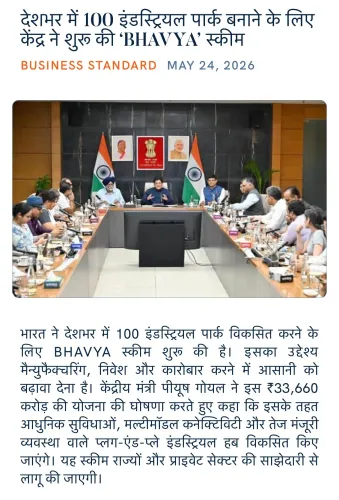
BHAVYA scheme: India to build 100 plug-and-play industrial parks with ₹33,660 crore outlay
Synopsis
India is not just building factories — it's building the ground beneath them. The ₹33,660 crore BHAVYA scheme will fund 100 plug-and-play industrial parks over six years, delivering roads, power, water, and approvals before a single unit moves in. With manufacturing stuck at 16–17% of GDP for years, BHAVYA is the Centre's most structured attempt yet to close the gap with the 25% target.
Key Takeaways
The BHAVYA scheme , approved by the Cabinet in March 2026 , has an outlay of ₹33,660 crore to develop 100 plug-and-play industrial parks across India.
Financial assistance of up to ₹1 crore per acre is available, covering roads, power, water, drainage, and ICT-enabled administration.
The scheme runs from FY2026–27 to FY2031–32 ; up to 50 parks will be selected in the first phase via challenge mode.
India's manufacturing sector contributes 16–17% of GDP and employs over 27 million workers ; the National Manufacturing Mission targets 25% by 2035 .
As of February 2026 , India had 370 notified SEZs attracting investments worth ₹7.82 lakh crore and employing over 31.7 lakh people .
Medium and high-technology industries now account for 46.3% of manufacturing value addition, signalling a shift to higher-value production.
India's manufacturing sector is undergoing a structural transformation under the ₹33,660 crore Bharat Audyogik Vikas Yojna (BHAVYA) scheme, which targets the development of 100 plug-and-play industrial parks across the country. According to a factsheet issued by the government on 14 October 2026, the manufacturing sector currently contributes 16–17 per cent of GDP and employs over 27 million workers, with the National Manufacturing Mission aiming to raise that share to 25 per cent by 2035.
Why Plug-and-Play Parks Matter
As industries scale, the demand for ready infrastructure — reliable power, efficient logistics, and fast regulatory approvals — has become a critical bottleneck. Plug-and-play industrial parks address this by delivering essential infrastructure and common facilities before industries begin operations, cutting both the time and cost of setting up new manufacturing units.
The shift is also driven by global supply chain diversification. As multinationals seek alternatives to concentrated production hubs, well-connected and pre-built industrial locations in India become a competitive asset, according to the government factsheet.
What BHAVYA Provides
Cabinet-approved in March 2026, BHAVYA is being implemented in partnership with state governments and private developers. The scheme offers financial assistance of up to ₹1 crore per acre for park development, covering internal roads, power supply, water networks, drainage, common effluent treatment, and ICT-enabled administration.
Up to 25 per cent of approved funding can be directed toward external infrastructure — road, rail, and last-mile logistics connectivity — to integrate each park with the broader transport network. Each park will span between 25 and 1,000 acres, depending on mandatory size criteria under the scheme guidelines.
Implementation runs over six years, from FY2026–27 to FY2031–32. In the first phase, up to 50 industrial parks will be selected through a challenge mode across two rounds, with the remainder chosen in subsequent phases to reach the 100-park target.
India's Industrial Evolution: From SEZs to Integrated Corridors
BHAVYA builds on decades of iterative policy. The first phase of India's industrial strategy focused on Special Economic Zones (SEZs) and industrial estates. As of February 2026, India had 370 notified SEZs, which have attracted investments worth ₹7.82 lakh crore and created employment for over 31.7 lakh people.
The next phase moved to larger, integrated corridors through the National Industrial Corridor Development Programme (NICDP), which combined manufacturing zones with utilities, logistics, and urban services. As of 14 October 2026, 4,164 industrial parks have been mapped on the India Industrial Land Bank (IILB).
Key integrated nodes already operational or under development include Dholera Special Investment Region (Gujarat), Shendra-Bidkin Industrial Area (Maharashtra), Vikram Udyogpuri (Madhya Pradesh), and Integrated Industrial Township Greater Noida (Uttar Pradesh).
Technology-Intensive Manufacturing on the Rise
The composition of Indian manufacturing is also shifting. Medium and high-technology industries now account for 46.3 per cent of manufacturing value addition, according to the government factsheet. This reflects a deliberate pivot toward higher-value, technology-intensive production — a trend BHAVYA is designed to accelerate by reducing entry-level barriers and compressing the timeline from investment commitment to active production.
Broader Goals: MSMEs, Jobs, and Regional Growth
Beyond large anchor industries, BHAVYA explicitly targets MSMEs, aiming to support small manufacturers with shared infrastructure they could not otherwise afford independently. The scheme is also framed as a tool for regional industrial rebalancing, with parks to be distributed across states to spread economic opportunity beyond established manufacturing belts.
With implementation set to run through FY2031–32, the first set of parks selected under BHAVYA will be a critical test of whether India can translate policy ambition into shovel-ready industrial capacity at scale.
Point of View
Which often left investors to negotiate utilities and approvals independently. But the 25% GDP target has been on the books since at least 2014, and manufacturing's share has barely moved. The critical variable is execution speed: if the 'challenge mode' selection process devolves into a bureaucratic queue, the six-year timeline will slip. India's window to capture supply chains diversifying away from China is narrow, and 100 parks selected in tranches over years may not match the urgency of investor timelines.
NationPress
14 Oct 2026
Frequently Asked Questions
What is the BHAVYA scheme?
BHAVYA — Bharat Audyogik Vikas Yojna — is a ₹33,660 crore government scheme approved by the Cabinet in March 2026 to develop 100 plug-and-play industrial parks across India. It provides financial assistance of up to ₹1 crore per acre for infrastructure including roads, power, water, and ICT systems, and is implemented in partnership with state governments and private developers.
What does 'plug-and-play' mean in the context of these industrial parks?
Plug-and-play parks provide essential infrastructure — power, water, drainage, roads, and regulatory approvals — before industries begin operations. This means a manufacturer can move directly from investment decision to production without spending time and capital building basic utilities from scratch, significantly reducing entry barriers.
When will BHAVYA be implemented and how many parks will be built?
The scheme runs from FY2026–27 to FY2031–32. Up to 50 parks will be selected in the first phase through two rounds of a challenge mode process, with the remaining parks chosen in subsequent phases to reach a total of 100. Each park will cover between 25 and 1,000 acres.
What is India's current manufacturing contribution to GDP, and what is the target?
Manufacturing currently contributes 16–17% of India's GDP and employs over 27 million workers. The National Manufacturing Mission aims to raise this share to 25% by 2035, a target that has been in place for over a decade without being met.
How does BHAVYA differ from earlier industrial programmes like SEZs?
Earlier SEZs primarily offered land and regulatory incentives; as of February 2026, India had 370 notified SEZs attracting ₹7.82 lakh crore in investment. BHAVYA goes further by delivering integrated infrastructure — including last-mile logistics and ICT administration — before industries arrive, reducing setup time and cost in a way that the SEZ model largely left to individual investors.