BHAVYA Scheme guidelines released: 100 industrial parks, ₹33,660 crore outlay by 2032
Synopsis
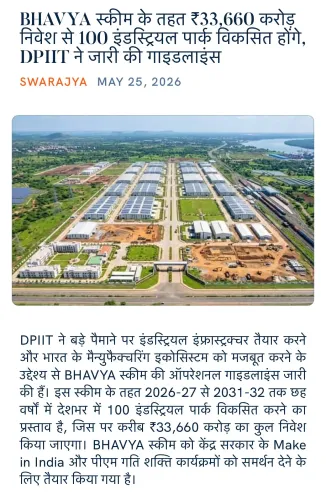
The Centre has released operational guidelines for BHAVYA, a ₹33,660 crore scheme to build 100 world-class industrial parks by 2032. With plug-and-play infrastructure, SPV-led execution, and a challenge-based selection process, BHAVYA is India's most structured industrial park push yet — arriving precisely when global supply chains are hunting for credible alternatives to China.
Key Takeaways
The Commerce Ministry released operational guidelines for the BHAVYA Scheme on 23 May 2025 .
The scheme targets 100 industrial parks over six years from 2026-27 to 2031-32 , with an outlay of approximately ₹33,660 crore .
The first phase covers up to 50 parks selected through a challenge-based competitive process .
Minimum land area: 100 acres for non-hilly states; 25 acres for hilly states, northeastern states, UTs, and smaller states; up to 1,000 acres permitted.
Parks will be implemented via Special Purpose Vehicles (SPVs) under the Companies Act, 2013 .
The scheme aligns with Make in India , PM Gati Shakti , and Central and State skilling, logistics, and sustainability programmes.
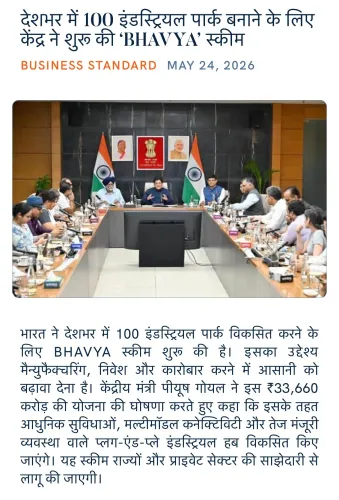
The Commerce Ministry on Saturday, 23 May released detailed operational guidelines for the BHAVYA Scheme, a flagship initiative designed to develop 100 investment-ready industrial parks across India over six years, backed by a total financial outlay of approximately ₹33,660 crore. The scheme runs from 2026-27 to 2031-32 and is positioned as a structural push to make India a globally competitive manufacturing destination.
What BHAVYA Covers
The scheme provides for development of both greenfield and eligible brownfield industrial parks. Minimum land requirements have been set at 100 acres for non-hilly states and 25 acres for hilly states, northeastern states, Union Territories, and smaller states. Parks of up to 1,000 acres are also permitted under the framework.
The guidelines lay down a comprehensive architecture covering eligibility criteria, project selection methodology, funding structure, governance, monitoring systems, and implementation modalities. The core emphasis is on plug-and-play infrastructure, multimodal logistics connectivity, reliable utility systems, worker-support facilities, digital governance systems, and sustainable development features.
Phase-Wise Rollout and Selection Process
In the first phase, up to 50 industrial parks will be taken up through a challenge-based competitive selection process. This approach is intended to ensure that only viable, well-planned projects receive central support, reducing the risk of stalled or underutilised industrial estates — a recurring problem with past government-backed parks.
Implementation will be undertaken through Special Purpose Vehicles (SPVs) incorporated under the Companies Act, 2013. Each SPV will be responsible for project planning, development, operation, management, investor facilitation, and long-term asset maintenance.
Policy Convergence and Strategic Alignment
BHAVYA has been explicitly aligned with 'Make in India', 'PM Gati Shakti', and the broader industrial competitiveness agenda. The guidelines also provide for convergence with Central and State Government initiatives spanning logistics, skilling, sustainability, renewable energy, utility infrastructure, and industrial development.
This convergence architecture is notable: rather than operating as a standalone scheme, BHAVYA is designed to act as an integrating layer across existing policy pipelines — potentially amplifying the impact of each constituent programme.
Why This Matters for India's Manufacturing Push
India's industrial park ecosystem has historically struggled with fragmented land acquisition, inadequate utilities, and poor last-mile connectivity. The BHAVYA framework's stress on investment-ready ecosystems directly addresses these bottlenecks. The inclusion of worker-support infrastructure and digital governance signals a shift toward parks that attract not just capital, but sustained operations.
With global supply chains actively diversifying away from China, the timing of these guidelines is strategically significant. Industry bodies and state governments are expected to begin engaging with the challenge-based selection process in the coming months. The first tranche of parks under Phase 1 will set the template for the remaining 50 parks in subsequent phases.
Point of View
But the proof will be in Phase 1 execution: how many of the 50 shortlisted parks actually achieve 'investment-ready' status within the promised timeline. The SPV model adds accountability, but SPVs are only as strong as the state governments that back them. With global manufacturers actively scouting post-China alternatives, India has a narrow window — BHAVYA either delivers plug-and-play infrastructure at scale, or cedes that opportunity to Vietnam and Indonesia by default.
NationPress
19 Sept 2026
Frequently Asked Questions
What is the BHAVYA Scheme?
BHAVYA is a central government scheme to develop 100 investment-ready industrial parks across India between 2026-27 and 2031-32, with a total financial outlay of approximately ₹33,660 crore. It is aligned with Make in India and PM Gati Shakti objectives.
How many industrial parks will be built under BHAVYA, and when?
The scheme targets 100 industrial parks over six years from 2026-27 to 2031-32. The first phase will take up to 50 parks through a challenge-based competitive selection process.
What are the land requirements for parks under BHAVYA?
A minimum of 100 acres is required for non-hilly states, while hilly states, northeastern states, Union Territories, and smaller states need a minimum of 25 acres. Parks of up to 1,000 acres are also permitted under the scheme.
How will BHAVYA industrial parks be implemented?
Projects will be implemented through Special Purpose Vehicles (SPVs) incorporated under the Companies Act, 2013. Each SPV will handle planning, development, operations, investor facilitation, and long-term asset maintenance.
Which government programmes does BHAVYA converge with?
BHAVYA is designed to converge with Central and State Government initiatives covering logistics, skilling, sustainability, renewable energy, utility infrastructure, and broader industrial development, in addition to Make in India and PM Gati Shakti.