BHAVYA scheme targets investment-ready industrial parks to boost manufacturing: DPIIT
Synopsis
India's BHAVYA scheme is reframing how industrial parks are built — success won't be measured by infrastructure laid, but by investors landed and factories running. With 31 states in the room and testing facilities being embedded inside industrial corridors, this is a structural attempt to close the gap between policy announcement and production reality.
Key Takeaways
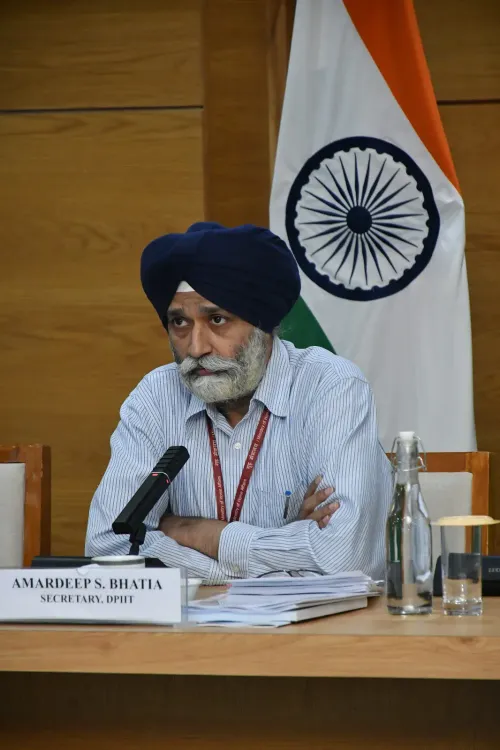
DPIIT Secretary Amardeep Singh Bhatia outlined the BHAVYA (Bharat Audyogik Vikas Yojana) scheme's goals at a NICDC workshop on 29 May 2025 in New Delhi .
The scheme targets investment-ready industrial parks that can rapidly attract industries, generate employment, and boost export competitiveness.
More than 100 representatives from 31 states and Union Territories participated in the discussions at Vanijya Bhawan .
Project evaluation will focus on long-term industrial viability and investment potential , not just infrastructure creation.
National Test House (NTH) is collaborating with NICDC to embed testing and certification facilities — including EV battery and drone certification — within industrial corridor projects.
The Bharat Audyogik Vikas Yojana (BHAVYA) scheme is designed to create investment-ready industrial parks capable of rapidly attracting industries, generating employment, and strengthening India's manufacturing ecosystem, Department for Promotion of Industry and Internal Trade (DPIIT) Secretary Amardeep Singh Bhatia said on Friday, 29 May. Bhatia made the remarks while addressing a workshop organised by the National Industrial Corridor Development Corporation (NICDC) at Vanijya Bhawan, New Delhi.
What BHAVYA Aims to Achieve
Bhatia stressed that the success of the BHAVYA scheme would not be judged by infrastructure creation alone, but by how effectively industrial parks attract investors and evolve into operational manufacturing hubs. He urged states and Union Territories to prepare investor-centric proposals that highlight ease of doing business, competitive advantages, and strong supporting ecosystems, ensuring industries can commence operations within a reasonable timeframe.
Project evaluation under the scheme, he added, would prioritise long-term industrial viability and investment potential over short-term metrics.
'The scheme seeks to create industrial parks where infrastructure readiness translates into rapid investment grounding, manufacturing activity, employment generation and export competitiveness,' Bhatia stated.
Workshop Scope and Participation
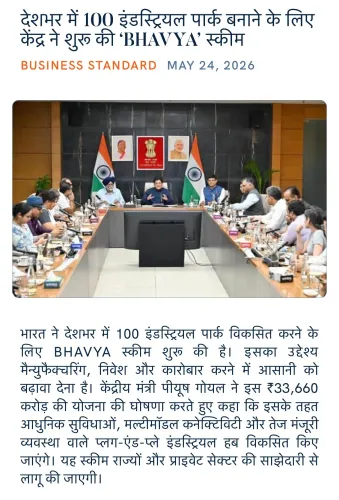
The workshop, organised under the aegis of DPIIT, focused on the BHAVYA scheme framework and the testing facilities offered by the National Test House (NTH) and the Bureau of Indian Standards (BIS). More than 100 representatives from 31 states and Union Territories participated in the discussions, underscoring the scheme's national reach.
NICDC Chief Executive Officer and Managing Director Rajat Kumar Saini, in his welcome address, highlighted the importance of developing investment-ready industrial ecosystems backed by robust infrastructure, testing facilities, and institutional support.
Quality Infrastructure and Testing Facilities
The workshop was structured across two sessions, with the first dedicated to quality infrastructure and testing capabilities. National Test House Director General Dr. Alok Srivastav presented NTH's expanding testing and certification ecosystem, which now covers drone certification, EV battery testing, aerospace components, solar equipment, and organic food testing.
Notably, NTH highlighted its collaboration with NICDC to establish testing facilities and sample collection centres within industrial corridor projects, enabling industries to access quality certification services closer to manufacturing hubs — a step that could meaningfully reduce compliance timelines for new entrants.
Broader Context and What's Next
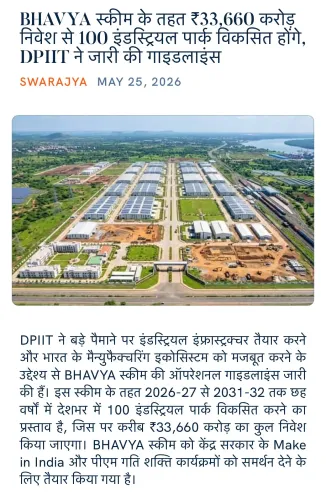
The BHAVYA scheme sits within India's wider push to raise manufacturing's share of GDP, a target that has remained elusive despite successive policy drives. By embedding quality infrastructure — including standardised testing — directly within industrial parks, the framework attempts to address a persistent bottleneck: the gap between infrastructure availability and actual production commencement.
With state-level proposals now being solicited and evaluation criteria centred on investment viability, the scheme's next phase will test whether Centre-state coordination can translate workshop intent into on-ground industrial activity.
Point of View
Yet the harder variable remains land acquisition and single-window clearance at the state level. Whether 31 states can move from workshop participation to investor-ready proposals in a credible timeframe is the test this scheme has set for itself.
NationPress
24 Sept 2026
Frequently Asked Questions
What is the BHAVYA scheme?
BHAVYA, or Bharat Audyogik Vikas Yojana, is a central government scheme aimed at creating investment-ready industrial parks that can rapidly attract industries, generate employment, and strengthen India's manufacturing ecosystem. The scheme is administered under the Department for Promotion of Industry and Internal Trade (DPIIT) and evaluated on the basis of long-term industrial viability and investment potential.
What was discussed at the NICDC workshop on 29 May 2025?
The NICDC workshop at Vanijya Bhawan, New Delhi, focused on the BHAVYA scheme framework and testing infrastructure offered by the National Test House and the Bureau of Indian Standards. More than 100 representatives from 31 states and Union Territories attended, with sessions covering quality infrastructure, testing facilities, and investor-centric park development.
How will BHAVYA scheme projects be evaluated?
According to DPIIT Secretary Amardeep Singh Bhatia, project evaluation under BHAVYA will focus on long-term industrial viability and investment potential — not merely on infrastructure creation. States are being asked to submit investor-centric proposals highlighting ease of doing business and competitive advantages.
What role does the National Test House play in BHAVYA?
The National Test House (NTH) is collaborating with NICDC to establish testing facilities and sample collection centres within industrial corridor projects. NTH's capabilities include drone certification, EV battery testing, aerospace components, solar equipment, and organic food testing, enabling industries to access certification services closer to manufacturing hubs.
Which states participated in the BHAVYA workshop?
Representatives from 31 states and Union Territories — more than 100 officials in total — participated in the NICDC workshop held at Vanijya Bhawan, New Delhi, on 29 May 2025.