Rajnath Singh Calls for India to be a Leader in Drone Manufacturing
Synopsis
In a bid to enhance India's defense capabilities amid global uncertainties, Defence Minister Rajnath Singh has called for the nation to embark on a mission to become a leading hub for indigenous drone manufacturing, ensuring strategic autonomy and Aatmanirbhar status.
Key Takeaways
India's goal : To lead in indigenous drone manufacturing.
Strategic focus : Emphasis on self-reliance and component production.
Innovation ecosystem : 676 start-ups and MSMEs engaged in defense.
New initiatives : DISC-14 and ADITI challenges launched.
MSMEs' growth : Significant increase in MSMEs contributing to the economy.
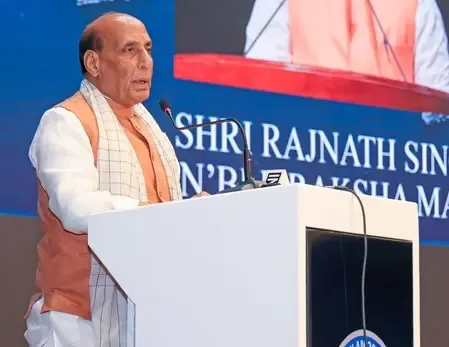
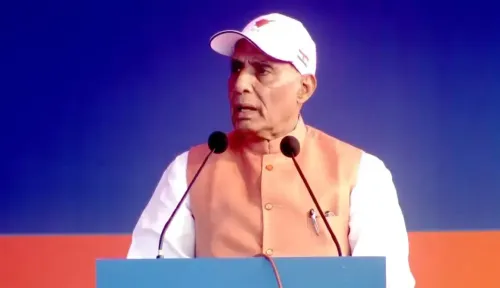
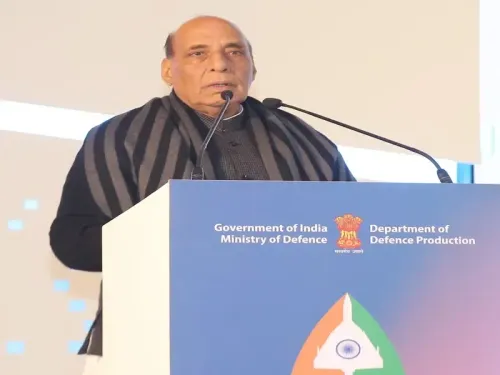
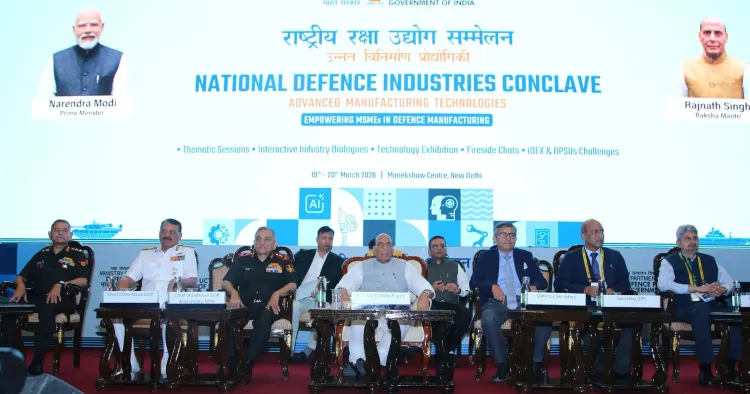
New Delhi, March 19 (NationPress) - Defence Minister Rajnath Singh emphasized on Thursday that India needs to enter a mission mode to position itself as a global leader in domestic drone manufacturing within the next few years. This initiative aims to secure strategic autonomy, bolster defence preparedness, and achieve Aatmanirbhar status amid current geopolitical challenges.
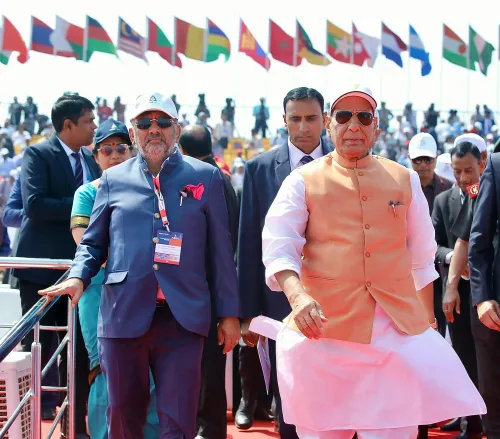
While inaugurating the two-day National Defence Industries Conclave at the Manekshaw Centre, Singh pointed out that ongoing global conflicts, such as the Russia-Ukraine war and tensions between Iran and Israel, underscore the importance of drones and counter-drone technologies in future warfare. He stressed that self-reliance in drone production is crucial not only at the finished product level but also at the component level.
“From the drone's moulds to its software, engines, and batteries, everything must be produced in India. This is a challenging task, as many nations currently import critical components from China,” he noted.
Singh further stated that the development of a nation’s defence industrial ecosystem relies on the collaboration of large industries, MSMEs, start-ups, and innovators, alongside a robust policy framework from the government tailored to address the country’s specific defence needs.
“As of February 2026, around 676 start-ups, MSMEs, and individual innovators have integrated into the defence innovation ecosystem since the establishment of iDEX in 2018, resulting in 548 contracts signed. Among these, 58 prototypes have been approved for procurement, valued at approximately Rs 3,853 crore. Moreover, 45 procurement contracts worth nearly Rs 2,326 crore have been finalized,” the minister revealed.
During the inaugural session, Singh launched the 14th edition of the Defence India Start-up Challenge (DISC-14) and the 4th edition of the ADITI challenges under the iDEX initiative. A total of 107 problem statements, including 82 under DISC-14 and 25 under ADITI Challenges 4.0, were introduced to foster innovations in various defence domains.
A new initiative comprising 101 innovation challenges from defence PSUs was also unveiled by Singh to promote design-focused innovation by MSMEs and start-ups.
He referred to iDEX and ADITI as transformative initiatives that empower start-ups, innovators, and MSMEs to develop innovative solutions tailored to meet the Defence Forces' requirements.
Singh noted that MSMEs are increasingly active in fields like Artificial Intelligence, Robotics, Automation, and Advanced Manufacturing, signifying a significant positive shift in the sector.
He mentioned that the number of MSMEs in India has surged from about 4.67 crore in 2012-13 to almost 8 crore, according to recent statistics. This growth highlights the rising entrepreneurial spirit in the nation, with small industries playing a critical role in driving economic expansion.
In his address, Sanjeev Kumar, Secretary of Defence Production, emphasized that the conclave aims to advance manufacturing technologies and integrate MSMEs into the production ecosystem and value chain, starting from design and development to manufacturing. A digital database named Srijan Deep has also been created, listing over 40,000 industries in the defence sector to enhance R&D resources.
Present at the event were Chief of Defence Staff General Anil Chauhan, Chief of the Naval Staff Admiral Dinesh K Tripathi, Chief of the Army Staff General Upendra Dwivedi, DRDO Chairman Samir V. Kamat, and other senior officials.
Point of View
The emphasis on indigenous production of drones and components is crucial for national security. This initiative not only fosters innovation but also strengthens the country's economic landscape, driven by a collaborative approach involving various sectors.
NationPress
21 Sept 2026
Frequently Asked Questions
What is the significance of India's drone manufacturing initiative?
The initiative aims to enhance India's strategic autonomy, improve defense preparedness, and achieve self-reliance in response to current global geopolitical uncertainties.
How many start-ups and MSMEs are involved in the defense innovation ecosystem?
As of February 2026, approximately 676 start-ups and MSMEs have integrated into the defense innovation ecosystem since 2018.
What are the key components that India aims to manufacture locally?
India aims to produce all components of drones, including moulds, software, engines, and batteries, domestically.
What recent initiatives were launched during the National Defence Industries Conclave?
The 14th edition of the Defence India Start-up Challenge and the 4th edition of the ADITI challenges were launched to promote innovation in various defense domains.
What is the role of MSMEs in the defense sector?
MSMEs are crucial for driving innovation in fields like AI, robotics, and advanced manufacturing, contributing significantly to the defense ecosystem.