India's Role in Global AI Democratization: IMF Chief Insights
Synopsis
India is playing a crucial role in the global AI landscape, promoting technological access for developing nations, as shared by IMF Chief Kristalina Georgieva. Discover the potential economic impacts and challenges highlighted during the Asia in 2050 Conference.
Key Takeaways
India is a key player in the global AI revolution.
AI could boost Asia's economic growth significantly.
Access to AI technology is being expanded for developing nations.
AI may disrupt various job markets, requiring adaptation.
Investment in skills and infrastructure is crucial for future growth.
New Delhi, March 5 (NationPress) India is positioning itself as a pivotal force in the global Artificial Intelligence landscape, contributing to the democratization of this innovative technology for not only its own citizens but also for developing nations globally, stated Kristalina Georgieva, Managing Director of the International Monetary Fund, on Thursday.
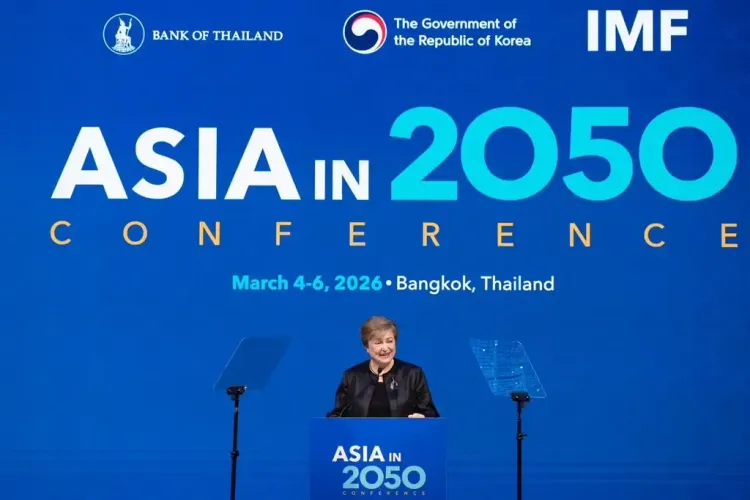
During her address at the Asia in 2050 Conference in Bangkok, Georgieva highlighted that the swift advancement of AI holds the potential to transform the global economy, with Asia playing a crucial role in this evolution.
“If countries effectively leverage this technology to enhance productivity, AI could boost Asia’s economic growth by almost one percentage point annually,” she remarked.
“India’s efforts to democratize AI extend beyond its borders, benefiting numerous developing countries,” she continued.
Georgieva noted that India's expansive digital ecosystem, its burgeoning tech industry, and a youthful workforce could facilitate broader access to AI tools worldwide.
However, she cautioned that AI might disrupt labor markets throughout the region.
“While the demand for both high-skilled and low-skilled positions may rise, many mid-level roles could be jeopardized as automation grows,” she explained.
She expressed concern regarding the effects on entry-level jobs, which frequently involve routine tasks susceptible to automation.
“This situation could lead to uncertainty for new graduates entering the workforce,” she remarked.
To navigate these challenges, she emphasized the need for governments to invest in digital infrastructure, enhance skills training, and ensure that workers can adapt to swiftly evolving technologies.
She added that fostering a flexible workforce and promoting lifelong learning will be essential for reaping the benefits of AI while mitigating its risks.
The IMF chief urged that nations that proactively prepare and invest in their human resources will be better positioned to capitalize on AI-driven growth, while those that procrastinate may risk falling behind in the global economic landscape.
Point of View
India's initiative to democratize AI underscores its commitment to fostering global technological equity. This move not only enhances its international standing but also aligns with the needs of developing nations, indicating a forward-thinking approach in a rapidly changing technological landscape.
NationPress
30 Sept 2026
Frequently Asked Questions
How is India contributing to AI democratization?
India is enhancing access to AI technology for both its population and developing countries through its vast digital infrastructure and young workforce.
What economic benefits could AI bring to Asia?
AI has the potential to increase Asia's economic growth by nearly one percentage point annually if utilized effectively to boost productivity.
What challenges does AI pose to the job market?
AI may disrupt labor markets, increasing demand for high- and low-skilled jobs while putting pressure on many middle-level positions due to automation.
What should governments do to address AI-related challenges?
Governments must invest in digital infrastructure, improve skill training, and ensure workers can adapt to rapidly changing technologies.
Why is lifelong learning important in the age of AI?
Continuous learning is essential to build a flexible workforce that can adapt to technological changes and leverage AI opportunities.