Could India Become the Most Influential Civilization as AI Takes Over?
Synopsis
What if the rise of AI transforms the global landscape? A new report suggests that India could rise as the most influential civilization, focusing on consciousness over materialism. Discover how ancient traditions may guide us toward meaning in a post-work world.
Key Takeaways
AI is changing the landscape of work and human identity.
India's exploration of consciousness may guide future civilizations.
Material success, as seen in China, is contrasted with India's inner mastery.
Understanding consciousness could become a vital skill in a post-work era.
The integration of sacred and mundane practices is crucial for coherence.
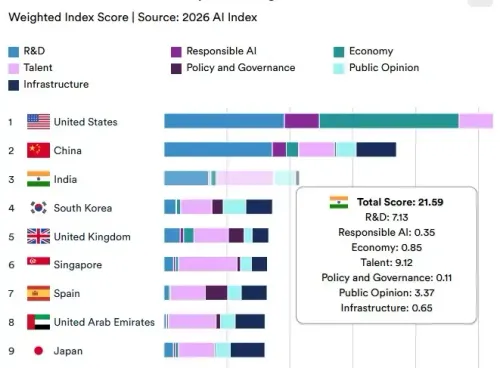
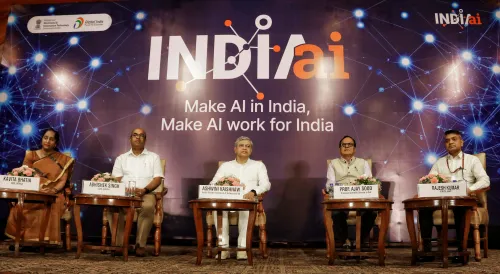
New Delhi, Nov 4 (NationPress) As machines and artificial intelligence (AI) take the place of human labor, humanity may turn its focus inward, searching for meaning over material existence. In this transformative landscape, India—rather than China or the West—might emerge as the leading civilization, rooted in its extensive exploration of consciousness, as outlined in a recent report.
Jan Krikke writes in Asia Times that India is set to guide the future in a world devoid of traditional work.
Macrohistorian Lawrence Taub forecasts that by mid-century, advancements in automation, AI, and 'free energy' will render the ‘Worker Age’ obsolete, prompting societies to grapple with an identity crisis.
“While the 19th century utilized physical power and the 20th century focused on information, the 21st century must engage with consciousness. The new battleground will center around meaning rather than mere production,” the article notes.
No nation exemplifies the ‘Worker Age’ more thoroughly than China.
“Its Confucian principles of discipline, hierarchy, and collective unity have led to an unparalleled industrial revolution, lifting nearly a billion people out of extreme poverty, creating megacities almost overnight, and establishing itself as the world’s manufacturing hub,” the article asserts.
China epitomizes both the triumph and the fatigue of the 'Worker Age'.
“If China signifies material success, India signifies inner depth. For thousands of years, Indian civilization has delved into the facets of consciousness that modern neuroscience is just beginning to explore,” the article explains.
The Upanishads investigated the interplay between the mind and reality; the Bhagavad Gita presented a psychology of action free from attachment; and Yoga and Vedanta crafted stringent methods for self-exploration and emotional control.
“Unlike other civilizations, India has never segregated the metaphysical from the everyday. The sacred and the mundane have always been intertwined—from meditative practices before meals to rituals that celebrate the passage of time. This holistic approach may become crucial in a post-work world where individuals seek coherence rather than mere consumption,” the article posits.
In an era where AI can surpass human intellect yet lacks understanding, India’s ancient traditions offer frameworks for discernment—guiding individuals on how to observe, interpret, and live with consciousness.
“This could emerge as the most critical skill of our time,” the article concludes.
Point of View
This report emphasizes India's unique position as a civilization that merges ancient wisdom with contemporary challenges. It highlights the potential for India to lead in a future defined by the search for meaning over material gains, showcasing a path that could resonate globally.
NationPress
29 Sept 2026
Frequently Asked Questions
How might AI impact the future of work?
AI is expected to automate many traditional jobs, creating an identity crisis that societies must navigate as the focus shifts from material production to the search for meaning.
Why is India considered a leading civilization in this context?
India's long history of exploring consciousness through its cultural and philosophical practices positions it uniquely to influence future discussions about identity and meaning.