KOSPI gains 0.24% on tech buying as Seoul inflation hits 2.9% in Sept
Synopsis
Seoul's KOSPI clawed back from early losses as tech bargain-hunters pushed Samsung Electronics and SK hynix higher ahead of a long weekend. Separately, South Korea's September inflation print came in at 2.9% — driven by a 20% diesel price surge — raising questions about how long the government's fuel price cap can hold against Middle East-driven energy pressures.
Key Takeaways
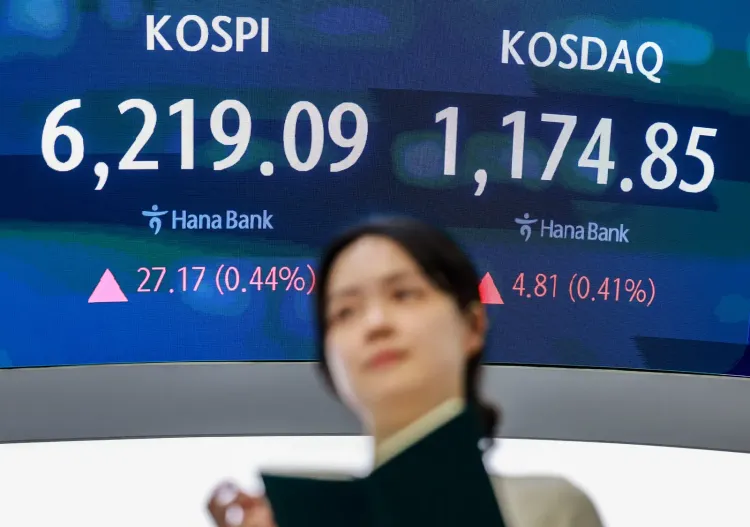
KOSPI recovered to trade up 16.72 points (0.24%) at 6,977.07 as of 11:20 am on 2 October , after opening 0.47% lower.
Samsung Electronics edged up 0.09% ; SK hynix gained 0.44% , leading the tech-led recovery.
South Korea's CPI rose 2.9% year-on-year in September , with petroleum products surging 14.8% on-year.
Diesel prices jumped 20% and gasoline prices rose 11.8% in September, driven by Middle East geopolitical tensions.
The government's fuel price cap is estimated to have limited overall CPI growth by 0.6 percentage point .
Seoul markets will be closed Monday for a national holiday.
The Korea Composite Stock Price Index (KOSPI) recovered from early losses to trade 16.72 points, or 0.24 per cent, higher at 6,977.07 as of 11:20 am local time on Friday, 2 October, as investors scooped up major technology stocks ahead of a national holiday. The benchmark had opened 0.47 per cent lower before bargain hunters stepped in, narrowing the session's initial decline.
Tech Heavyweights Drive the Rebound
Samsung Electronics, the top stock by market capitalisation, edged up 0.09 per cent, while chip giant SK hynix gained 0.44 per cent. However, not all major names followed suit — SK Square, the parent company of SK hynix, declined 0.43 per cent, and Samsung Electro-Mechanics, an electronics component affiliate of Samsung Electronics, slipped 0.13 per cent. The mixed performance among market heavyweights reflects cautious optimism rather than broad-based conviction.
US Market Cues Offer Limited Support
Overnight, Wall Street finished modestly in the green, providing a partial tailwind to Seoul. The Dow Jones Industrial Average rose 0.04 per cent, the S&P 500 gained 0.19 per cent, and the tech-heavy Nasdaq Composite added 0.04 per cent. Gains on Wall Street were capped by rising crude oil prices even as benchmark US Treasury yields eased from fresh multi-decade highs — a dynamic that continues to weigh on global risk appetite. The Korean won was trading at 1,359 won against the US dollar as of 11:20 am, up 0.6 won from the previous session's close, indicating mild currency stability.
South Korea Inflation Climbs 2.9% in September
South Korea's consumer prices rose 2.9 per cent year-on-year in September, according to data released on Friday by the Ministry of Data and Statistics, with energy costs remaining elevated even as agricultural goods prices declined. The figure marks a return to the 2 per cent range, after consumer price growth came in at 2.8 per cent in July and 3.1 per cent in August.
Energy Prices Remain a Key Pressure Point
Petroleum product prices surged 14.8 per cent on-year in September, reportedly driven by prolonged geopolitical tensions in the Middle East. Diesel prices rose sharply by 20 per cent, while gasoline prices climbed 11.8 per cent. South Korea relies heavily on imports to meet its energy needs, making it particularly vulnerable to global crude price swings. The government noted that a fuel price cap currently in place is estimated to have contained the overall consumer price increase by 0.6 percentage point. Trading in Seoul will be suspended on Monday for a national holiday, with the next session watched closely for post-holiday positioning.
Point of View
South Korea's energy vulnerability is laid bare. The government's fuel price cap is doing real work — 0.6 percentage point of suppression is not trivial — but it is a temporary fix against a structural dependency on imported energy that Middle East tensions keep exposing. If crude remains elevated into the fourth quarter, Seoul will face a harder choice between fiscal support and inflationary pass-through.
NationPress
2 Oct 2026
Frequently Asked Questions
Why did KOSPI recover on 2 October despite opening lower?
The KOSPI reversed early losses as investors engaged in bargain-hunting, particularly in major technology stocks like Samsung Electronics and SK hynix, ahead of a national holiday on Monday. The benchmark recovered from a 0.47% opening decline to trade 0.24% higher at 6,977.07 by mid-morning.
What is South Korea's inflation rate for September 2026?
South Korea's consumer prices rose 2.9% year-on-year in September, according to the Ministry of Data and Statistics. This follows 2.8% growth in July and 3.1% in August, with energy costs — particularly diesel up 20% and gasoline up 11.8% — remaining the key driver.
How are Middle East tensions affecting South Korea's economy?
Prolonged geopolitical tensions in the Middle East have kept petroleum product prices elevated, with South Korea's energy import bill rising sharply. Petroleum products surged 14.8% on-year in September, directly pushing up consumer prices in an economy heavily reliant on imported energy.
What is the South Korean government doing to manage fuel prices?
The government has a fuel price cap in place that is estimated to have limited the overall increase in consumer prices by 0.6 percentage point in September. Without the cap, headline CPI would have been even higher given the scale of global crude price increases.
When will Seoul's stock market next be open after 2 October?
Seoul's stock market will be closed on Monday for a national holiday, making the next trading session Tuesday. Investors are likely to watch global crude price movements and any further US Treasury yield shifts over the long weekend.