Nvidia Backs UK AI and Quantum Startups in London

Synopsis
Nvidia CEO Jensen Huang announced investments in five UK startups at a London event, backing Boltz Bio, Foresight Works, Hivergé AI, PrimaMente, and quantum computing firm Riverlane — extending Nvidia's AI-ecosystem strategy across Europe's deep-tech capital.
Key Takeaways
Nvidia announced investments in five UK startups at a London event on 14 October 2026 .
The backed companies span AI drug discovery (Boltz Bio), enterprise AI (Foresight Works, Hivergé AI, PrimaMente), and quantum computing control systems (Riverlane).
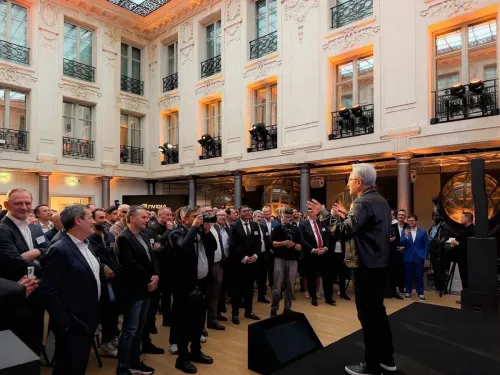
Jensen Huang made the announcements in person, underscoring the strategic weight Nvidia places on the UK market.
Riverlane , based in Cambridge , focuses on quantum error-correction and control — a long-horizon bet on post-GPU computing architectures.
The move aligns with the UK AI Sector Deal of 2018 and the country's sustained effort to attract deep-tech private investment.
Specific investment amounts and timelines have not been disclosed publicly.
A single evening in London just added five new names to Nvidia's global investment map. On Wednesday, 14 October 2026, chip giant Nvidia used a London event to announce targeted investments in Boltz Bio, Foresight Works, Hivergé AI, PrimaMente, and Cambridge-based quantum computing firm Riverlane — spanning drug discovery, enterprise AI, and the emerging frontier of quantum control systems.
Jensen Huang's London moment — and what each startup represents
Nvidia chief executive Jensen Huang made the announcements in person, lending the occasion the kind of executive-level weight that signals strategic intent rather than routine portfolio activity. The five companies cut across some of the most consequential verticals in technology today: Boltz Bio works on AI-accelerated drug design, while Riverlane has carved out a specific niche building quantum error-correction software and hardware control stacks — the plumbing that quantum computers need before they can do real work.
Nvidia's post framed the breadth simply: 'From new medicines to quantum computing, there's plenty to build.' That line, terse as it is, maps onto exactly the verticals the UK has been betting on with public money and regulatory runway for the better part of a decade.
Why the UK — and why now
The United Kingdom has spent years positioning itself as Europe's default destination for AI and deep-tech capital. The UK AI Sector Deal of 2018 laid the early groundwork — government incentives, talent pipelines, and a regulatory posture designed to attract exactly the kind of private investment Nvidia is now deploying. That architecture is now bearing fruit in a visible way.
For Nvidia, the London push is consistent with a broader European playbook: the company has been seeding AI-ecosystem companies across the continent, ensuring that builders who touch Nvidia's GPU and software stack grow into anchor customers and innovation partners simultaneously. Backing a quantum-computing firm like Riverlane — headquartered in Cambridge — also signals Nvidia is watching the horizon beyond current-generation AI hardware.
Riverlane and the quantum bet hiding in plain sight
Riverlane may be the most forward-looking name on the list. The Cambridge firm focuses on the control systems that sit between classical computers and quantum processors — arguably the most critical and least glamorous layer of the quantum stack. An Nvidia investment here is not about near-term revenue; it is a hedge on the architecture of computing itself, placed at the point where Britain's university-linked deep-tech scene is densest.
Whether the UK government follows with matching public funds — a pattern it has used in previous deep-tech rounds — remains to be watched closely. What is already clear is that one London evening moved five British startups from the margins of the global AI conversation firmly toward its centre.
Point of View
Creating long-term demand pull beyond hardware sales. The inclusion of a quantum computing firm like Riverlane is particularly telling: it suggests Nvidia is positioning itself at the intersection of current-generation GPU-driven AI and the next wave of hybrid classical-quantum workflows. For the UK, landing Jensen Huang in person is a validation that the country's decade-long policy investment in AI and quantum is translating into global capital flows, not just domestic hype.
NationPress
15 Oct 2026
Frequently Asked Questions
Which UK startups did Nvidia invest in?
Nvidia announced investments in Boltz Bio, Foresight Works, Hivergé AI, PrimaMente, and Riverlane at a London event on 14 October 2026.
What does Riverlane do and why is Nvidia investing?
Riverlane is a Cambridge-based company that builds quantum computing control systems and error-correction software. Nvidia's investment signals a strategic interest in the quantum computing layer that will sit alongside future AI workloads.
How much did Nvidia invest in UK AI startups?
Specific investment amounts have not been publicly disclosed by Nvidia.
Why is Nvidia investing in UK AI companies?
Nvidia has been expanding its AI ecosystem across Europe by backing startups that build on its GPU and software platforms. The UK's regulatory environment and deep-tech talent base, supported by policies like the UK AI Sector Deal of 2018, make it an attractive destination.
Was Jensen Huang in London for the announcement?
Yes, Nvidia CEO Jensen Huang was present in London and personally announced the investments in the five UK startups.