Nvidia Backs Grok 4.6 Launch on GB300 NVL72 Hardware

Synopsis
Nvidia has congratulated the SpaceX AI team on launching Grok 4.6, confirming the frontier model was trained and runs on the GB300 NVL72 with NVLink — delivering top performance and the lowest token cost at the frontier.
Key Takeaways
Nvidia publicly endorsed the release of Grok 4.6 by the SpaceX AI team on 12 August 2026 .
Grok 4.6 was both trained on and runs on Nvidia's GB300 NVL72 rack-scale AI system.
NVLink interconnect underpins the model's performance and reliability claims.
Nvidia and xAI claim Grok 4.6 delivers the lowest token cost among frontier models.
The announcement reinforces Nvidia's position as the default hardware backbone for cutting-edge AI model development.
Nvidia has thrown its weight behind the latest frontier AI model from the xAI team, publicly congratulating SpaceX AI on the release of Grok 4.6 — and making clear that its own silicon is at the heart of what makes the model run.
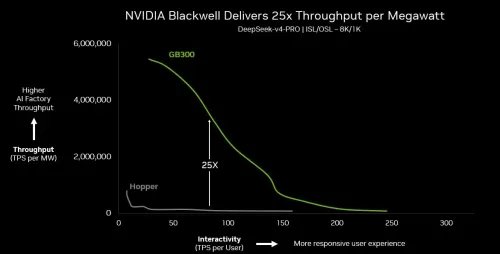
In a post on Wednesday, 12 August 2026, chip giant Nvidia confirmed that Grok 4.6 was both trained and runs on the NVIDIA GB300 NVL72 system, interconnected via NVLink. The company highlighted three headline claims: exceptional performance, high reliability, and — pointedly — the lowest token cost at the frontier.
What the GB300 NVL72 and NVLink bring to the table
The GB300 NVL72 is Nvidia's high-density, rack-scale AI compute platform, and NVLink is the company's proprietary high-bandwidth interconnect that allows GPU clusters to communicate at speeds far beyond standard networking. Together, they are positioned as the backbone for the most demanding large-model training and inference workloads. Nvidia's endorsement of Grok 4.6 is, in effect, a live proof-of-concept: a frontier model trained end-to-end on its newest hardware stack, with the token-cost claim serving as a direct pitch to cloud providers and AI developers watching their inference economics.Why token cost is the new battleground
At the frontier of AI, raw capability is table stakes. The real commercial fight has shifted to efficiency — how much it costs to generate each token of output at scale. By leading with 'lowest token cost,' Nvidia and the xAI team are speaking directly to the enterprises and developers who deploy models in production, where inference bills compound fast. It is a signal that the GB300 NVL72 architecture is not just powerful but economical at scale — a combination that matters enormously to cloud providers building out AI infrastructure. For Nvidia, the congratulatory post is more than goodwill. It is a product statement: the world's newest frontier model runs best on Nvidia iron. As AI labs race to release successive model generations, each announcement increasingly doubles as a hardware validation event — and Nvidia intends to be named in every one.Point of View
Where margins are made or lost. For cloud providers and AI developers in India and globally, hardware-efficiency claims at this level shape procurement decisions worth billions. Nvidia's dominance looks self-reinforcing: the more frontier labs train on its silicon, the more its architecture becomes the de facto standard.
NationPress
12 Aug 2026
Frequently Asked Questions
What is Grok 4.6 and who made it?
Grok 4.6 is a frontier AI model released by the SpaceX AI team, congratulated by Nvidia on 12 August 2026.
What Nvidia hardware does Grok 4.6 run on?
Grok 4.6 was trained and runs on the Nvidia GB300 NVL72 system, using NVLink high-bandwidth interconnects.
What is NVLink and why does it matter for AI?
NVLink is Nvidia's proprietary high-speed interconnect that allows GPU clusters to share data far faster than standard networking, boosting performance for large AI model training and inference.
Why is token cost important in AI model releases?
Token cost measures how much it costs to generate each unit of AI output at scale; lower token costs make frontier models commercially viable for enterprises and cloud providers running high-volume deployments.
What does this mean for Nvidia's position in AI infrastructure?
The endorsement reinforces Nvidia's role as the default hardware backbone for frontier AI, as each major model trained on its chips validates its architecture for the next wave of AI deployments.