Nvidia GB300 NVL72 Claims 10x Efficiency Edge Over Hopper
Synopsis
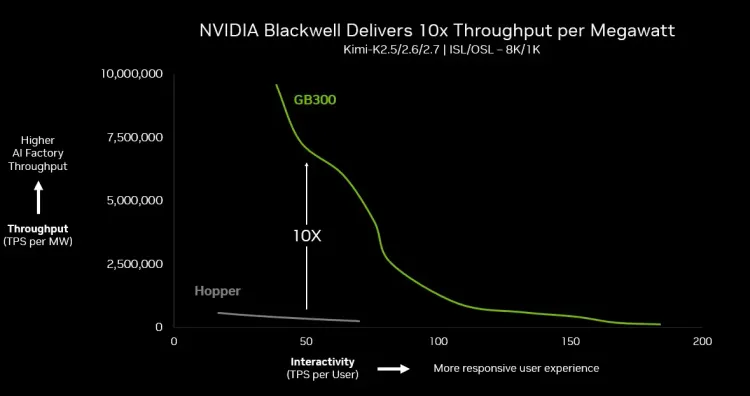
Nvidia's official account claims its GB300 NVL72 rack-scale systems achieve up to 10 times greater performance per watt than its Hopper-generation GPUs on the Kimi K2.6 model, marking one of the company's boldest efficiency milestones as AI power demands intensify globally.
Key Takeaways
Nvidia claims its GB300 NVL72 systems deliver up to 10× higher performance per watt than Hopper -generation GPUs.
The benchmark is based on the Kimi K2.6 AI model workload.
The Hopper architecture was launched in 2022 and remains one of the most widely deployed AI GPU platforms globally.
Performance-per-watt is a critical metric for hyperscalers and governments facing power constraints in AI infrastructure expansion.
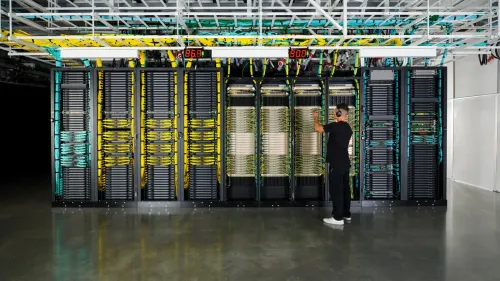
The GB300 NVL72 is a rack-scale system that integrates GPUs, networking, and memory into a single optimised unit.
Independent verification of the efficiency claim across broader workloads is still awaited.
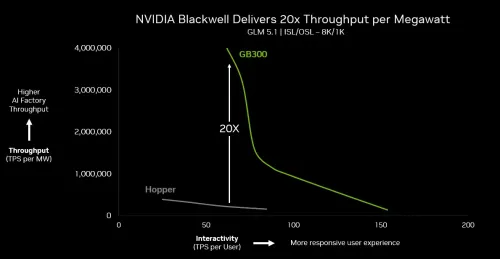
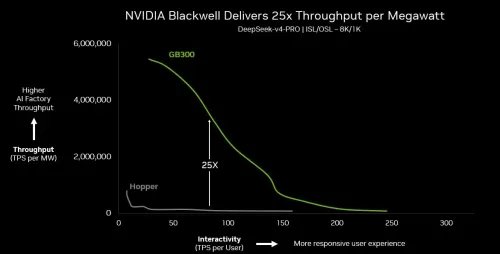
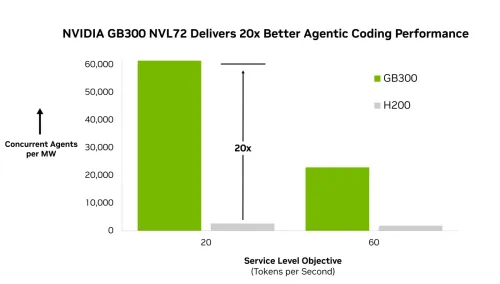
Chip giant Nvidia announced on Tuesday, 14 July 2026 that its GB300 NVL72 rack-scale systems deliver up to 10 times higher performance per watt than its previous-generation Hopper architecture when running the Kimi K2.6 AI model workload.
Context
The post, shared from Nvidia's official corporate account, states: 'On Kimi K2.6, NVIDIA GB300 NVL72 systems deliver up to 10× higher performance per watt than NVIDIA Hopper.' The claim positions the GB300 NVL72 as a generational leap in inference efficiency, benchmarked against one of the most widely deployed AI model families in production today.
The Hopper architecture, launched by Nvidia in 2022 as the successor to Ampere, became the dominant platform for large-scale AI training and inference across hyperscale data centres globally. Its H100 and H200 GPUs became industry reference points for AI compute density and efficiency.
Policy Backdrop
Performance-per-watt has emerged as a critical metric as governments and cloud operators grapple with the energy footprint of expanding AI infrastructure. Data centres running frontier AI models now consume power at scales comparable to mid-sized industrial facilities, making efficiency gains a policy as much as a commercial concern.
Nvidia has consistently framed successive GPU generations around efficiency improvements, arguing that denser, more power-efficient systems reduce the total infrastructure cost and carbon burden of AI at scale. A 10× efficiency claim, if borne out in independent benchmarks, would represent one of the most significant generational jumps the company has publicly cited.
Stakeholders and Impact
The primary beneficiaries of such an efficiency gain would be data centre operators and AI developers running large inference workloads. Hyperscalers — companies that operate cloud infrastructure at global scale — face binding power constraints at many facilities, meaning a tenfold improvement in performance per watt could translate directly into lower operating costs or the ability to run larger models within existing power envelopes.
For Indian enterprises and government AI programmes investing in domestic GPU infrastructure, efficiency metrics carry added weight: power availability and cost remain bottlenecks to scaling AI compute inside the country. A rack-scale system like the GB300 NVL72, which integrates multiple GPUs into a single optimised unit, also reduces the complexity of deploying dense AI clusters.
What's Next
The industry will watch for independent verification of the 10× performance-per-watt figure across a broader range of model workloads beyond Kimi K2.6. Analysts will also track how cloud providers price GB300 NVL72 capacity relative to existing Hopper-based instances, and whether the efficiency gains translate into lower inference costs for end users.
Nvidia's rack-scale strategy — bundling GPUs, networking, and memory into integrated NVL systems — signals the company's intent to shift competition from individual chip specs to full-system performance, a framing that could reshape procurement decisions at hyperscalers and national AI infrastructure programmes alike.
Point of View
Not merely a performance upgrade. By anchoring the benchmark to Kimi K2.6, a frontier inference workload, Nvidia signals that its rack-scale systems are optimised for the inference era, where volume and cost-per-query matter more than peak training throughput. For India's nascent AI infrastructure push, such efficiency milestones could influence procurement choices in government-backed compute programmes. The broader arc here is Nvidia consolidating its moat not just in raw performance but in the economics of running AI at scale.
NationPress
13 Oct 2026
Frequently Asked Questions
What is the Nvidia GB300 NVL72?
The Nvidia GB300 NVL72 is a rack-scale AI computing system that integrates multiple GPUs with high-speed networking and memory into a single optimised unit, designed for large-scale AI inference and training workloads.
How does GB300 NVL72 compare to Nvidia Hopper?
Nvidia claims the GB300 NVL72 delivers up to 10 times higher performance per watt than Hopper-generation GPUs when running the Kimi K2.6 AI model, representing a significant generational efficiency improvement.
What is Nvidia Hopper architecture?
Nvidia Hopper is a GPU architecture launched in 2022 as the successor to Ampere. It became the industry standard for AI training and inference, with the H100 and H200 GPUs being its most widely deployed chips.
Why does performance per watt matter for AI data centres?
Performance per watt determines how much AI compute a data centre can run within its power limits. As AI models grow larger, power efficiency directly affects operating costs, infrastructure scale, and environmental impact.