Nvidia Claims 50x AI Throughput Gain with Blackwell Ultra
Synopsis
Nvidia announced on 29 May 2026 that its Blackwell Ultra-powered AI factories deliver 50x higher throughput per megawatt, positioning the architecture as the engine of a new industrial revolution. The claim has direct implications for data-centre operators, AI developers, energy utilities, and India's fast-growing AI infrastructure sector.
Key Takeaways
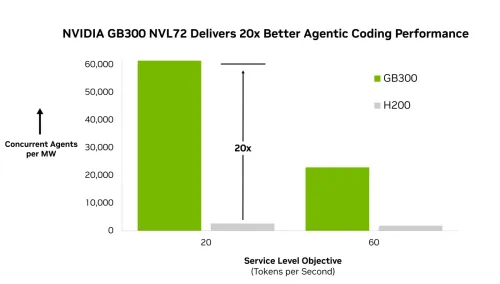
Nvidia announced on 29 May 2026 that Blackwell Ultra AI factories deliver 50x higher throughput per megawatt versus prior generations.
The company framed the development as the start of 'the next industrial revolution,' positioning AI factories as energy-to-intelligence converters.
Blackwell is Nvidia's 2024 -announced GPU architecture succeeding Hopper , with the 'Ultra' variant targeting hyperscale deployments.
Key stakeholders include data centre operators , AI model developers , and energy utilities whose capacity planning is affected by AI power demand.
US export controls on advanced chips remain a live policy variable that will shape which markets can access Blackwell Ultra at scale.
For India , where AI infrastructure investment is accelerating, validated efficiency gains could reshape the economics of domestic compute buildout.
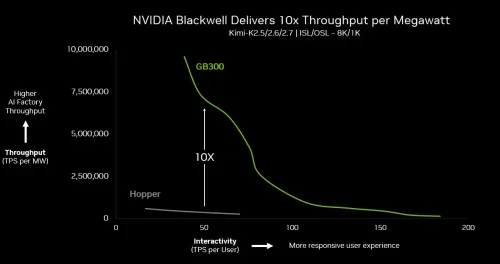
Chip giant Nvidia declared on Friday, 29 May 2026 that the next industrial revolution has arrived, announcing that its AI factories built on the Blackwell Ultra architecture deliver 50x higher throughput per megawatt compared to prior generations — framing the leap as a civilisational shift in how energy is converted into intelligence.
Context
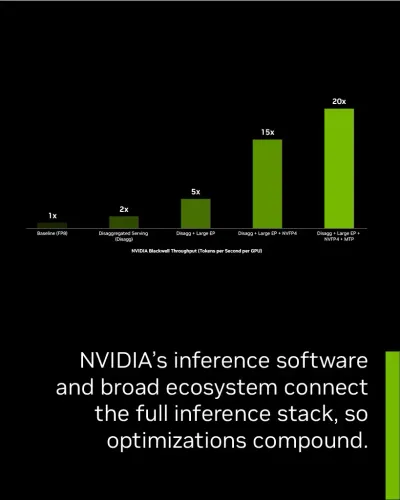
In its post, Nvidia stated: 'The next industrial revolution is here. NVIDIA AI factories convert energy into continuous intelligence, delivering 50x higher throughput per megawatt with Blackwell Ultra.' The claim positions Blackwell Ultra not merely as a product upgrade but as a foundational infrastructure shift — a factory model where electricity flows in and usable AI compute flows out at unprecedented efficiency.
Blackwell is Nvidia's GPU architecture family announced in 2024 as the successor to the Hopper generation, which itself succeeded Ampere in 2022. Each generation has been benchmarked against the prior one on AI training and inference workloads. The 'Ultra' suffix signals a higher-binned or enhanced variant within the Blackwell family, targeting hyperscale data centres.
Policy Backdrop
The announcement lands against a charged regulatory and geopolitical backdrop. US semiconductor policy since 2022 has combined domestic manufacturing incentives with strict export controls on advanced chips, directly shaping where Nvidia's most powerful silicon can be sold and deployed. The Blackwell Ultra's performance claims will likely draw fresh scrutiny over which markets can access it.
Simultaneously, governments and grid operators worldwide are grappling with the electricity appetite of AI infrastructure. Data centres running large-scale AI workloads have emerged as a material factor in national energy planning, from India's data-centre policy discussions to capacity debates in the United States and Europe. A 50x throughput-per-megawatt improvement, if validated at scale, would directly address the energy-cost argument that has complicated AI expansion approvals.
Stakeholders and Impact
Data centre operators and cloud hyperscalers stand to be the most immediate beneficiaries, as energy efficiency translates directly into operating-cost reduction and the ability to scale compute without proportional power-infrastructure investment. For AI model developers — including large research labs and enterprise AI teams — higher throughput per megawatt means faster iteration cycles at lower cost.
Energy utilities are a less obvious but significant stakeholder: if AI factories become meaningfully more efficient, the projected surge in grid demand from AI could moderate, altering capacity-planning assumptions. In India, where data-centre investment has accelerated sharply and power availability remains a constraint in several states, efficiency gains of this magnitude could reshape the economics of domestic AI infrastructure buildout.
What's Next
Industry attention will turn to independent benchmarks and customer deployments that can verify the 50x throughput-per-megawatt figure under real-world conditions. Nvidia's next GTC conference is expected to provide deeper technical disclosures on Blackwell Ultra specifications, supply timelines, and partnership announcements.
Regulatory scrutiny on data-centre power usage is intensifying in major markets, and any validated efficiency leap from Nvidia will feed directly into those policy conversations. For India, which is building out its AI compute capacity under national digitalisation priorities, the arrival of more efficient AI factory architectures could accelerate procurement decisions by both public-sector and private-sector operators.
Point of View
Echoing how electricity and steam were once described. The 50x throughput-per-megawatt claim, if independently verified, would give Nvidia a powerful rebuttal to the growing political and regulatory pressure over AI's energy footprint. For policymakers in markets like India, where power constraints are a real bottleneck for data-centre approvals, this efficiency narrative could accelerate procurement and policy clearances. The announcement also intensifies the competitive pressure on rivals to match not just raw performance but energy efficiency as a primary benchmark.
NationPress
14 Oct 2026
Frequently Asked Questions
What is Nvidia Blackwell Ultra?
Blackwell Ultra is an enhanced variant of Nvidia's Blackwell GPU architecture family, first announced in 2024, designed for hyperscale AI training and inference workloads with significantly improved energy efficiency.
What does 50x throughput per megawatt mean for AI data centres?
It means Blackwell Ultra-based systems can process 50 times more AI compute for every megawatt of electricity consumed compared to prior-generation hardware, which would substantially cut operating costs and reduce the power-infrastructure investment needed to scale AI capacity.
How does Nvidia's Blackwell Ultra affect India's AI infrastructure plans?
India is rapidly expanding its data-centre capacity under national digitalisation priorities, but power availability is a constraint in several states. A validated 50x efficiency gain could make AI infrastructure deployment more economically viable and easier to get grid approvals for.
What are Nvidia AI factories?
Nvidia uses the term 'AI factories' to describe large-scale data-centre facilities built around its GPU clusters, where electrical energy is the input and continuous AI compute — for training models or running inference — is the output.
Will Nvidia Blackwell Ultra be available in India?
Availability in specific markets, including India, will depend on US export-control regulations governing advanced semiconductor chips, as well as commercial agreements with cloud providers and data-centre operators. No specific India launch timeline has been announced.