Nvidia Commissions DGX GB300 AI System at US Navy School
Synopsis
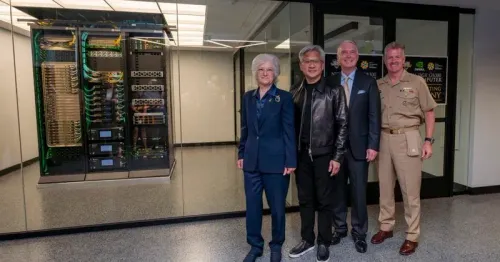
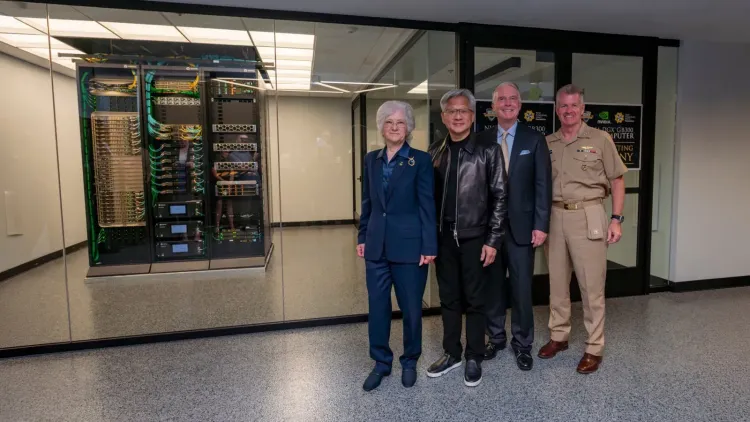
Nvidia CEO Jensen Huang joined federal leaders at the Naval Postgraduate School in Monterey, California, to commission the DGX GB300 AI system. The on-premises installation will serve 1,500 students and 600 faculty for research, model training, and defence-focused application development.
Key Takeaways
Nvidia and CEO Jensen Huang commissioned the DGX GB300 AI system at the Naval Postgraduate School in Monterey, California .
The system gives 1,500 students and 600 faculty on-premises access to large-scale AI computing.
Use cases include research, model training, simulations, and real-world application development.
The deployment aligns with the US National AI Initiative Act of 2020 and federal efforts to secure domestic AI compute capacity.
On-premises infrastructure is prioritised at defence-adjacent institutions to address security concerns over cloud alternatives.
The NPS installation could serve as a model for similar deployments at other US service academies or DoD labs.
Chip giant Nvidia announced on Thursday, 24 July 2026 that its chief executive Jensen Huang joined federal leaders and ecosystem partners at the Naval Postgraduate School (NPS) in Monterey, California, to commission the NVIDIA DGX GB300 system — a large-scale on-premises AI computing installation serving the institution's academic and research community.
The event, held as part of the 'Converge @ NPS' gathering, will give 1,500 students and 600 faculty members direct access to high-performance AI infrastructure for research, model training, simulations, and real-world application development. Nvidia described the commissioning as marking 'a shared commitment to advancing AI education, research, and mission-focused innovation.'
Context
The Naval Postgraduate School is a federally funded graduate institution operated by the US Navy, based in Monterey, California. It educates active-duty military officers and federal civilian personnel in advanced technical, policy, and strategic disciplines. The school's mandate places a premium on research that bridges academic rigour with defence-relevant application.
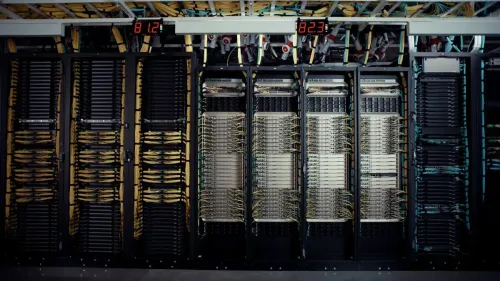
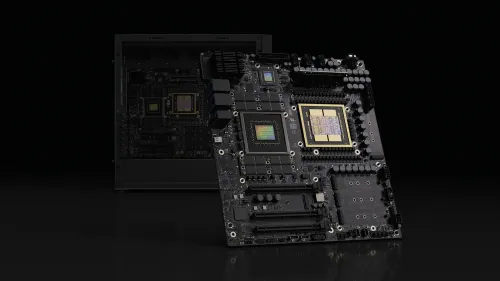
The DGX GB300 is Nvidia's latest generation of purpose-built AI supercomputing systems, designed for large-scale model training and inferencing. Deploying such a system on-premises — rather than via commercial cloud — is significant for an institution handling research that may involve sensitive or restricted data.
Policy Backdrop
The commissioning aligns with the US National AI Initiative Act of 2020, which established a coordinated federal framework to advance AI research, education, and workforce development across government agencies. Since then, US federal bodies have progressively expanded public-private partnerships with technology firms to secure domestic AI compute capacity.
On-premises deployments have been increasingly favoured by defence-adjacent institutions because they address security concerns that cloud-based alternatives raise for sensitive or potentially classified research workflows. The NPS installation fits squarely within this broader federal strategy of keeping critical AI infrastructure within controlled environments.
Stakeholders and Impact
The most immediate beneficiaries are the 1,500 students — predominantly military officers — and 600 faculty at NPS, who will gain on-site access to computing power previously available only through external or cloud-based arrangements. This is expected to accelerate thesis research, simulation work, and the development of AI-driven tools with direct defence applications.
For Nvidia, the deal deepens its footprint within the US federal and defence research ecosystem at a time when competition for government AI contracts is intensifying. Jensen Huang's personal presence at the commissioning ceremony signals the strategic weight the company places on public-sector relationships. Federal ecosystem partners co-present at Converge @ NPS also stand to benefit from closer collaboration enabled by shared infrastructure.
What's Next
Analysts and policymakers will watch for measurable research output from the new system — including published models, simulation results, and defence-relevant applications — as a gauge of the installation's real-world impact. A successful deployment at NPS could serve as a template for similar rollouts at other US service academies or Department of Defense laboratories.
The broader question is whether this model of federally commissioned, vendor-partnered on-premises AI infrastructure becomes standard practice across US military education institutions, reinforcing domestic AI capability at the institutional level rather than relying on commercial cloud providers.
Point of View
Nvidia signals that it views the public sector not merely as a customer but as a strategic partner in shaping the next generation of AI-capable defence personnel. This mirrors a broader pattern of US technology firms racing to secure long-term institutional relationships with federal agencies as Washington accelerates its AI investment agenda. For India, which is building its own public-sector AI compute infrastructure, the NPS model — vendor-partnered, on-premises, mission-focused — offers a relevant reference point.
NationPress
24 Jul 2026
Frequently Asked Questions
What is the Nvidia DGX GB300 system installed at the Naval Postgraduate School?
The DGX GB300 is Nvidia's latest large-scale on-premises AI supercomputing system, designed for model training, simulations, and AI research. It was commissioned at the Naval Postgraduate School in Monterey, California , to serve 1,500 students and 600 faculty .
Why did Jensen Huang visit the Naval Postgraduate School?
Jensen Huang , CEO of Nvidia , attended the 'Converge @ NPS' event to personally commission the DGX GB300 AI system alongside federal leaders and ecosystem partners, underscoring Nvidia's commitment to US public-sector AI partnerships.
What is the Naval Postgraduate School and why does it matter for AI?
The Naval Postgraduate School (NPS) is a US Navy graduate institution in Monterey, California , that trains military officers and federal civilians in advanced technical and strategic fields. Its AI computing needs are defence-critical, making on-premises infrastructure preferable to commercial cloud solutions.
How does this Nvidia deployment connect to US federal AI policy?
The deployment aligns with the US National AI Initiative Act of 2020 , which mandated coordinated federal investment in AI research, education, and workforce development. It reflects a sustained federal push to secure domestic AI compute capacity through public-private partnerships.
Could similar Nvidia AI systems be deployed at other US military institutions?
Analysts expect the NPS installation to serve as a blueprint for similar deployments at other US service academies or Department of Defense laboratories, depending on research output and operational success of the DGX GB300 system.