Nvidia unveils GraspGen-X foundation model at CVPR 2026
Synopsis
Chip giant Nvidia has announced three Nvidia Research papers at CVPR 2026 focused on physical AI, headlined by GraspGen-X — described as the first foundation model for zero-shot robotic grasping, trained on billions of simulated grasps. The release signals Nvidia's deepening push into embodied AI and large-scale simulation for robotics.
Key Takeaways
Nvidia is presenting three papers on physical AI at CVPR 2026 .
GraspGen-X is described as the first foundation model for zero-shot robotic grasping.
The model is trained on billions of simulated grasps , leveraging synthetic data at scale.
The work extends Nvidia Research's pivot from graphics and generative AI into embodied robotics.
Real-world performance and sim-to-real transfer remain the key benchmarks to watch.
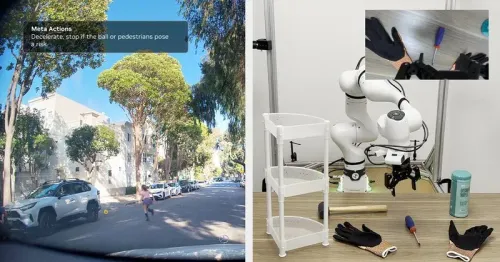
Chip giant Nvidia announced on 3 June 2026 that its research division will present three papers on physical artificial intelligence at CVPR 2026, the leading global computer vision conference. The headline contribution is GraspGen-X, described by the company as the first foundation model for zero-shot robotic grasping, trained on billions of simulated grasps.
In its post, the company said the papers 'offer groundbreaking solutions for training at scale across diverse applications', highlighting GraspGen-X as a model that generalises to objects it has never seen before without task-specific retraining.
Context
CVPR, the Conference on Computer Vision and Pattern Recognition, has been held annually since 1983 and is regarded as the premier academic venue for computer vision and machine learning research. Nvidia has been a consistent presenter at the conference over the past decade, with prior contributions spanning generative models, neural rendering and simulation.
The 2026 edition continues that pattern, but with a sharper focus on what the company terms 'physical AI' — the application of large-scale learning techniques to robots and embodied agents operating in the real world.
Policy backdrop
Foundation models, which gained prominence through large language and vision systems, are now being adapted to robotics. The central challenge is data: while text and images exist in abundance online, physical interaction data is scarce. Nvidia's approach, as reflected in GraspGen-X, leans on synthetic data generated inside high-fidelity simulators to overcome that bottleneck.
The 'zero-shot' framing is significant. A grasping model trained without exposure to a specific object, yet able to pick it up reliably, would mark a step toward general-purpose manipulation — a long-standing goal in robotics research.
Stakeholders and impact
The immediate audience is the academic and industrial robotics community. Researchers building warehouse pickers, household assistants and surgical robots have historically been constrained by the need to collect or label task-specific grasp data. A foundation model trained on billions of simulated grasps could, if it transfers cleanly to real hardware, lower that barrier substantially.
For Nvidia commercially, the work reinforces its position as both a hardware supplier and a software platform provider for robotics. The company's broader stack — including simulation environments and accelerated training infrastructure — sits underneath such research output.
Indian robotics start-ups and academic labs, several of which already build on Nvidia's developer tools, are likely to examine the release closely. Manufacturing automation, agricultural robotics and logistics are among the sectors where grasping reliability remains a practical constraint.
What's next
The remaining two papers in Nvidia Research's CVPR 2026 slate were teased but not detailed in the post. The company indicated they also address training at scale across physical AI applications.
Beyond the conference, the question for the field is whether GraspGen-X and similar foundation models translate from simulation to real-world deployment without significant performance loss — the so-called sim-to-real gap. Follow-on publications at robotics venues such as ICRA or NeurIPS will be watched for empirical benchmarks and third-party reproductions.
If the approach holds up, it could accelerate the timeline for general-purpose manipulation robots moving from laboratory demonstrations into commercial deployments across warehouses, factories and service settings.
Point of View
The company is positioning itself as the default platform for the next wave — physical and embodied AI. Branding GraspGen-X as a 'foundation model' for grasping is deliberate, borrowing the language of large language models to reframe robotics as a scaling problem. The bet is that billions of simulated interactions can substitute for scarce real-world data. Whether that transfers cleanly to factory floors and warehouses is the question that will define the next two to three years of robotics research.
NationPress
20 Oct 2026
Frequently Asked Questions
What is Nvidia GraspGen-X?
GraspGen-X is a foundation model from Nvidia Research designed for zero-shot robotic grasping. According to the company, it is trained on billions of simulated grasps and can generalise to objects it has not encountered during training.
How many papers is Nvidia presenting at CVPR 2026?
Nvidia Research is presenting three papers at CVPR 2026, all focused on physical AI and training at scale across diverse applications, with GraspGen-X being the headline contribution.
What does zero-shot grasping mean?
Zero-shot grasping refers to a robot's ability to pick up objects it has never seen during training without task-specific fine-tuning. It is a long-standing goal in robotics aimed at enabling general-purpose manipulation.
Why is Nvidia focused on physical AI?
Nvidia has expanded from graphics and generative AI into embodied and physical AI to position its GPUs and simulation platforms as the underlying infrastructure for the next generation of robotics, where large-scale simulation is increasingly central to training.