Nvidia Keynote Goes Live as Jensen Huang Takes Stage
Synopsis
Chip giant Nvidia declared its keynote live on 1 June 2026, signalling a potential major product or platform announcement. CEO Jensen Huang has historically used such events to unveil new GPU architectures. The global AI developer community, hyperscale operators, and investors are watching closely for updates to Nvidia's chip roadmap and software stack.
Key Takeaways
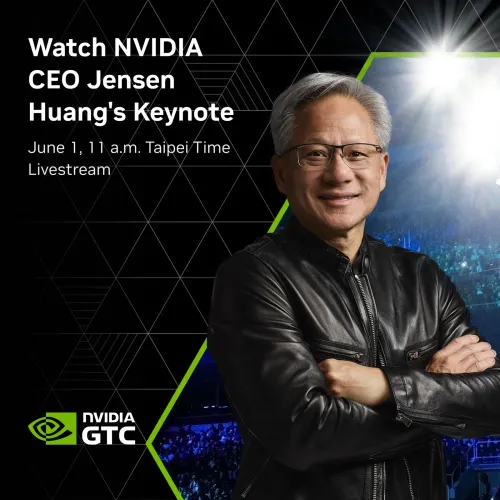
Nvidia posted that its keynote went live at 3:28 AM UTC on 1 June 2026 .
The corporate account invited followers to tune in via a video link embedded in the post.
Nvidia's keynotes have historically served as launch venues for major GPU families, including Hopper (2022) and Blackwell (2024) .
The event occurs against a backdrop of US export controls on advanced chips and rising competition from custom silicon at Google, Amazon, and Microsoft.
India's sovereign AI and data-centre ambitions make Nvidia's product roadmap announcements directly relevant to domestic technology policy.
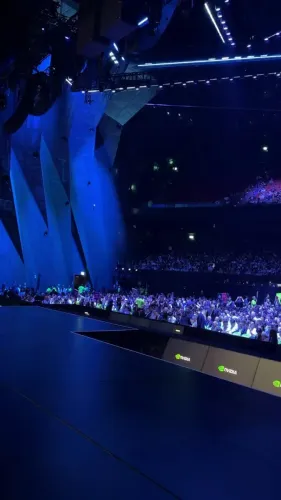
Chip giant Nvidia announced on Monday, 1 June 2026 that its keynote presentation had gone live, inviting followers and the global technology community to tune in to what the company billed as a must-watch event for AI and GPU enthusiasts worldwide.
Context
The post, published at 3:28 AM UTC on 1 June 2026, read simply: 'Keynote is live. Are you tuned in?' accompanied by a video link. The brevity of the message, paired with the company's corporate green heart emoji, is consistent with Nvidia's established practice of using social media as a real-time broadcast amplifier during major developer events.
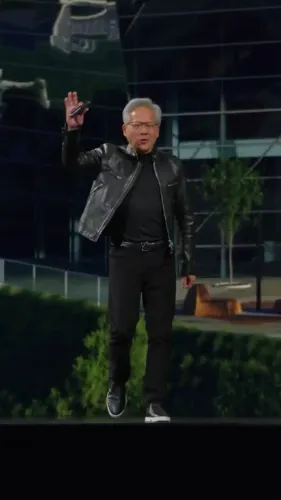
Nvidia's keynotes — almost always delivered by founder and chief executive Jensen Huang — have become landmark moments in the global semiconductor and AI calendar. Past events have served as the launchpad for successive GPU generations, including the Hopper architecture in 2022 and the Blackwell family in 2024, each of which reshaped the economics of AI training and inference at scale.
Policy Backdrop
Nvidia's product announcements do not occur in a vacuum. The company operates under a stringent regime of United States export controls that restrict the sale of its most advanced data-centre accelerators to China and certain other markets. Each new chip generation therefore carries immediate geopolitical weight, as governments and hyperscale operators worldwide assess which products they can legally procure and deploy.
Simultaneously, custom-silicon programmes at Google, Amazon, and Microsoft have intensified competitive pressure on Nvidia's dominant position in AI infrastructure. Any keynote announcement touching on next-generation architectures, software stacks such as CUDA or NIM, or new partner integrations is scrutinised against this competitive backdrop.
Stakeholders and Impact
The audience for a Nvidia keynote spans AI developers, hyperscale data-centre operators, semiconductor supply-chain partners, and institutional investors tracking the company's product roadmap. For India specifically, the announcements carry significance for domestic cloud providers, AI startups, and government-backed compute initiatives seeking access to frontier GPU capacity.
India's push to build sovereign AI infrastructure — including data-centre investments and chip-import strategies — means that any shift in Nvidia's product availability timelines or pricing tiers has downstream consequences for the country's technology ambitions. Indian enterprises and research institutions are among the fastest-growing customers for Nvidia's data-centre products globally.
What's Next
Observers will watch closely for any product availability timelines revealed during the stream, updates to Nvidia's AI software ecosystem, and signals tied to the company's upcoming earnings cycle. Partner announcements and ecosystem expansions — particularly those touching Asia-Pacific markets — will also be closely parsed by analysts and policymakers alike.
As the keynote stream continues, the technology and investment communities will be updating their assessments of Nvidia's competitive positioning in what remains the most consequential infrastructure race of the current decade.
Point of View
High-energy social post reflects a deliberate strategy of treating its developer events as cultural moments rather than mere product briefings. For India, where AI infrastructure investment is accelerating, every Nvidia architecture cycle sets the terms of what sovereign compute ambitions are practically achievable. The timing — amid active US export-control debates and intensifying competition from hyperscaler custom silicon — means the keynote carries strategic weight well beyond its product catalogue. Policymakers and enterprise buyers in India will be parsing any availability or pricing signals with unusual urgency.
NationPress
15 Oct 2026
Frequently Asked Questions
What is the Nvidia keynote on 1 June 2026 about?
Nvidia announced its keynote was live on 1 June 2026, but the specific content of the presentation has not been officially detailed in advance. Based on past events, such keynotes typically feature announcements on new GPU architectures, AI software platforms, and ecosystem partnerships delivered by CEO Jensen Huang.
Who delivers Nvidia's keynotes?
Nvidia's major keynotes are almost always delivered by founder and chief executive Jensen Huang , who uses these events to unveil new chip generations and AI platform updates.
Why do Nvidia keynotes matter for India?
India is a fast-growing market for Nvidia's data-centre products, and domestic AI infrastructure initiatives depend heavily on access to frontier GPU capacity. Any changes to product availability, pricing, or export eligibility announced at a keynote have direct implications for Indian cloud providers, startups, and government compute programmes.
What were Nvidia's previous major keynote announcements?
Nvidia used its annual developer conferences to launch the Hopper GPU architecture in 2022 and the Blackwell family in 2024 , both of which significantly expanded global AI training and inference capacity.
How do US export controls affect Nvidia's announcements?
The United States restricts the export of Nvidia's most advanced accelerators to China and certain other markets. Each new product generation is therefore assessed by governments and operators worldwide to determine which chips can be legally purchased and deployed, giving Nvidia keynotes immediate geopolitical relevance.