Nvidia, SK Group Announce $500 Billion AI Factory and Memory Pact
Synopsis
Nvidia and SK Group have announced a $500 billion-plus partnership covering a 2-gigawatt AI factory in South Korea to be built by SK Telecom and a joint next-generation HBM memory co-development programme with SK Hynix, positioning Korea as a global AI infrastructure hub.
Key Takeaways
Nvidia and SK Group announced a joint initiative valued at over $500 billion on 25 July 2026 .
SK Telecom will build a 2-gigawatt Nvidia Vera Rubin DSX AI Factory in South Korea to serve global compute demand.
SK Hynix and Nvidia will co-develop next-generation AI memory, including HBM , deepening an existing supply relationship into a co-design partnership.
South Korea has backed AI and semiconductor leadership as a national priority since its 2019 National AI Strategy .
The initiative reflects a broader global pattern of cross-border alliances to address surging demand for AI compute and memory capacity.
Implementation timelines, energy infrastructure, and HBM roadmap milestones will be the key near-term indicators of progress.
Chip giant Nvidia and South Korean conglomerate SK Group announced on Saturday, 25 July 2026 a joint initiative valued at over $500 billion, covering next-generation AI factories and advanced memory development, with South Korea positioned as a central node in global AI infrastructure.
Context
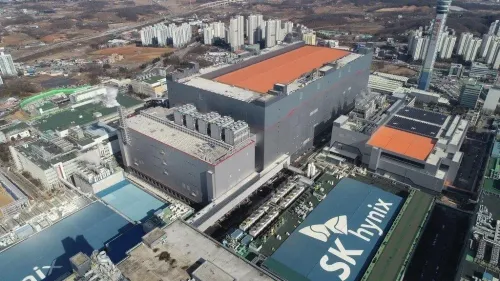
SK Telecom, South Korea's largest mobile operator, will build a 2-gigawatt Nvidia Vera Rubin DSX AI Factory in Korea designed to serve global compute demand. The facility represents one of the largest announced AI data centre projects tied to a single chip architecture. Separately, SK Hynix — the world's leading producer of high-bandwidth memory — and Nvidia will jointly develop next-generation AI memory, including HBM (High-Bandwidth Memory), which is critical to powering modern AI training clusters.
Nvidia's post stated: 'Korea is ready to become a global AI powerhouse with world-class networks and data centers, leadership in chip technology and vast industrial scale.' The announcement signals a deepening of a supply-chain relationship that has grown substantially as AI workloads have scaled.
Policy Backdrop
South Korea has pursued AI and semiconductor leadership as a national priority since at least 2019, when its government launched the National AI Strategy to channel investment into chip fabrication, data infrastructure, and AI research. SK Hynix began volume production of HBM3 memory in 2022, supplying components integral to Nvidia's GPU-based AI accelerators used in data centres worldwide.
The latest initiative extends that trajectory, moving from a supplier relationship to a co-development partnership. This shift gives South Korea a more active role in defining the architecture of next-generation AI memory, not merely manufacturing to specification.
Stakeholders and Impact
For SK Group, the deal spans two of its most strategically important subsidiaries: SK Telecom on the infrastructure and connectivity side, and SK Hynix on the silicon side. Together, they position the conglomerate as a vertically integrated AI infrastructure partner for Nvidia rather than a component vendor. The 2-gigawatt scale of the proposed AI factory underscores the enormous energy and capital requirements of frontier AI compute.
For the broader semiconductor and AI industry, the announcement reflects a wider pattern of cross-border alliances aimed at addressing surging demand for AI compute capacity. Memory has emerged as a critical bottleneck in AI system performance, making the SK Hynix–Nvidia co-development agreement particularly significant for system architects and cloud providers globally.
What's Next
Attention will now turn to implementation timelines for the Vera Rubin DSX AI Factory, the energy and grid infrastructure required to support a 2-gigawatt facility, and the technical roadmap for next-generation HBM co-developed by SK Hynix and Nvidia. Regulatory approvals, land acquisition, and power procurement in South Korea will be among the near-term milestones to watch.
If executed at the announced scale, the initiative could meaningfully shift global AI compute capacity toward East Asia, complementing existing data centre clusters in the United States and Europe and reinforcing South Korea's ambition to be a tier-one AI nation.
Point of View
If realised, would make this one of the largest single technology partnerships ever announced, reflecting the extraordinary capital intensity of the AI compute race. For policymakers in India and elsewhere, the deal is a signal that nations with strong semiconductor and network foundations are moving quickly to lock in structural roles in the global AI supply chain. Countries that lack equivalent chip or data centre assets may find themselves increasingly dependent on infrastructure built and controlled by others.
NationPress
25 Jul 2026
Frequently Asked Questions
What is the Nvidia and SK Group $500 billion AI deal about?
Nvidia and SK Group announced a $500 billion-plus initiative on 25 July 2026 covering the construction of a 2-gigawatt AI factory in South Korea by SK Telecom and a joint programme to co-develop next-generation AI memory, including HBM, with SK Hynix.
What is the Nvidia Vera Rubin DSX AI Factory?
The Vera Rubin DSX AI Factory is the name given to the planned 2-gigawatt AI compute facility that SK Telecom will build in South Korea under the partnership with Nvidia, designed to serve global AI compute demand.
What is HBM and why does it matter for AI?
HBM, or High-Bandwidth Memory, is a specialised type of chip memory that delivers very high data transfer speeds essential for AI training systems. SK Hynix is one of the world's leading HBM producers and has supplied Nvidia's AI GPUs since at least 2022.
Why is South Korea important in AI chip development?
South Korea is home to leading semiconductor manufacturers including SK Hynix and has advanced 5G networks through SK Telecom. Its government has backed AI and chip investment since the 2019 National AI Strategy, making it a key node in global AI infrastructure.
How does this Nvidia–SK Group deal affect India and other countries?
The deal signals that nations with strong chip manufacturing and network infrastructure are securing structural roles in the global AI supply chain. Countries without equivalent capabilities, including India, may need to accelerate their own semiconductor and data centre investments to remain competitive.