Nvidia Takes RTX to T1 Base Camp with Faker in Seoul
Synopsis
Nvidia's CEO Jensen Huang visited T1's Base Camp in Seoul on 9 June 2026, joining Faker for a Riot Games x RTX Spark product announcement, signed gear giveaways, and surprise fan interactions — a high-profile activation in the heart of global esports culture.
Key Takeaways
Jensen Huang visited T1's Base Camp in Seoul, South Korea on or around 9 June 2026 .
The visit included a co-branded Riot Games x RTX Spark announcement, marking a formal hardware-software partnership.
Faker (Lee Sang-hyeok), T1's marquee player and one of esports' most recognised figures, was present at the event.
Signed gear was distributed and gamers were reportedly surprised on-site, suggesting a fan-engagement component beyond the product launch.
The activation reinforces Nvidia's strategy of embedding its RTX GPU line within elite esports environments to drive consumer credibility.
South Korea's esports infrastructure — including the LCK and T1's global fanbase — makes it a priority market for Nvidia's gaming hardware division.
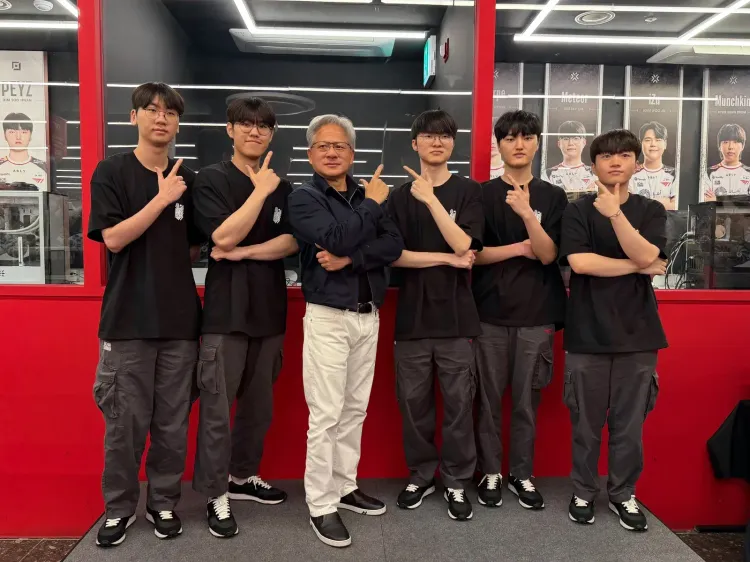
Chip giant Nvidia on Tuesday, 9 June 2026 shared a recap of a visit to T1's Base Camp in Seoul, South Korea, where CEO Jensen Huang met legendary esports player Faker (Lee Sang-hyeok) for a joint Riot Games x RTX Spark announcement, signed gear giveaways, and surprise interactions with gamers on-site.
What Happened
Nvidia's post described the event in brief but vivid terms: 'Then: @T1LoL Base Camp. Jensen + @faker. A @riotgames x RTX Spark announcement. Signed gear. Surprised gamers. Korea's gaming culture understood the assignment.' The phrasing suggests the visit was part of a curated brand activation rather than a spontaneous drop-in, with multiple planned elements — a product announcement, merchandise, and a live audience of fans.
Faker, whose real name is Lee Sang-hyeok, is widely regarded as the most decorated player in League of Legends history and serves as a central figure in T1's global brand. His presence at a hardware partnership event carries significant marketing weight in a country where professional gaming enjoys mainstream cultural status.
Context: Nvidia and the Esports Ecosystem
Nvidia has built a sustained strategy of aligning its RTX consumer GPU line with high-profile gaming titles and esports organisations. Partnerships with game developers and tournament circuits allow the company to demonstrate real-time rendering features — ray tracing, AI-assisted upscaling, and frame generation — in environments where performance is both measurable and publicly visible.
Riot Games, the Los Angeles-based developer behind League of Legends, operates one of the world's largest structured esports ecosystems, including the LCK (League Champions Korea), which is based in Seoul. A co-branded announcement between Riot and Nvidia under the RTX Spark label points to a deeper integration between the game's software pipeline and Nvidia's hardware feature set, though the precise technical details of the RTX Spark announcement have not been independently confirmed.
South Korea as a Strategic Market
South Korea has been a foundational market for competitive gaming since the late 1990s, when StarCraft broadcasts on cable television helped establish esports as a legitimate spectator sport. Today, the country hosts dedicated esports arenas, full-time professional leagues, and a fan culture that treats top players with the recognition accorded to mainstream athletes.
For Nvidia, activating in Seoul — and specifically at T1's Base Camp — signals an understanding that hardware credibility in this market is built through proximity to elite players, not just specification sheets. The 'signed gear' element and surprise fan interactions suggest the event was designed to generate organic social reach alongside the formal product announcement.
What to Watch
Industry observers will track the specifics of the Riot Games x RTX Spark integration as they are disclosed — particularly whether it involves in-game visual enhancements, frame-rate optimisations, or co-marketed hardware bundles. Follow-on activations at other major esports venues or with other T1-affiliated titles are also possible, given the scale of the organisation's global fanbase.
For the Indian gaming market, which has seen rapid growth in League of Legends viewership and RTX GPU adoption among competitive players, any software-hardware integration announced through this partnership could have downstream relevance for local tournaments and content creators.
Point of View
The company is purchasing legitimacy in the one market where GPU performance is treated as a competitive variable, not a consumer preference. The Riot Games x RTX Spark co-branding suggests the partnership goes beyond marketing into technical integration, which would give Nvidia a recurring presence inside one of the world's most-watched esports titles. For Indian observers, this matters because League of Legends viewership and RTX adoption are both growing domestically, and global partnership structures typically inform regional rollouts. The broader pattern is consistent: Nvidia is methodically converting esports credibility into hardware sales pipelines, market by market.
NationPress
23 Oct 2026
Frequently Asked Questions
What is the Riot Games x RTX Spark announcement?
The Riot Games x RTX Spark announcement is a co-branded partnership between Nvidia and Riot Games, the developer of League of Legends, unveiled at T1's Base Camp in Seoul on 9 June 2026. The precise technical details — such as in-game optimisations or bundled hardware — have not yet been fully disclosed publicly.
Who is Faker and why is he important for Nvidia?
Faker, whose real name is Lee Sang-hyeok, is a professional League of Legends player for T1 and is widely considered the greatest player in the game's history. His association with Nvidia's RTX brand gives the partnership significant credibility among competitive gamers globally, including in India.
What is T1 Base Camp?
T1 Base Camp is the training and content facility of T1, South Korea's most prominent esports organisation, known for multiple League of Legends World Championship titles. It serves as a hub for player practice, fan engagement, and brand activations.
How does this Nvidia esports partnership affect Indian gamers?
While the activation took place in Seoul, Nvidia's RTX Spark integration with Riot Games could influence software features and hardware bundles available in India, where League of Legends viewership and RTX GPU adoption among competitive players have been growing steadily.
What is Nvidia's RTX technology?
Nvidia's RTX is a line of consumer and professional graphics processing units featuring real-time ray tracing, AI-assisted upscaling (DLSS), and frame generation technologies. It is widely used by competitive gamers and content creators for high-performance visual rendering.