Nvidia Uses Its Own AI Speech Model to Speed Up Global Marketing
Synopsis
Nvidia has revealed that its internal Digital Marketing team built an AI-powered localisation platform using NVIDIA Nemotron Speech, targeting the translation queues and custom integration delays that slow global campaigns. The move signals real-world enterprise deployment of Nvidia's own speech AI stack.
Key Takeaways
Nvidia's Digital Marketing team built an AI-powered localisation platform using NVIDIA Nemotron Speech , announced on 28 July 2026 .
The platform targets two specific pain points: translation queues and custom integrations that delay international product launches.
NVIDIA Nemotron is Nvidia's own family of enterprise-grade large language and speech models.
The announcement represents internal 'eat your own cooking' adoption of Nvidia's AI infrastructure by the company itself.
No independently verified performance benchmarks from the linked results page are available from training data.
Further enterprise AI disclosures are expected at Nvidia's GTC conference series.
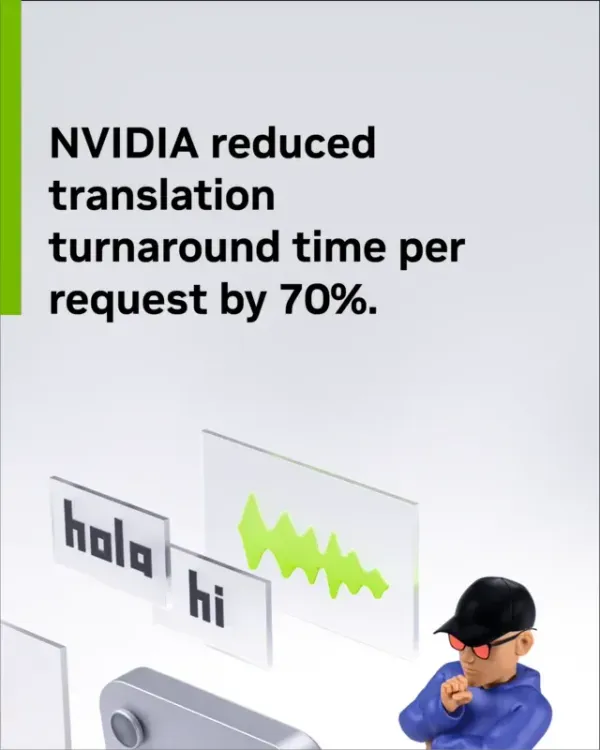
Chip giant Nvidia announced on Tuesday, 28 July 2026 that its internal Digital Marketing team has built an AI-powered localisation platform using NVIDIA Nemotron Speech, aimed at eliminating the translation queues and custom integration bottlenecks that slow international product launches.
The company shared the development on its official corporate X account, noting that 'translation queues and custom integrations can slow global launches' and that the new platform was built specifically to address that friction. The post directed followers to a linked results page for further detail.
Context
NVIDIA Nemotron is Nvidia's family of large language and speech models designed for enterprise-grade generative AI tasks. By deploying Nemotron Speech internally, Nvidia is using its own AI infrastructure stack — the same technology it sells to enterprise customers — to solve a real operational problem inside the company.
Localisation in global marketing typically involves translating text, adapting audio, and syncing content across multiple regional workflows. Each step traditionally requires third-party vendors or bespoke integrations, creating delays that compress launch windows in competitive markets.
Policy Backdrop
The move is consistent with a broader industry pattern in which technology companies are turning to proprietary generative AI systems to reduce dependence on external service providers and compress time-to-market for global campaigns. For Nvidia, whose products underpin much of the world's AI compute infrastructure, demonstrating internal adoption carries additional weight as a proof-of-concept signal to enterprise buyers.
The disclosure also arrives as AI localisation tools are drawing increased attention from global marketing and product teams seeking to scale content across languages without proportional increases in headcount or vendor spend.
Stakeholders and Impact
The primary beneficiaries of the platform, as described by Nvidia, are digital marketing teams and global product launch teams that manage multi-language content pipelines. By automating or accelerating the localisation layer, such teams can theoretically reduce the lag between an English-language campaign and its regional equivalents.
For Nvidia's enterprise customers watching the company's own AI adoption, the announcement functions as a live case study. It reinforces the company's positioning that Nemotron-family models are production-ready for complex, real-world workflows — not just benchmarks.
What's Next
Nvidia has not disclosed a public rollout timeline for the platform or shared independently verifiable performance benchmarks in the post itself. Further detail on enterprise AI tool adoption is expected to surface at Nvidia events such as GTC, where the company routinely presents applied AI use cases alongside product announcements.
As competition in AI-driven localisation intensifies, Nvidia's decision to build on its own speech models rather than licence external solutions could prompt other large technology firms to similarly audit their internal AI toolchains and accelerate in-house deployment of proprietary models.
Point of View
Public disclosure of in-house adoption directly reinforces Nvidia's enterprise sales narrative. The move also fits a wider pattern of hyperscalers and chip companies vertically integrating AI toolchains to reduce third-party dependencies and demonstrate real-world ROI. For Indian technology and marketing teams evaluating AI localisation vendors, Nvidia's public case study will likely add credibility pressure on competing platforms to disclose comparable benchmarks.
NationPress
28 Jul 2026
Frequently Asked Questions
What is NVIDIA Nemotron Speech?
NVIDIA Nemotron Speech is part of Nvidia's Nemotron family of large language and speech models built for enterprise generative AI tasks, used here to power an internal marketing localisation platform.
Why did Nvidia build its own AI localisation platform?
Nvidia built the platform to eliminate translation queues and custom integration delays that slow global product and marketing launches, using its own Nemotron Speech model rather than third-party services.
What does Nvidia's AI localisation tool do?
The tool automates or accelerates the process of adapting marketing content across languages, reducing the time between an original campaign and its regional versions.
Is this Nvidia product available to other companies?
The post describes an internal platform built by Nvidia's own Digital Marketing team; no public commercial availability for the specific localisation platform has been announced.
Where can I see the results of Nvidia's AI localisation platform?
Nvidia linked to a results page in its official post on X; independently verified performance data from that page is not available in current public training data.