China's foldable pontoon barge rescues 6,000 in Guangxi floods

Synopsis
A foldable, self-propelled pontoon barge deployed by state-owned China Anneng Construction Group evacuated more than 6,000 people from a flooded college campus in Guangxi in under 24 hours — a feat conventional inflatable boats could not achieve.
Key Takeaways
China Anneng Construction Group deployed three foldable, self-propelled pontoon barges to Guigang , Guangxi , starting Wednesday, 9 July 2026 .
More than 6,000 staff and students were trapped at the Guangxi Logistics Vocational and Technical College by floodwaters nearly 5 metres deep.
Each barge measures 60 metres long and 8 metres wide, with a load capacity exceeding 60 tonnes and a single-trip capacity of more than 500 people .
The full evacuation was completed by midday on Thursday, 10 July 2026 , according to state broadcaster CCTV .
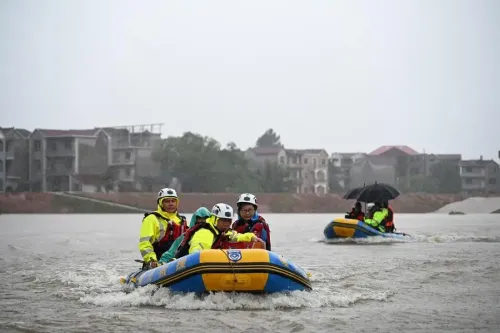
Before the barges arrived, rescuers relied on inflatable and assault boats, which could extract only a small number of people per trip.
China Anneng Construction Group deployed foldable, self-propelled pontoon barges to rescue more than 6,000 staff and students trapped by floodwaters at the Guangxi Logistics Vocational and Technical College in Guigang, Guangxi Zhuang autonomous region, marking one of the most significant applications of the emerging rescue technology in southern China's ongoing flood disaster.
What the pontoon barge can do
The vessel deployed in the Guigang operation measures approximately 60 metres long and 8 metres wide, with a total load capacity exceeding 60 tonnes, according to China Anneng. In a single trip, it can transport more than 500 people — a throughput that conventional inflatable and assault boats cannot approach.
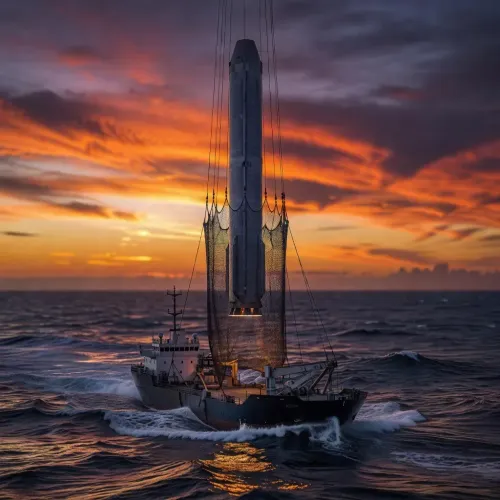
The barge functions simultaneously as a boat, a bridge, and a life raft, giving rescue coordinators flexibility in environments where floodwaters block both road and river access. China Anneng described the vessel's capabilities in a post on Zhihu, China's question-and-answer platform.
Why it matters
Before the barges arrived at the college campus, rescuers were extracting only a small number of survivors per trip using standard inflatable boats, according to reports. Floodwaters at the site reached nearly 5 metres (16.4 feet) deep, cutting off the entire campus population.
China Anneng deployed three of the heavy-duty barges from last Wednesday night through Thursday, 10 July 2026. By midday on Thursday, all students and teachers had been evacuated to dry ground, state broadcaster CCTV reported.
The competitive backdrop
China Anneng Construction Group is a state-owned emergency rescue force, and the pontoon barge programme reflects broader investment by China's state apparatus in purpose-built disaster-response equipment. The vessel's design — foldable and self-propelled — allows rapid deployment to sites where conventional heavy equipment cannot reach.
State news agency Xinhua confirmed the scale of the Guigang operation, describing it as one of the largest single rescue actions in the current flooding cycle across Guangxi.
What's next
Flooding across southern China remains active, and authorities have not indicated whether additional pontoon barge units will be pre-positioned ahead of further rainfall. The performance of the technology in Guigang is likely to inform procurement and deployment doctrine for future large-scale flood responses across the region.
Point of View
High-capacity rescue platforms into its state emergency infrastructure — moving well beyond ad-hoc improvisation. This mirrors the country's pattern of converting large-scale disaster events into field trials for next-generation civil-military equipment, compressing the gap between prototype and operational deployment. What mainstream coverage underplays is the logistics doctrine shift: a single 500-person-per-trip vessel changes the calculus of mass-casualty flood response in ways that helicopters and small boats cannot replicate at scale. Other flood-prone nations in Southeast and South Asia will be watching closely.
NationPress
13 Oct 2026
Frequently Asked Questions
What is the China pontoon barge used in the Guangxi flood rescue?
It is a foldable, self-propelled pontoon barge deployed by China Anneng Construction Group that functions as a boat, bridge, and life raft simultaneously. The unit used in Guigang is 60 metres long, 8 metres wide, carries over 60 tonnes, and can transport more than 500 people per trip.
How many people were rescued at the Guangxi Logistics Vocational and Technical College?
More than 6,000 staff and students were evacuated from the college campus in Guigang, Guangxi Zhuang autonomous region. Three pontoon barges operated from Wednesday night through Thursday midday to complete the evacuation, according to state broadcaster CCTV.
Who operates the self-propelled pontoon barge in China?
China Anneng Construction Group, a state-owned emergency rescue organisation, deployed and operated the barges during the Guangxi flood response. The group described the vessel's specifications in a post on Zhihu.
Why is the pontoon barge better than inflatable boats for flood rescue?
Conventional inflatable and assault boats can carry only a small number of people per trip, making large-scale evacuations extremely slow. The pontoon barge can move more than 500 people in a single crossing, dramatically compressing the time needed to evacuate thousands of stranded individuals.
How deep were the floodwaters in Guigang, Guangxi?
Floodwaters at the Guangxi Logistics Vocational and Technical College in Guigang reached nearly 5 metres (16.4 feet) deep, according to state news agency Xinhua. That depth rendered road access impossible and overwhelmed the capacity of smaller rescue craft.