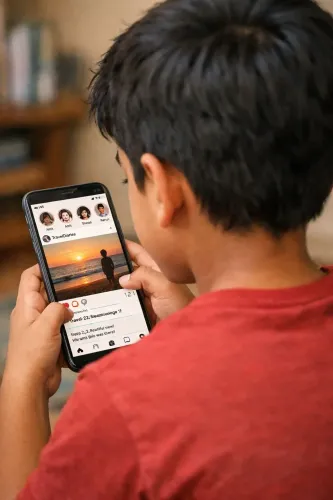
Could New Child Protection Laws Compromise Privacy?

Synopsis
Child-safety technologist Stephen Antony Venansious warns that new protective laws could inadvertently put minors at risk by necessitating invasive data collection. He advocates for methods that prioritize privacy without compromising safety, urging a shift in focus from age verification to preventing harmful online behavior.
Key Takeaways
Child safety laws may introduce new risks.
Invasive age-verification could compromise privacy .
On-device analysis is a viable alternative for behavior detection .
Global legislation varies but aims to protect minors.
Balancing safety and privacy rights is essential for effective protection.
Kollam, Dec 12 (NationPress) Child-safety expert Stephen Antony Venansious has raised alarms about the potential dangers posed by new child-protection regulations, which may require invasive age-verification and data collection from minors.
"When we compel a child to provide their face or identity just to engage in online activities, we have fundamentally failed them," he stated, emphasizing that protective measures should not infringe upon children's privacy.
Venansious has pioneered a system that identifies grooming and abusive behavior through on-device analysis, bypassing the need for biometric checks or centralized data storage.
This tool is available as an Application Programming Interface for gaming, educational, and social media platforms, allowing it to flag risky interactions without requiring children to submit photographs, identity documents, or other sensitive data.
He argues that the ongoing global discussion is overly fixated on confirming children's identities rather than preventing harmful behaviors online.
His comments come in the wake of numerous child-safety laws being enacted worldwide.
In the United States, proposed federal regulations may mandate platforms to verify the age of nearly all users.
Apple's CEO Tim Cook has expressed his concerns, cautioning that these initiatives could compel companies to collect extensive sensitive documents from underage individuals.
Australia is contemplating nationwide restrictions on social media usage for those under 16, while states such as Texas and Utah in the US are pushing similar legislation, raising alarms about potential surveillance and misuse of data.
India is experiencing similar challenges.
A report supported by NITI Aayog documented a 32 percent increase in cybercrimes targeting children from 2021 to 2022, underscoring the rising risks of cyberbullying, predatory behavior, and violations of privacy.
The report highlighted that children are spending more time online, even as parental digital literacy remains inconsistent.
In a statement issued on December 9, Unicef also cautioned that blanket bans and stringent age-based filters might backfire, potentially driving children into unregulated online environments.
It contended that effective child protection must focus on safer platform designs, enhanced content moderation, and improved digital literacy, all while respecting children's rights to privacy and participation.
As governments continue to implement new regulations, there is a growing call for regulators to balance the urgency for enhanced online safety with the need to prevent child protection from evolving into a new form of surveillance.
Venansious insists that the priority must be clear: "Our mission is to safeguard childhood without converting children into data points and to demonstrate that safety and privacy can coexist."
Point of View
It's crucial to recognize the duality of child protection and privacy rights. While the intention behind new legislation is commendable, we must ensure that these measures don't morph into unwarranted surveillance. The discourse should pivot towards innovative solutions that safeguard children without compromising their personal information.
NationPress
26 Sept 2026
Frequently Asked Questions
What are the main concerns regarding child protection laws?
Experts warn that new laws may lead to intrusive data collection and age verification, risking children's privacy.
How does Venansious's system work?
His system detects grooming and abusive behavior through device analysis without collecting sensitive data from children.
What are the global implications of this issue?
Countries worldwide are grappling with balancing child safety and privacy, with various legislative efforts underway.
What has UNICEF stated about these measures?
UNICEF warns that blanket bans could push children into unregulated online spaces, countering the intent of safety measures.
How can child safety be improved without invading privacy?
By focusing on safer platform designs, better content moderation, and enhancing digital literacy without compromising children's rights.