China's NORINCO lab unveils Xiaoyuan, a wheeled-legged robot guide dog
Synopsis
A NORINCO-affiliated defence research lab in Hangzhou has unveiled Xiaoyuan, billed as the world's first wheeled-and-legged robot guide dog, at a Beijing expo — a striking example of China's defence-industrial complex pivoting advanced robotics toward civilian disability support.
Key Takeaways
Zhiyuan Research Institute , linked to defence giant NORINCO , launched the Xiaoyuan robot guide dog on 4 September 2026 in Beijing .
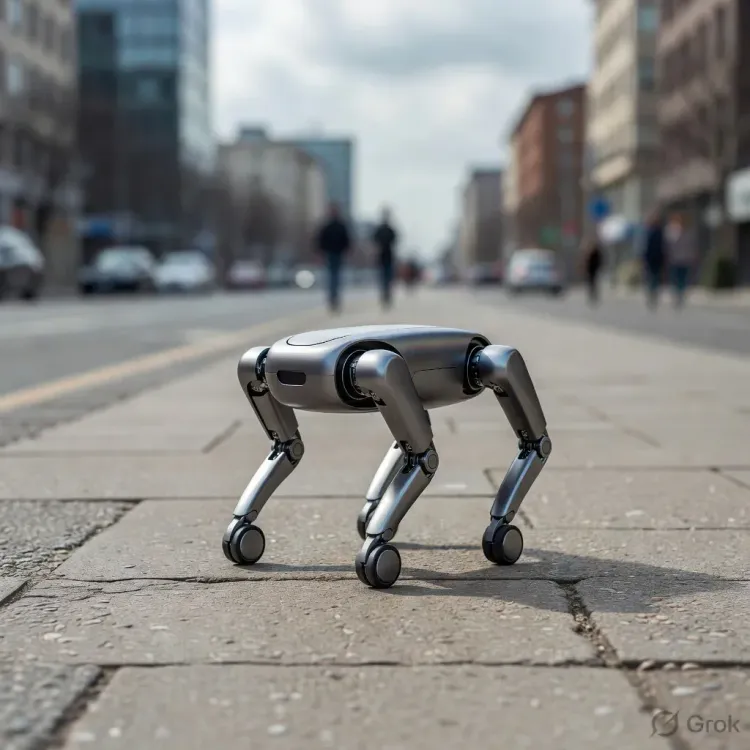
The robot uses a hybrid wheeled-and-legged design: wheels for flat terrain, four legs for stair navigation.
Outdoor positioning accuracy is within 30 centimetres ; obstacle-avoidance success rates are at least 99% indoors and 96% outdoors , according to the institute.
Xiaoyuan connects to disability federation systems, an accessibility map, and a remote volunteer assistance portal.
No commercial release date or pricing has been announced; the launch was part of the China Care and Rehabilitation Expo .
Hangzhou-based Zhiyuan Research Institute, affiliated with China North Industries Group (NORINCO) — China's largest defence contractor — has unveiled what it describes as the world's first wheeled-and-legged robot guide dog for visually impaired users. The robot, named Xiaoyuan, was launched on Friday, 4 September 2026, at the China Care and Rehabilitation Expo in Beijing, marking a notable pivot by a major defence-linked research body into assistive civilian technology.
Why it matters
The launch underscores a widening trend of China's defence-industrial complex channelling robotics and AI capabilities toward consumer and social welfare applications. Guide dogs remain scarce across China: the China Association of Persons with Visual Disabilities has long flagged a severe shortage of trained animals relative to the country's estimated tens of millions of visually impaired citizens. Xiaoyuan is positioned as a scalable technological alternative.
How Xiaoyuan works
The robot uses a hybrid locomotion system — wheels for quiet, efficient travel on flat surfaces and four legs for stair-climbing — a design the institute says preserves the acoustic environment that visually impaired users depend on. It can detect overhead hazards such as low-hanging branches that conventional white canes cannot flag, according to the institute.
On precision, Xiaoyuan delivers centimetre-level outdoor positioning with an error margin of fewer than 30 centimetres. Its obstacle-avoidance success rate is stated at a minimum of 99 per cent indoors and 96 per cent outdoors, according to the institute.
Connectivity and support ecosystem
Xiaoyuan integrates with a suite of services including disability federation systems, an accessibility map, and a remote volunteer assistance portal, allowing users to summon human help when the robot reaches its operational limits. This layered connectivity distinguishes it from standalone assistive devices and positions it within a broader smart-city accessibility infrastructure.
The competitive backdrop
The assistive robotics segment is attracting growing interest globally, with startups and research labs in the United States, Europe, and Japan pursuing similar quadruped and wheeled platforms. Zhiyuan Research Institute's defence pedigree gives it access to ruggedised sensor stacks and navigation algorithms typically reserved for military applications — a potential edge in reliability benchmarks. Whether Xiaoyuan reaches commercial production and at what price point remains to be disclosed.
What's next
No commercial launch timeline or pricing has been announced. The expo debut is likely the beginning of a broader certification and pilot-deployment process. Observers will watch whether NORINCO's civilian robotics push accelerates amid China's broader policy emphasis on eldercare and disability-support technology through 2026 and beyond.
Point of View
Institutions like NORINCO's research arms can justify continued state investment and signal societal relevance beyond military procurement. What mainstream coverage tends to underplay is the data dimension: a deployed fleet of guide robots navigating real urban environments would generate invaluable high-density mapping and sensor-fusion data, directly feeding back into autonomous systems with far broader applications. The 99% indoor obstacle-avoidance claim is impressive on paper, but the critical test will be real-world edge cases — crowded markets, construction zones, monsoon-season pavements — where the gap between lab benchmarks and field reliability tends to widen sharply.
NationPress
4 Sept 2026
Frequently Asked Questions
What is the Xiaoyuan robot guide dog?
Xiaoyuan is a hybrid wheeled-and-legged robot designed to assist visually impaired people navigate independently. It was developed by Zhiyuan Research Institute in Hangzhou , an affiliate of defence contractor NORINCO , and unveiled on 4 September 2026 at the China Care and Rehabilitation Expo in Beijing .
Why did a defence research institute build a guide dog robot?
Zhiyuan Research Institute is affiliated with China North Industries Group (NORINCO) , China 's largest defence contractor, which has been expanding into civilian applications. The move reflects a broader push by defence-linked research bodies to demonstrate social utility and leverage advanced robotics capabilities — including navigation and sensor fusion — for non-military markets.
How accurate is the Xiaoyuan robot guide dog?
According to the institute, Xiaoyuan achieves outdoor positioning accuracy within 30 centimetres and an obstacle-avoidance success rate of at least 99 per cent indoors and 96 per cent outdoors . It can also detect overhead hazards such as low-hanging branches that standard white canes cannot identify.
When will Xiaoyuan be available to buy?
No commercial availability date or pricing has been announced as of the 4 September 2026 expo launch. The debut appears to be an initial public showcase; a certification and pilot-deployment process would typically follow before any retail release.
How does Xiaoyuan compare to a real guide dog?
Xiaoyuan is designed to address a well-documented shortage of trained guide dogs in China . Unlike a live animal, it connects to digital services — including an accessibility map and a remote volunteer assistance portal — offering a scalable, tech-integrated alternative. However, real-world performance in complex urban environments has yet to be independently verified.