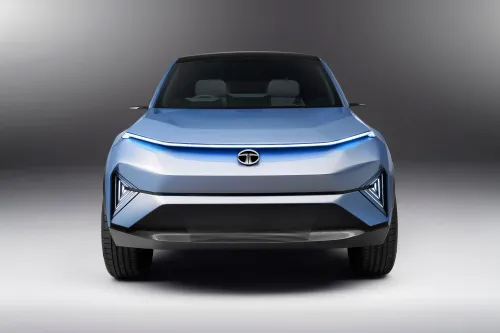
Tata Motors to hike PV prices up to 1.5% from July 1, EVs included

Synopsis
Tata Motors is raising prices by up to 1.5% across its full passenger vehicle range — including EVs — from 1 July, joining Hyundai, Maruti Suzuki, and M&M in a wave of industry-wide hikes driven by rising input costs. For EV buyers especially, the clock is ticking before the new prices kick in.
Key Takeaways
Tata Motors Passenger Vehicles (TMPV) announced a price hike of up to 1.5% effective 1 July .
The revision covers both ICE and electric vehicle (EV) models across all variants.
The company cited rising input costs and inflationary pressures as the key reasons, noting it continues to absorb a significant share internally.
Hyundai Motor India (up to ₹12,800 ) and Maruti Suzuki India (up to ₹30,000 ) have also raised prices from June ; M&M revised prices earlier this year.
TMPV shares traded higher at ₹385.60 on the BSE following the announcement.
Tata Motors Passenger Vehicles (TMPV) will raise prices by up to 1.5% across its entire passenger vehicle portfolio — covering both internal combustion engine (ICE) and electric vehicle (EV) models — effective 1 July. The company disclosed the revision through a stock exchange filing on Friday, 12 June, citing rising input costs and sustained inflationary pressure as the primary drivers.
What the Price Hike Covers
The increase will apply across all models and variants in TMPV's lineup, though the exact quantum will differ by model. The company stated that the revision has been calibrated to preserve the overall value proposition of its products even as cost pressures mount. Notably, TMPV said it continues to absorb a significant portion of the cost escalation internally, passing only a part of the burden on to buyers.
Why Tata Motors Is Raising Prices
According to the automaker, the hike is aimed at partially offsetting the impact of rising input costs and continued inflationary pressures — a challenge that has squeezed margins across the automotive sector. The inclusion of EVs in the revision is notable, as manufacturers have historically been cautious about raising prices on electric models given the segment's price sensitivity and ongoing adoption push.
Industry-Wide Trend
The move places Tata Motors alongside a growing list of automakers that have resorted to calibrated price increases in recent months. Hyundai Motor India announced a hike of up to ₹12,800 across its model range from June, attributing it to rising input costs, elevated commodity prices, and higher operational expenses. Maruti Suzuki India also announced a price increase of up to ₹30,000 across its portfolio from June, citing sustained input cost increases. Mahindra and Mahindra (M&M) had revised prices for its SUV and commercial vehicle range earlier this year. This marks a broad-based industry recalibration rather than a company-specific decision.
Market Reaction
Following the announcement, shares of TMPV traded higher at ₹385.60 on the Bombay Stock Exchange (BSE), suggesting investors viewed the pricing action as a margin-protective measure rather than a demand risk. The market's muted-to-positive response reflects a wider acceptance that automakers have limited room to keep absorbing cost inflation without adjusting sticker prices.
With the July revision now confirmed, prospective buyers of Tata vehicles — including popular EV models — may look to close purchases before the end of June to avoid the higher outlay.
Point of View
But the more significant detail is that EVs are not being spared — a signal that the company no longer sees price insulation as a viable EV growth strategy. With Hyundai, Maruti, and M&M all moving in the same direction within weeks of each other, this is less a Tata decision and more a sector-wide admission that input cost absorption has hit its ceiling. The risk is cumulative: each incremental hike nudges entry-level buyers toward the used-car market or deferred purchases, potentially softening volume growth in H2. Whether margins actually improve will depend on whether demand holds — and on commodity price trajectories that remain outside any automaker's control.
NationPress
26 Sept 2026
Frequently Asked Questions
What is the Tata Motors price hike from July 2025?
Tata Motors Passenger Vehicles (TMPV) will increase prices by up to 1.5% across its passenger vehicle portfolio, including both ICE and EV models, effective 1 July. The exact increase will vary by model and variant.
Why is Tata Motors increasing car prices?
The company has cited rising input costs and continued inflationary pressures as the primary reasons. TMPV stated it is absorbing a significant portion of cost escalation internally and passing only part of the increase to customers.
Are Tata Electric Vehicles also affected by the price hike?
Yes. The price revision covers Tata Motors' full passenger vehicle range, including its electric vehicle models. This makes the hike notable given EVs' price sensitivity and the ongoing push to grow EV adoption in India.
Which other automakers have raised prices recently?
Hyundai Motor India raised prices by up to ₹12,800 from June, Maruti Suzuki India increased prices by up to ₹30,000 from June, and Mahindra and Mahindra revised prices for its SUV and commercial vehicle range earlier this year — all citing input cost pressures.
How did the market react to Tata Motors' price hike announcement?
Shares of TMPV traded higher at ₹385.60 on the BSE following the announcement, indicating that investors viewed the pricing action positively as a margin-protection measure.