China says US lab sought to buy superconducting magnet 40% superior to its own
Synopsis
In a striking reversal, the US Department of Energy's Brookhaven National Laboratory — once the world leader in superconducting magnets — reportedly sought to buy a Chinese-made magnet that Beijing claims beats American technology by 40%, after China spent 13 years developing it independently.
Key Takeaways
Brookhaven National Laboratory , a US Department of Energy facility, reportedly contacted China's Institute of High Energy Physics in May 2025 to purchase a combined superconducting magnet.
The Chinese magnet, used in the Beijing Electron-Positron Collider (BEPCII) upgrade, reportedly outperforms comparable American technology by 40% .
China's Institute of High Energy Physics spent 13 years developing the magnet to reduce reliance on foreign suppliers, according to researcher Zhu Yingshun .
Brookhaven National Laboratory was previously described as having 'monopolised' this category of superconducting magnet technology, per Science and Technology Daily .
There is no public confirmation that the US laboratory has acquired the magnet, and any transfer would carry significant geopolitical implications.
Chief collider operator Yu Chenghui stated China can 'consistently win' in competition with the world's best in cutting-edge basic science.
The US Department of Energy's Brookhaven National Laboratory — once the global benchmark in superconducting magnet technology — reportedly approached China's Institute of High Energy Physics in May 2025 seeking to purchase a Chinese-made combined superconducting magnet that Beijing claims outperforms American equivalents by 40%. The disclosure, made by Science and Technology Daily, a publication run by China's science ministry, signals a striking reversal in a field where the United States long held an unchallenged lead.
The magnet at the centre of the story
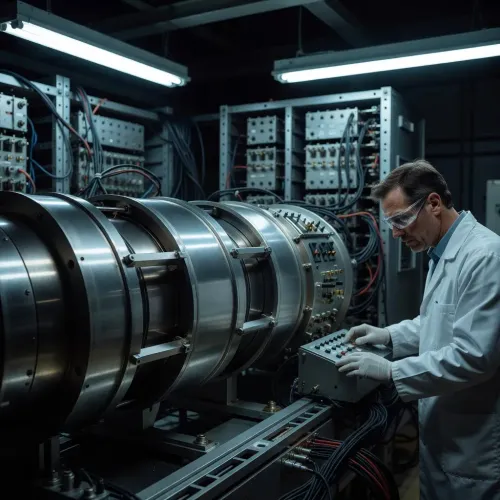
The device in question is a combined superconducting magnet of the type deployed in the Beijing Electron-Positron Collider's (BEPCII) latest upgrade. According to Science and Technology Daily, Brookhaven National Laboratory once 'monopolised' this category of specialised hardware before reaching out to its Chinese counterpart. There has been no public indication that the US laboratory has successfully acquired the magnet.
Thirteen years to independence
'To break free from our dependence on others as soon as possible, we spent 13 years developing the world's best combined superconducting magnet,' Zhu Yingshun, a researcher at the Institute of High Energy Physics, told the newspaper. The remark underscores how China's push for self-sufficiency in advanced scientific instrumentation — accelerated by US export controls on semiconductors and other critical technologies — has begun yielding tangible results in basic-science infrastructure.
Why it matters
Superconducting magnets are foundational to particle accelerators, MRI machines, fusion reactors, and next-generation quantum computing hardware. A Chinese edge in this domain carries implications well beyond the Beijing Electron-Positron Collider, touching defence, medical technology, and the global race to build practical fusion energy systems. Yu Chenghui, chief operator of the collider, told the newspaper: 'We have proven that the Chinese are capable of competing head-to-head with the world's best in cutting-edge fields of basic science, and can consistently win.'
The competitive backdrop
The episode arrives as Washington and Beijing remain locked in a broad technology rivalry spanning semiconductors, artificial intelligence, and advanced materials. China's official media has amplified the story as evidence that US-led export restrictions have inadvertently accelerated domestic innovation rather than containing it. The Institute of High Energy Physics sits within the Chinese Academy of Sciences and oversees some of the country's most ambitious particle-physics programmes, including research connected to the Standard Model and the search for exotic particles such as the glueball.
What's next
Whether Brookhaven National Laboratory will ultimately secure the magnet — or whether Chinese authorities will permit the transfer given current geopolitical tensions — remains an open question. The outcome could set a precedent for how dual-use scientific hardware flows between the two superpowers. Analysts and policymakers on both sides will be watching for any formal export-licensing decision from Beijing.
Point of View
Washington may have catalysed exactly the indigenous capability it sought to prevent. Superconducting magnets are dual-use at their core, with applications spanning fusion energy, quantum hardware, and advanced medical imaging, meaning a Chinese lead here is strategically significant far beyond particle physics. Mainstream coverage tends to frame the tech rivalry through semiconductors and AI, but foundational scientific instrumentation — the hardware that enables discovery — is an equally contested and underreported front. The real test will be whether Beijing allows the transfer to Brookhaven, a decision that would reveal how China weighs scientific diplomacy against the leverage that technological superiority now affords it.
NationPress
26 Sept 2026
Frequently Asked Questions
Why did Brookhaven National Laboratory want to buy a Chinese superconducting magnet?
Brookhaven National Laboratory reportedly approached China's Institute of High Energy Physics in May 2025 because the Chinese-made combined superconducting magnet — used in the Beijing Electron-Positron Collider upgrade — is claimed to outperform comparable US technology by 40%. The US lab, once considered the global leader in this technology, has not confirmed the approach publicly.
What is the Beijing Electron-Positron Collider and why does it matter?
The Beijing Electron-Positron Collider (BEPCII) is a particle accelerator operated by China's Institute of High Energy Physics under the Chinese Academy of Sciences. It is used to study fundamental particles and phenomena related to the Standard Model of physics, including research into exotic particles such as the glueball.
Has the US laboratory successfully acquired the Chinese magnet?
No. As of the reporting date, there is no public indication that Brookhaven National Laboratory has acquired the magnet. Any transfer would likely require approval from Chinese authorities and could face scrutiny given current US-China technology tensions.
How long did China take to develop this superconducting magnet?
China spent 13 years developing the combined superconducting magnet, according to Institute of High Energy Physics researcher Zhu Yingshun. The goal was to eliminate dependence on foreign suppliers for this class of advanced scientific hardware.
What does this development mean for the US-China technology rivalry?
It signals that China has achieved a leadership position in at least one category of advanced scientific instrumentation that the United States previously dominated. The episode illustrates how China's push for self-reliance — partly driven by US export controls — has produced competitive breakthroughs in foundational technology with broad applications in energy, defence, and medicine.