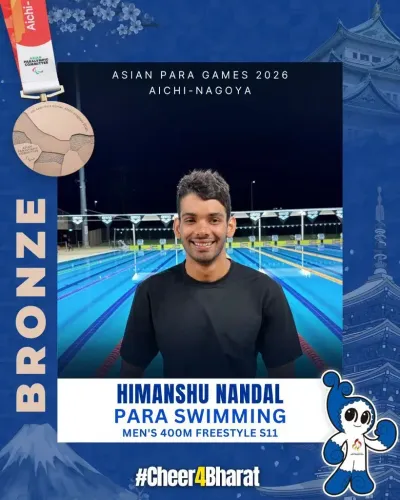
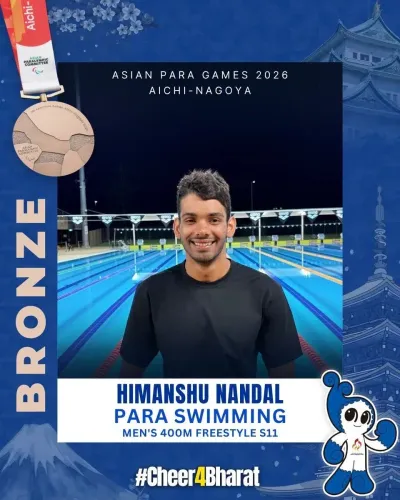
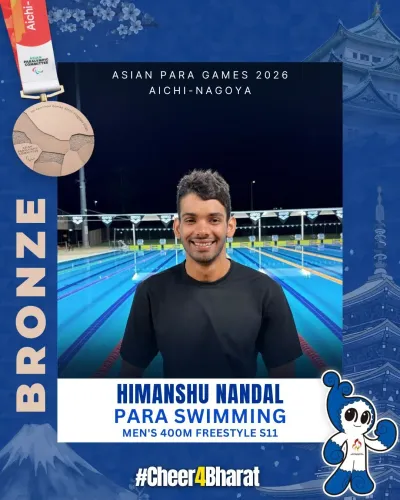
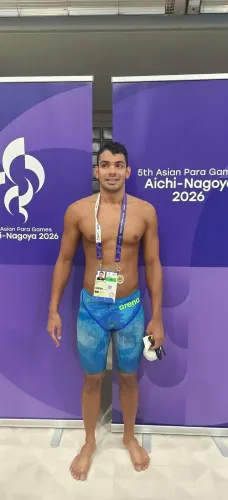
Asian Para Games 2026: Himanshu Nandal wins hat-trick of bronze medals in Nagoya
Synopsis
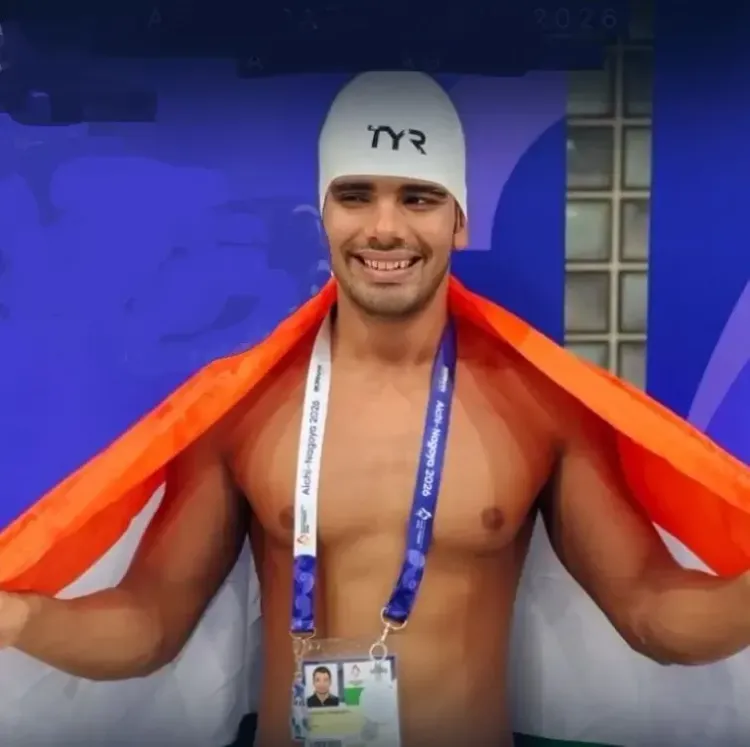
Blind para-swimmer Himanshu Nandal turned a crushing fourth-place finish in his favourite event into fuel — winning three bronzes in Nagoya across the 400m freestyle, 100m breaststroke and 100m freestyle. The 22-year-old from Haryana, the first Indian blind swimmer to qualify for the Paris Paralympics, is now chasing personal bests as his next stepping stone to gold.
Key Takeaways
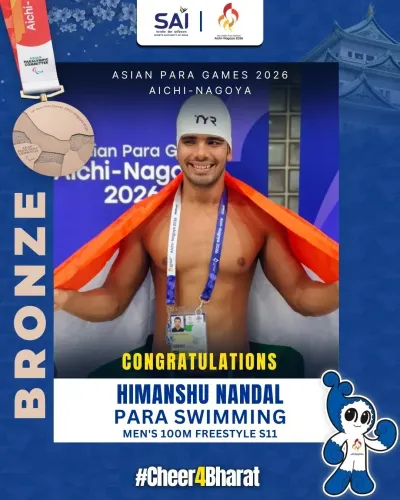
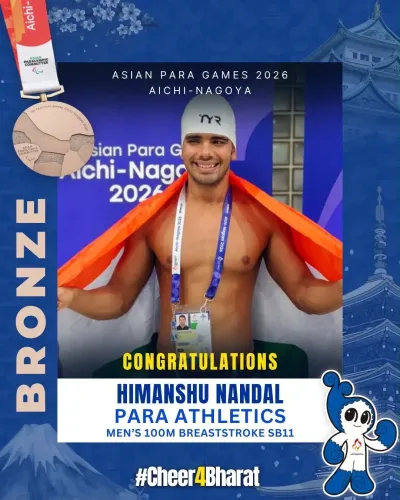
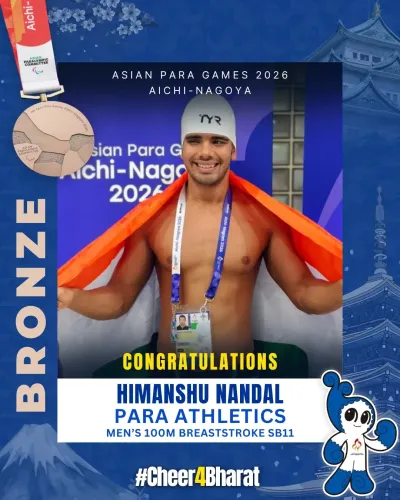
Himanshu Nandal won three bronze medals at the Asian Para Games 2026 in Aichi-Nagoya, Japan .
Medals came in the men's 400m freestyle S11 , 100m breaststroke S11 , and 100m freestyle S11 .
His final bronze on Friday came in a time of 1 min 5.90 sec ; Japan's Uchu Tomita won gold in a Games-record 58.22 sec .
Nandal, 22 , is blind from birth due to optic nerve failure and began competitive swimming only in 2021 after a national-level judo career.
He became the first Indian blind swimmer to achieve the Minimum Qualification Standard for the Paris Paralympics in 2024 .
Nandal is a political science graduate from Atma Ram Sanatan Dharma College, Delhi University , and is eyeing a postgraduate course in sports management.
Indian para-swimmer Himanshu Nandal completed a hat-trick of bronze medals at the Asian Para Games 2026 in Aichi-Nagoya, Japan, bouncing back from the heartbreak of a fourth-place finish in the men's 100m backstroke — an event he had targeted for two years. The 22-year-old, who competes in the S11 classification for visually impaired swimmers, emerged as one of India's standout para-swimming performers at the Games.
The Disappointment That Drove the Comeback
The backstroke miss cut deep. Nandal had built his campaign around that race, only for his body to, as he put it, simply not 'switch on' on the day. 'The 100m backstroke was one of my main events, and I was looking forward to this event for the last two years. I wanted to compete in the 100m backstroke and clock my personal best because I'm really passionate about this event. However, I don't know; my body did not switch on that day. It did not connect, and I could not clock a personal best, and it hit me on that day,' he said.
Rather than dwelling on the setback, Nandal made a deliberate mental shift. 'However, the next day, I just tried to convince myself, and it worked, that I need to focus on more events because I've got five more events remaining. It did continue in the background, but I worked harder for the next events and focused on what was coming next for me,' he added.
Three Medals, One Gruelling Week
The mental reset translated directly into results. Nandal opened his medal tally on Tuesday with a bronze in the men's 400m freestyle S11, clocking 5:10.91. He followed it up with another bronze in the 100m breaststroke S11, before rounding off the campaign with a third bronze in the 100m freestyle S11 on Friday, finishing in 1 min 5.90 sec. Japan's Uchu Tomita took gold in a Games-record 58.22 sec, while China's Chuanzhen Sun claimed silver in 58.70 sec.
Of the three, Nandal singled out the breaststroke as the most nerve-shredding. 'The best one and the challenging one, I would say, was the 100m breaststroke because the gap between bronze and fourth position was very small, just in microseconds, and it was like by a hair,' he said. The 400m freestyle, he acknowledged, carried its own weight — it was the first event after the backstroke disappointment, and clearing it mattered psychologically as much as physically.
From Rohtak to Nagoya: The Journey Behind the Medals
Born blind due to optic nerve failure, Nandal grew up in Rohtak, Haryana, in a sporting household — his father represented India in hockey at the national level. The family moved to Delhi when he was four, where he joined the National Association for the Blind and learnt Braille.
He first made his mark in judo, winning national-level medals, before coaches spotted his potential in the pool and encouraged the switch to swimming in 2021. The transition was not without friction — water allergies posed an early challenge — but his progress was swift. In 2024, he became the first Indian blind swimmer to achieve the Minimum Qualification Standard for the Paris Paralympics, and in 2025 he reached two finals at the World Para Swimming Championships in Singapore.
Training in Darkness: How the S11 Routine Works
Competing in the S11 category means navigating the pool entirely without sight. Nandal explained that the training regime mirrors that of sighted swimmers in most respects, with one critical addition. 'The training is pretty much normal, but the only difference is the two tappers standing on both sides of the pool. If there are no two tappers available, then one tapper has to walk about four kilometres or as long as the workout is,' he said.
Lane navigation relies on tactile cues: 'As we cannot see, we have to move with the lane lines, hugging them and touching them after every third or fourth stroke.' That discipline, he said, is largely what differentiates S11 training from conventional swimming.
What Comes Next for Nandal
Away from the pool, Nandal is a political science graduate from Atma Ram Sanatan Dharma College, Delhi University, and is considering a postgraduate course in sports management — a field he believes will complement his lived experience as an athlete. On the sporting front, his stated goal is singular: beat his own personal bests, event by event. 'If I keep beating my personal best, I'll move closer to the gold medal,' he said. With the Asian Para Games bronze hat-trick now on his résumé, that progression looks very much on track.
Point of View
But the more telling detail is the margin in the breaststroke — microseconds from fourth. At that level, the gap between India's para-swimmers and the gold-medal tier is technical and marginal, not categorical. The backstroke fourth-place finish, in the event he had prepared for longest, points to the unpredictable nature of peak performance under pressure. India's para-sport ecosystem needs to ask whether athletes like Nandal — who essentially self-engineered a switch from judo to swimming at 21 — are being supported with the sports-science infrastructure that could convert those hairline bronze margins into gold.
NationPress
24 Oct 2026
Frequently Asked Questions
How many medals did Himanshu Nandal win at the Asian Para Games 2026?
Himanshu Nandal won three bronze medals at the Asian Para Games 2026 in Aichi-Nagoya, Japan. The medals came in the men's 400m freestyle S11, 100m breaststroke S11, and 100m freestyle S11 events.
What is the S11 classification in para swimming?
The S11 classification is for swimmers with complete or near-complete visual impairment, meaning they compete entirely without sight. Swimmers in this class use tactile cues such as lane lines and rely on poolside 'tappers' to signal approaching walls.
Why is Himanshu Nandal's story significant for Indian para sport?
Nandal is the first Indian blind swimmer to achieve the Minimum Qualification Standard for the Paris Paralympics, having only taken up swimming competitively in 2021 after a national-level judo career. His hat-trick of bronzes in Nagoya underlines the rapid rise of India's S11 swimming programme.
Where is Himanshu Nandal from and what is his background?
Nandal was born blind due to optic nerve failure and grew up in Rohtak, Haryana. His father played hockey at the national level. He moved to Delhi at age four, joined the National Association for the Blind, and later graduated in political science from Atma Ram Sanatan Dharma College, Delhi University.
What are Himanshu Nandal's goals after the Asian Para Games 2026?
Nandal has stated that his immediate target is to beat his personal bests across his events, which he believes will progressively close the gap to a gold medal. He is also considering postgraduate study in sports management to complement his athletic career.