Cadillac F1 2026: no shortcuts as newest team confronts the grid's brutal reality
Synopsis
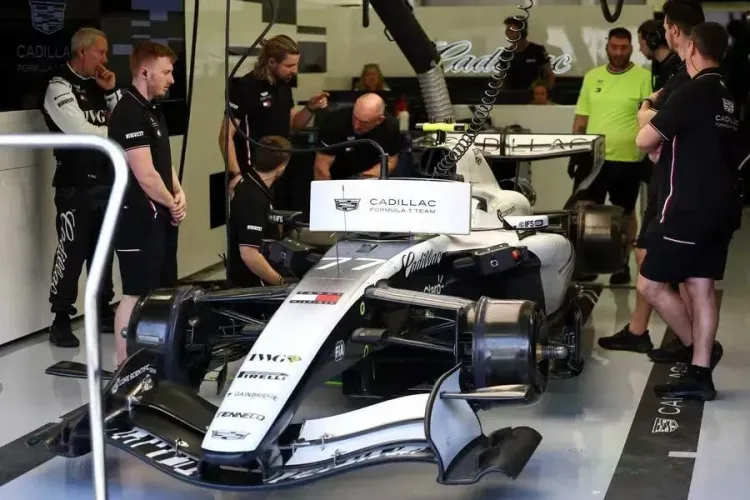
Cadillac arrived on the F1 grid faster than almost anyone expected — and is now discovering exactly why that grid is so hard to compete on. With simulation tools still being built, aerodynamic correlation lagging, and a data deficit measured in decades, the real race for team owner Dan Towriss and team principal Graeme Lowdon isn't on track yet. It's in the factory.
Key Takeaways
Cadillac F1 is four races into its debut 2026 season , with the MAC-26 yet to reach midfield competitiveness.
Drivers Sergio Perez and Valtteri Bottas have recorded seven finishes from eight combined starts .
Team owner Dan Towriss acknowledged 'naivete' about the complexity of building a competitive F1 operation from scratch.
Team principal Graeme Lowdon identified accumulated data and intellectual property as the hardest gap to close, noting the team's data is 'a tiny fraction' of rivals'.
Aerodynamic development and simulation-to-track correlation have been flagged as the primary technical priorities.
The team is backed by General Motors and TWG Global , providing financial depth absent from earlier new-entrant failures such as Manor , Caterham , and HRT .
Cadillac Formula One has cleared the first hurdle of its debut 2026 season — but team owner Dan Towriss and team principal Graeme Lowdon are under no illusions about the scale of the challenge that remains. Four races in, the MAC-26 is not yet a midfield contender, and the organisation is still building the foundational tools that rival teams have accumulated over decades.
From Concept to Grid in Under Two Years
Less than two years ago, Cadillac's F1 project existed more as an ambition than a functioning race team. By the time the lights went out in Melbourne to open the 2026 season, it had already become a global operation spanning Silverstone, Indianapolis, and North Carolina, staffed by personnel drawn from across the paddock.
The speed of that assembly, however, could not fully prepare those involved for what followed. 'There definitely was some naivete,' Towriss said during the Japanese Grand Prix weekend last month. 'You can say it's complicated, but until you get in and see all the pieces and everything that's needed, the amount of coordination, the number of complex systems that have to work together in unison, it's another level entirely.'
Seven Finishes, Zero Illusions
Drivers Sergio Perez and Valtteri Bottas have produced seven finishes from a combined eight starts, offering a degree of early reassurance — particularly given that more established outfits such as Aston Martin have also struggled with the demands of the new regulations. But Towriss is wary of using mere race completion as a measure of progress. 'I actually kind of bristle at that, because finishing a race is not the goal,' he said.
The pressure, he added, is self-generated rather than results-driven. 'The pressure that comes is the pressure of Formula One, week in and week out, and it's self-imposed,' Towriss said.
Lowdon's Manor Lessons and What Has Changed
For Lowdon, the experience of building a new F1 team carries a familiar weight. His previous tenure leading Manor — an operation that battled for survival alongside Caterham and HRT before eventually folding — offered hard lessons in how quickly new entrants can be overwhelmed by modern F1's demands.
The context, he acknowledges, has shifted considerably. Cadillac's project is underpinned by the financial resources of General Motors and TWG Global, providing a structural depth that Manor never had. Yet some of the underlying challenges persist. 'Teams build up intangible intellectual property that is invaluable, and it takes years, if not decades, to build,' Lowdon said. 'The data we're assembling is a tiny fraction of what other teams have.'
The Aerodynamic Gap and the Simulation Problem
In practical terms, Cadillac is still operating without several tools that established teams consider standard — most critically, the ability to reliably correlate simulation data with real-world on-track performance. 'Aero's going to be at the top of the list,' Towriss said, identifying aerodynamic development as the area most likely to determine the pace of the team's progress.
Lowdon points to the same constraint from a different angle: the inability to run the car before the season began has delayed the process of building dependable feedback loops between wind tunnel testing, computational fluid dynamics (CFD), and live track data. Until that gap closes, improvement will arrive in incremental steps rather than sudden leaps.
Culture, Identity, and the Long Game
Where Cadillac believes it can accelerate its trajectory is in the internal functioning of the organisation itself. The team has been clear that its objective is not to replicate existing structures. 'We're not Mercedes, Red Bull, [or] Ferrari,' Towriss said. 'This is Cadillac Formula One.'
Early internal signals have been encouraging. 'What I'm really pleased about is the way the team is performing in problem-solving, the team spirit is really, really high,' Lowdon said. The stated ambition for the remainder of the season is measured: reduce the gap to the midfield, improve race by race, and lay the groundwork for more meaningful progress in subsequent seasons.
'The goal is to close the gap to the next team, race them, challenge them, and keep progressing,' Lowdon said. F1's history is littered with new entrants who arrived with ambition and departed with little to show for it — and Cadillac, for all its preparation and backing, is not exempt from those forces. What it does have, at least for now, is time, and a clear-eyed understanding that there are no shortcuts in a sport where even marginal advantages can take years to engineer.
Point of View
But candour doesn't close a lap-time gap. The team's real problem isn't culture or funding — it's the decade-plus of simulation data and aerodynamic institutional memory that rivals have and Cadillac simply cannot buy. New regulations were supposed to compress the field, yet the teams that have struggled most in 2026 are precisely the ones without deep historical baselines to reinterpret. Lowdon's Manor experience is instructive, but Manor never had General Motors behind it — the question is whether financial firepower alone can compress a learning curve that, in F1, typically runs in years, not months.
NationPress
24 Sept 2026
Frequently Asked Questions
How is Cadillac F1 performing in the 2026 season so far?
Four races into the 2026 season, Cadillac's MAC-26 has not yet reached midfield competitiveness, though drivers Sergio Perez and Valtteri Bottas have completed seven of eight combined starts. Team owner Dan Towriss has been open about the gap that still needs to be closed.
Who are the key figures leading the Cadillac F1 team?
The team is led by owner Dan Towriss and team principal Graeme Lowdon. It is backed financially by General Motors and TWG Global, and draws staff from across the F1 paddock.
What is the biggest technical challenge Cadillac F1 faces?
Cadillac's primary technical challenge is aerodynamic development and the lack of reliable correlation between simulation data and real-world track performance. The team has not yet built the feedback loops between wind tunnel, CFD, and track data that established teams rely on.
How does Cadillac's situation compare to previous new F1 entrants?
Cadillac carries significantly greater financial backing than predecessors such as Manor, Caterham, and HRT, all of which ultimately failed. However, team principal Graeme Lowdon — who led Manor — notes that the underlying challenge of building intangible intellectual property and data over years remains the same.
What are Cadillac F1's goals for the rest of the 2026 season?
The team's stated aim is to reduce the lap-time gap to midfield rivals, improve consistently race by race, and build a development platform for future seasons. No specific points targets or championship positions have been announced.