SA20 Season 5 auction: Graeme Smith's five-year plan for global T20 dominance
Synopsis
SA20 is five seasons old and commissioner Graeme Smith is thinking long-term — not with a hard expansion blueprint, but with a philosophy of steady improvement. A mini-auction that saw a South Africa Under-19 prospect go for R 2.9 million is the clearest signal yet that IPL-backed franchises are investing in the future, not just buying global names.
Key Takeaways
SA20 commissioner Graeme Smith outlined a five-year growth plan centred on steady improvement rather than rapid expansion, following the league's Season 5 mini-auction on 8 October 2026 .
Jason Rowles , a former South Africa Under-19 player, was signed by Joburg Super Kings for R 2.9 million — the auction's standout deal.
789 players initially registered for the auction; 156 were shortlisted, competing for just 19 available slots.
Smith confirmed that expansion talks — new franchises, longer windows — are ongoing but will be handled year by year within the new ICC FTP four-year cycle.
South Africa had over 21 players at last year's IPL — the highest of any nation — reflecting the league's role in boosting local talent's global profile.
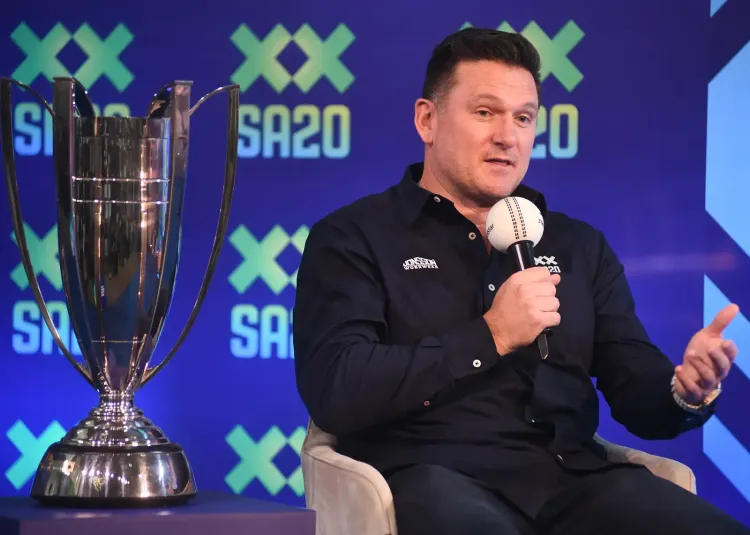
SA20 commissioner Graeme Smith has outlined an ambitious five-year roadmap for the South African franchise T20 league, centred on continuous improvement and cementing its place among the world's elite cricket competitions. His remarks came on 8 October 2026, following a fast-paced mini-auction in which six franchises finalised their squads for the upcoming fifth season.
Key Developments from the Mini-Auction
The auction drew significant attention for Joburg Super Kings' acquisition of former South Africa Under-19 player Jason Rowles for a staggering R 2.9 million — the headline deal of the day. Veteran Caribbean all-rounder Kieron Pollard, a long-standing fixture in Mumbai Indians-affiliated setups worldwide, also featured among the notable signings.
A total of 789 players had initially registered for the auction before the list was trimmed to 156 players — comprising 95 South Africans and 61 overseas stars — all competing for just 19 available slots. The sheer volume of registrations, Smith argued, reflects the league's growing appeal among international cricketers.
Smith's Vision: Quality, Not Just Growth
'Our vision is to get better and better every year,' Smith said in an interaction facilitated by SA20 post-auction. 'Firstly, you need to be a league of choice. I was really excited — just for 19 slots — to see how many players put their name on the auction list. That shows that players want to be here, want to play in the SA20. Cricket will always be the number one core of our product.'
Smith acknowledged that expansion discussions — around adding new franchises and extending the tournament window — are inevitable as the league matures. 'You'll take it year by year,' he said. 'You'll see the developments of franchise cricket still progress over the next year or two or three.' He added that he expects the global T20 landscape to settle around 'four or five high-profile leagues every year,' and that SA20's ambition is to rank among them — alongside the IPL, the Hundred, and others — as the pre-eminent competition in the Southern Hemisphere.
IPL Franchises Deepening Local Roots
Several SA20 teams are owned by IPL-affiliated entities, and Smith noted that over four-and-a-half years these franchises have developed a substantially sharper understanding of South African cricket's grassroots talent pipeline, particularly in the Under-23 bracket.
'Four or five years in, the IPL franchises have learned a lot about South Africa — in business and cricket,' Smith said. He pointed to Nqobani Mokoena, who 'came out of nowhere' to produce a standout season with Paarl Royals last year, as evidence that the scouting investment is yielding results. Notably, South Africa produced more players at the IPL last year than any other nation — over 21 — underscoring how the league has accelerated domestic talent's international exposure.
SA20's Broader Impact on South African Cricket
Smith was candid about the state of the game before SA20 launched: 'South African cricket was in a challenging space. The national team was struggling. There were a lot of administration issues. Fans were getting disgruntled with the game.' He argued the league has since reversed that trajectory — raising playing standards, attracting new spectators, and providing the national team with a more competitive pool of match-hardened players.
'Last year, walking around the stadium, the amount of people I met who were coming to cricket for the first time — the growth of the fan base is one of the key goals we wanted to achieve. Over the first few years, we've achieved all those things,' he said.
What Comes Next
With Season 5 squads now set, attention turns to whether the league can sustain its upward momentum amid a congested global T20 calendar. Smith's measured, year-by-year approach to expansion contrasts with more aggressive growth models seen elsewhere, signalling a preference for structural stability over rapid scaling. Whether the SA20 window can be protected within the ICC's new four-year FTP cycle will be a defining question for the league's next chapter.
Point of View
Overexpansion has undone leagues faster than underperformance. The real indicator to watch is not how many franchises SA20 adds, but whether its broadcast and attendance numbers hold against competing windows. The Rowles signing for R 2.9 million is a bet on South African grassroots depth; the return on that investment will say more about the league's future than any commissioner's vision statement.
NationPress
8 Oct 2026
Frequently Asked Questions
What is Graeme Smith's vision for SA20 over the next five years?
Smith wants the league to improve continuously year on year and establish itself as one of the top four or five franchise T20 competitions globally, alongside the IPL and the Hundred. He has indicated expansion decisions — such as adding new franchises or extending the window — will be taken incrementally rather than on a fixed timetable.
Who was the standout signing at the SA20 Season 5 mini-auction?
Former South Africa Under-19 player Jason Rowles was signed by Joburg Super Kings for R 2.9 million, the headline deal of the auction. Veteran all-rounder Kieron Pollard also featured among the notable acquisitions.
How competitive was the SA20 Season 5 auction pool?
A total of 789 players initially registered before the list was trimmed to 156 — 95 South Africans and 61 overseas players — competing for just 19 available slots. Smith cited the large registration numbers as evidence of the league's growing appeal.
How have IPL-affiliated franchises adapted to the SA20 environment?
According to Smith, IPL-owned franchises have developed a significantly deeper understanding of South African cricket's domestic talent pipeline over four-and-a-half years, particularly in the Under-23 bracket. He pointed to Nqobani Mokoena's breakout season with Paarl Royals as an example of that scouting investment paying off.
What has been SA20's broader impact on South African cricket?
Smith argues the league has raised domestic playing standards, attracted new fans to stadiums, and strengthened the national team's depth. He noted that South Africa had the most players at last year's IPL — over 21 — reflecting the increased international visibility the league has generated for local talent.