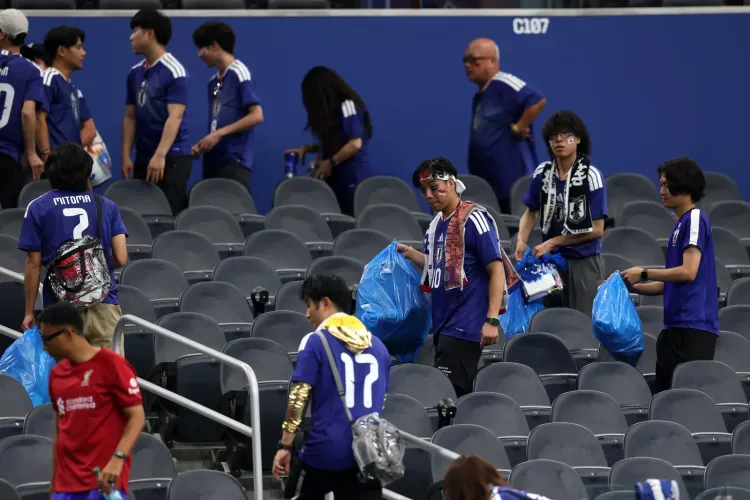
Japan fans clean Dallas Stadium after FIFA WC 2-2 draw vs Netherlands
Synopsis
Japan drew 2-2 with the Netherlands at Dallas Stadium — but their fans won the internet. Hundreds of supporters stayed back with blue trash bags to clean the stands, a tradition FIFA itself spotlighted on X. One fan summed it up: 'We are honoured to be here. We don't want to make the mess and then leave it.'
Key Takeaways
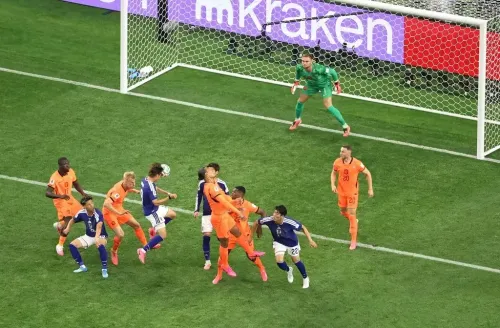
Japanese fans cleaned the stands at Dallas Stadium after a 2-2 draw against the Netherlands on 15 June at the FIFA World Cup .
Hundreds of supporters used large blue trash bags to collect bottles, food wrappers, and cups left by spectators.
FIFA praised the gesture on social media platform X , calling it 'impeccable manners'.
A Japanese supporter explained: 'We are honoured to be here.
We don't want to make the mess and then leave it.' The tradition dates back to at least the 2014 FIFA World Cup and is rooted in Japan's school-based civic education.
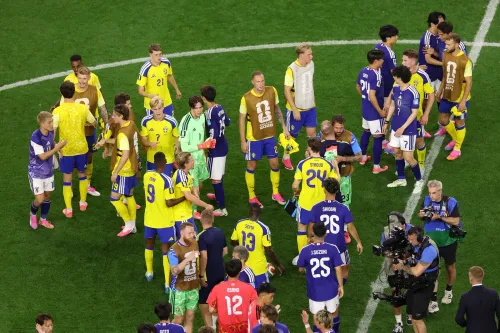
Japanese football supporters once again demonstrated their celebrated post-match tradition at the FIFA World Cup, staying behind to clean the stands at Dallas Stadium after a high-voltage 2-2 draw against the Netherlands on 15 June. While tens of thousands of spectators streamed toward the exits after the pulsating encounter, hundreds of Japanese fans armed with large blue trash bags methodically worked through the rows, collecting discarded bottles, food wrappers, and cups.
What the Fans Did
The cleanup was no spontaneous act — it is a ritual that Japanese supporters have carried to every major tournament for decades. Organised and unhurried, the fans combed through each section of seating long after the final whistle, leaving the stands visibly cleaner than they found them. The gesture drew widespread attention on social media and from football's global governing body.
What FIFA Said
FIFA shared images and a video of the cleanup on social media platform X, captioning one post: 'Japan fans doing what they do... supporters once again demonstrated their impeccable manners, tidying the stands before departing Dallas Stadium.' In a separate video shared by FIFA, a Japanese supporter explained the motivation behind the tradition: 'That's a culture, but more like a respect for everything: respect for players, supporters and also for the stadium. We are honoured to be here. We don't want to make the mess and then leave it.'
Global Reaction
The footage and images triggered an outpouring of admiration online. Commenters called the gesture 'commendable' and urged the world to take note. 'The world needs to learn from Japan,' one user wrote. Another added, 'Mad respect to Japan — one of the most mature people around the world.' Several users echoed a sentiment that has followed Japan's fanbase across tournaments: 'Class is permanent. Respect to the Japan fans once again.'
A Tradition That Transcends Football
Japan's stadium-cleaning habit dates back to at least the 2014 FIFA World Cup in Brazil, where it first captured global attention, and has been repeated at every major tournament since — including the 2018 and 2022 editions. Notably, Japanese school children routinely clean their own classrooms as part of the national curriculum, a practice widely credited with instilling the civic ethic on display in Dallas. As one user put it, 'This culture promotes their country more than the football team, and it's the biggest culture in this World Cup.' With Japan still in contention in the group stage, the world can expect to see those blue bags again.
Point of View
But what mainstream coverage rarely asks is why no other nation has institutionalised it at scale. The behaviour is not spontaneous altruism — it is the export of a domestic civic norm, shaped in classrooms where children clean their own schools. FIFA's decision to amplify it on X is itself a soft-power calculation: the governing body needs feel-good narratives in a tournament cycle shadowed by host-country controversies. The real story is not that Japan cleaned up in Dallas — it is that after more than a decade of global visibility, no other major football nation has meaningfully tried to replicate it.
NationPress
27 Sept 2026
Frequently Asked Questions
Why do Japanese fans clean stadiums after football matches?
Japanese supporters clean stadiums as an expression of cultural respect — for the venue, fellow spectators, and the sport itself. A fan in Dallas explained it directly: 'We are honoured to be here. We don't want to make the mess and then leave it.' The practice is rooted in Japan's school system, where students are expected to clean their own classrooms.
What happened at Dallas Stadium after Japan vs Netherlands at the FIFA World Cup?
After a 2-2 draw on 15 June, hundreds of Japanese fans stayed behind with large blue trash bags and systematically cleaned the stands, collecting bottles, food wrappers, and cups. FIFA shared images and video of the cleanup on social media platform X, praising their 'impeccable manners'.
How did FIFA react to the Japanese fans cleaning the stadium?
FIFA posted images and a video on X captioned: 'Japan fans doing what they do... supporters once again demonstrated their impeccable manners, tidying the stands before departing Dallas Stadium.' The posts drew widespread praise online.
Is this the first time Japanese fans have cleaned a World Cup stadium?
No. Japanese supporters have carried out post-match cleanups at every major FIFA World Cup since at least 2014 in Brazil, repeating the tradition in 2018 and 2022 as well. The Dallas cleanup is the latest in a well-documented pattern.
How did social media react to the Japanese fans' gesture?
The reaction was overwhelmingly positive. Users called the gesture 'commendable', with comments such as 'The world needs to learn from Japan' and 'Class is permanent' widely shared. Several noted that the cultural behaviour promotes Japan's global image as powerfully as its football results.