Is ILT20 Just a Warm-Up for the T20 World Cup? Insights from Neesham

Synopsis
James Neesham, the New Zealand all-rounder, shares his insights on the ILT20 and its significance compared to the T20 World Cup. He emphasizes the unique challenges each tournament presents, highlighting the evolving nature of T20 cricket and the demands on players. Discover why he believes the ILT20 should not be dismissed as mere preparation for the World Cup.
Key Takeaways
Neesham emphasizes the unique nature of the ILT20 .
The upcoming T20 World Cup presents different challenges compared to UAE conditions.
Power-hitting is now crucial in T20 batting, diminishing the role of anchor batters.
Fast bowlers face increasing pressures and may need to choose formats.
Adapting schedules to balance international play and franchise leagues is vital.
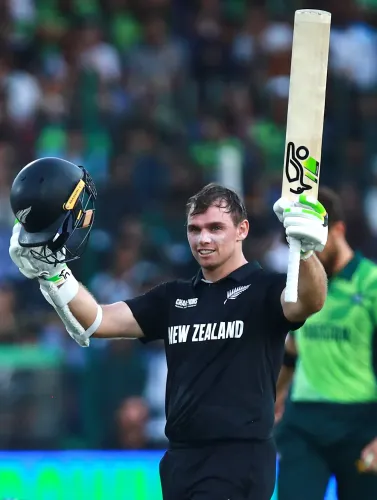
Dubai, Dec 10 (NationPress) James Neesham, the New Zealand seam-bowling all-rounder currently playing for Dubai Capitals in the International League T20 (ILT20), emphasized that the current tournament should not be considered a mere prelude to the upcoming T20 World Cup. He pointed out that the challenges of the grand event in India and Sri Lanka will differ significantly from those in the UAE.
Having played 93 T20I matches for New Zealand, Neesham has scored 1010 runs and taken 56 wickets. “Cricket is now played almost year-round globally. Thus, we shouldn’t overly prioritize one tournament over another. The conditions in India and Sri Lanka will be very different from those here,” he stated.
“It would be unwise to regard the ILT20 as a warm-up for the World Cup, as they present two distinct challenges,” Neesham conveyed in an exclusive interview with IANS from Dubai.
Neesham, who has participated in various T20 leagues, described his debut in the ILT20 as a remarkable experience. “This tournament stands out due to the high number of overseas players in each team, showcasing a superior quality of cricket. Coming from Nepal, where teams typically have only three or four overseas players and a majority of locals, this is a different atmosphere,” he noted.
Seeing the defending champions, Dubai Capitals, secure their first victory in the current competition has boosted morale. “It was great to achieve our first win of the season. The excellent performances by Rovman Powell and Jordan Cox gave us a solid total, and the bowlers executed well too. The mood in the team is positive, and we look forward to our upcoming training sessions before the next game on Saturday,” he said.
In recent times, power-hitting has become a crucial component of T20 batting, and Neesham remarked that the role of an anchor batter is becoming obsolete. “The game has evolved to be more aggressive, and the idea of an anchor batter who consistently bats through innings is nearly extinct now,” he asserted.
“Teams are now structured to be aggressive right from the start, bat deep, and aim to finish games decisively. Thus, the ability to hit boundaries is vital, and we hope to maintain this approach throughout the series,” he added.
Modern cricket has put increased pressure on fast bowlers, with rising workloads and injury risks due to overlapping international matches and franchise leagues. Neesham suggested that fast bowlers may soon need to choose their formats and called upon the ICC to balance the scheduling of international games with franchise leagues.
“Fast bowlers simply cannot sustain playing all three formats. They will have to make choices sooner than before. One-day cricket might decline as Test cricket maintains its prestige and T20 becomes the most lucrative,” he explained.
“It's apparent which direction players will head towards. I hope the ICC and other authorities can structure the schedule to allow cricketers to represent their countries while also maximizing their earnings from various leagues,” he concluded.
Neesham expressed a desire to manage his playing schedule effectively. “This varies for each individual. Personally, at 35 years old and with ample experience, I feel quite resilient regarding the physical demands of cricket. I hope to sustain this for the coming years.”
Point of View
I recognize the significance of Neesham's insights regarding the ILT20 and its distinction from the T20 World Cup. His perspective reflects the current dynamics of international cricket, emphasizing the need for players and teams to adapt to varying conditions and expectations. This article serves as a reminder of the evolving landscape of cricket that fans and players alike must navigate.
NationPress
19 Sept 2026
Frequently Asked Questions
What did James Neesham say about the ILT20?
James Neesham expressed that the ILT20 should not be viewed as merely a warm-up for the T20 World Cup, as the challenges of each tournament differ significantly.
How does Neesham feel about the role of anchor batters in T20 cricket?
Neesham believes that the role of anchor batters is becoming obsolete in modern T20 cricket, with teams now focusing on aggressive play from the start.
What are Neesham's views on fast bowlers in contemporary cricket?
He noted that fast bowlers may soon have to choose between formats due to the increased workloads and injury risks associated with overlapping international matches and franchise leagues.