7.99 lakh Waqf properties listed on UMEED Central Portal by August 7
Synopsis
India has listed nearly 8 lakh Waqf properties on the newly launched UMEED Central Portal-2025 — a transparency push mandated by the Waqf (Amendment) Act, 2025. Uttar Pradesh and West Bengal dominate the count, but the rollout was not without friction: technical glitches, connectivity gaps, and legacy data backlogs slowed early progress before a late surge ahead of the six-month deadline.
Key Takeaways
7.99 lakh Waqf properties have been enlisted on the UMEED Central Portal-2025 as of 7 August 2025 .
Uttar Pradesh ( 1.52 lakh ) and West Bengal ( 1.31 lakh ) are the top two states by number of properties listed.
The portal was launched on 6 June 2025 under the Waqf (Amendment) Act, 2025 , mandating upload of all pre-existing registered Waqf properties.
Maharashtra recorded the highest number of properties returned to Waqf makers at 9,292 .
Minister Kiren Rijiju acknowledged intermittent technical issues during the initial rollout, attributing them to legacy data volumes and connectivity gaps.
Server capacity was scaled up by the Ministry to handle a surge in uploads as the six-month deadline approached.
A total of 7.99 lakh Waqf properties have been successfully enlisted on the UMEED Central Portal-2025 as of 7 August 2025, according to official data released by the Ministry of Minority Affairs. The milestone marks a significant step in the Centre's push to digitise and transparently govern Waqf assets across the country.
State-wise breakdown
Uttar Pradesh leads all states with 1.52 lakh Waqf properties initiated or completed on the portal, followed closely by West Bengal with 1.31 lakh properties. Other states with a substantial presence on the portal include Kerala (79,929), Maharashtra (71,947), Telangana (63,982), and Karnataka (58,846).
The Waqf Board of Delhi has uploaded details of 3,233 properties, while the union territory of Dadra and Nagar Haveli and Daman and Diu recorded the lowest count, with just 2 Waqf properties enlisted as of 7 August.
Properties returned to Waqf makers
Maharashtra recorded the highest number of properties returned to Waqf makers, at 9,292. Kerala follows with 4,418 such returns, and Gujarat with 3,198, according to the Ministry's official documents.
About the UMEED Central Portal
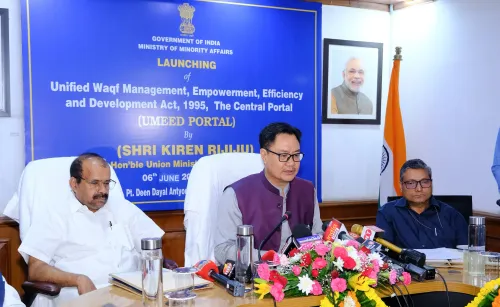
Minister of Minority Affairs Kiren Rijiju informed the Lok Sabha that the UMEED Central Portal-2025 was developed and launched on 6 June 2025 under Section 3(ka) of the Unified Waqf Management, Empowerment, Efficiency and Development (UMEED) Act, 1995, as amended by the Waqf (Amendment) Act, 2025. The portal is designed for uploading Waqf property details, registering new Waqf, and facilitating overall governance of Waqf properties in a transparent manner. The Act mandates that all existing Waqf registered before its commencement be uploaded onto the portal.
Technical challenges and government response
Rijiju acknowledged that following the portal's launch, certain intermittent technical and operational issues were reported by users, particularly during the initial phase and periods of high concurrent usage. He noted these issues were largely uniform across all states and union territories, including Kerala, and were transitional in nature.
The challenges arose primarily from the digitisation of large volumes of legacy data, variations in internet connectivity at the user end, differing levels of digital preparedness among field-level functionaries, and gaps in record availability with certain State Waqf Boards. Issues included occasional login delays and non-submission of mandatory documents.
Despite a modest start in uploads during the initial months, the Ministry reported a substantial increase in activity as the six-month deadline approached. To handle the surge in traffic, server capacity was augmented to ensure uninterrupted portal functioning, officials said.
With the bulk of the listing exercise now complete, the focus is expected to shift toward verification, dispute resolution, and the integration of legacy records that remain outstanding across several states.
Point of View
But the real governance test lies ahead. Uploading a property record is not the same as verifying its status, resolving encroachments, or settling competing claims — challenges that have plagued Waqf administration for decades. The wide disparity between states like Uttar Pradesh and union territories like Dadra and Nagar Haveli also raises questions about the uniformity of implementation. Notably, the acknowledged technical glitches and the late surge in uploads suggest compliance was deadline-driven rather than organically steady — a pattern that often precedes data quality issues downstream.
NationPress
30 Sept 2026
Frequently Asked Questions
What is the UMEED Central Portal-2025?
The UMEED Central Portal-2025 is a government platform launched on 6 June 2025 under the Waqf (Amendment) Act, 2025, for uploading details of Waqf properties, registering new Waqf, and enabling transparent governance of Waqf assets across India. It was developed as mandated by Section 3(ka) of the UMEED Act, 1995, as amended.
How many Waqf properties have been listed on the portal so far?
As of 7 August 2025, a total of 7.99 lakh Waqf properties have been enlisted on the UMEED Central Portal-2025, according to official data from the Ministry of Minority Affairs. Uttar Pradesh and West Bengal account for the largest shares.
Which states have the most Waqf properties on the portal?
Uttar Pradesh leads with 1.52 lakh properties, followed by West Bengal with 1.31 lakh. Kerala, Maharashtra, Telangana, and Karnataka also feature prominently, with counts ranging from roughly 58,000 to nearly 80,000 properties each.
What technical issues affected the portal rollout?
Minister Kiren Rijiju told the Lok Sabha that users reported intermittent login delays, connectivity problems, and difficulties submitting mandatory documents, particularly during the initial phase and peak usage periods. The Ministry subsequently scaled up server capacity to manage increased traffic ahead of the six-month deadline.
What happens after the properties are listed on the portal?
The listing exercise fulfils the Act's mandatory upload requirement. Going forward, the focus is expected to shift to verification of records, resolution of disputes, and integration of legacy data that remains outstanding with several State Waqf Boards.