Alberta referendum October 19: 10 questions that could reshape Canada
Synopsis
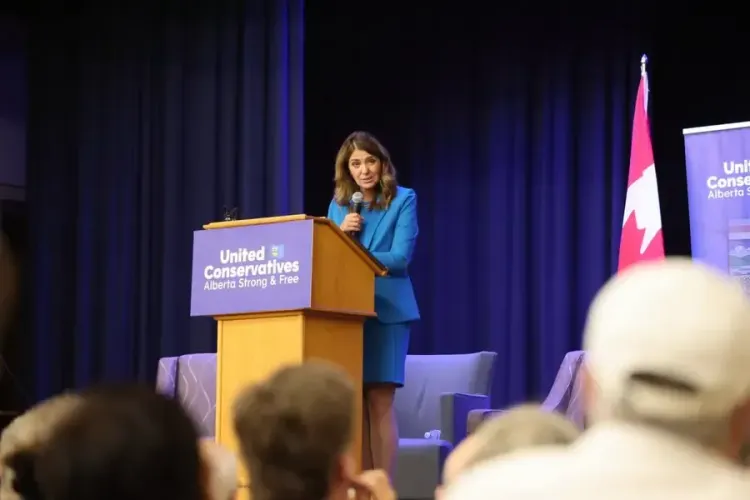
Alberta's 19 October referendum is not just a provincial vote — it is a constitutional stress test for Canada. Premier Danielle Smith has put 10 questions to voters, including Senate abolition and Alberta's very place in Confederation. With the amendment bar extremely high and other provinces watching in silence, the vote could either force a national conversation about federalism or give separatists new momentum.
Key Takeaways
Alberta holds a referendum on 19 October 2026 with 10 questions covering constitutional reform and separatism.
Premier Danielle Smith is seeking provincial control over judicial appointments, federal programme funding, and legislative supremacy in jurisdictional disputes.
Abolishing Canada's Senate would require unanimous provincial consent, parliamentary approval, and the Senate's own agreement — a bar Smith's government concedes is unlikely to be met.
Most other provincial leaders have declined to take firm positions, with only Yukon Premier Currie Dixon explicitly hoping Alberta remains in Confederation.
Opposition NDP leader Naheed Nenshi accuses Smith of seeking political confrontation rather than achievable reform.
Constitutional law professor Gerard Kennedy warns that opening negotiations could trigger competing demands from every province.
Alberta heads to the polls on 19 October 2026 for a referendum that could fundamentally redraw the balance of power between Canada's provinces and its federal government — and reignite the country's most serious separatism debate in decades. Premier Danielle Smith has placed 10 questions before voters, four of which involve major constitutional changes that would require Parliament and multiple provincial legislatures to approve.
What Albertans Are Being Asked
The four constitutional proposals at the heart of the referendum include abolishing Canada's Senate, allowing Alberta — rather than Ottawa — to appoint judges to the provincial Court of Appeal and Court of King's Bench, letting Alberta withdraw from federal programmes without losing associated funding, and giving provincial laws precedence over federal laws in jurisdictional disputes.
A fifth prominent question goes further still: it directly addresses Alberta's continued place within Canada, making this one of the most constitutionally charged votes in the country's recent history.
How High Is the Constitutional Bar
Three of the four constitutional proposals would, according to analysts, require approval from Parliament and at least seven provincial legislatures representing more than half of Canada's population. Abolishing the Senate faces an even steeper climb — it would need unanimous provincial consent, parliamentary approval, and the Senate's own agreement. Smith's government has itself acknowledged that Senate abolition is unlikely to clear that threshold.
Her office has nonetheless argued that 'targeted' constitutional amendments could succeed if Alberta voters deliver a strong mandate. Ryan Fournier, a communications adviser to Smith, said: 'Provinces across the country are tired of federal overreach and want more authority within Confederation, not less. We believe this conversation is a vital step towards a fairer Confederation.'
How Other Provinces Are Responding
Other provincial leaders have largely avoided committing to firm positions. Saskatchewan Premier Scott Moe's office declined to comment. A spokesperson for Northwest Territories Premier R.J. Simpson said the referendum 'is a matter for Albertans to consider through their own process.'
Nunavut Premier John Main said his territory would monitor the outcome, adding: 'Like Alberta, Nunavut is rich in resources that benefit the rest of Canada and the world, and we need external supports to bring those resources to market.' He expressed support for 'measures that build a stronger Canada.'
Yukon Premier Currie Dixon expressed hope that Alberta would stay in Confederation. 'Canada, including the Yukon, would be negatively affected if Alberta were to leave,' Dixon said.
Legal and Political Risks
Gerard Kennedy, a constitutional law professor at the University of Alberta, said other provinces might welcome proposals expanding their control over judicial appointments and federal programmes — 'It's extra provincial power. Why wouldn't they want it?' — but cautioned that persuading federal Parliament to surrender authority without receiving anything in return would be far harder. Kennedy also warned that opening constitutional negotiations could prompt every province to table its own demands, making a final agreement significantly more difficult.
Opposition New Democratic Party leader Naheed Nenshi accused Smith of engineering confrontation rather than seeking achievable reform. 'She doesn't want to get those things,' Nenshi said. 'She wants to complain about not getting those things. She wants the other provinces to say no.'
Broader Implications for Federal Democracies
The Alberta referendum carries resonance beyond Canada's borders. Large, diverse federations — including India — regularly grapple with analogous tensions over taxation, natural resources, and the division of authority between central and regional governments, even where constitutional structures differ. The outcome on 19 October will be closely watched as a test of how mature federations manage internal centrifugal pressures without fracturing.
Point of View
And the amendment formula for the remaining proposals is formidable — yet the vote proceeds. That gap between stated ambition and achievable outcome is the story. If the mandate comes back strong and Ottawa still says no, Smith gains a grievance narrative that is more valuable to her base than any actual constitutional win. Nenshi's critique — that she wants the rejection, not the reform — is the sharpest lens through which to read this exercise. For federalists watching from other provinces and other countries, the more troubling signal is that constitutional discontent is being channelled through a referendum mechanism that is inherently binary, when the underlying fiscal and resource grievances are structurally complex.
NationPress
28 Sept 2026
Frequently Asked Questions
What is the Alberta referendum on 19 October 2026 about?
The Alberta referendum asks voters to weigh in on 10 proposals, four of which involve major constitutional changes including abolishing Canada's Senate, giving Alberta control over provincial judicial appointments, allowing withdrawal from federal programmes without losing funding, and asserting provincial law over federal law in jurisdictional disputes. A separate question directly addresses Alberta's continued membership in Canada.
How difficult would it be to implement Alberta's constitutional proposals?
Three of the four constitutional proposals would require approval from Parliament and at least seven provincial legislatures representing more than half of Canada's population. Abolishing the Senate faces an even higher bar — unanimous provincial consent, parliamentary approval, and the Senate's own agreement — a threshold Premier Smith's own government has acknowledged is unlikely to be met.
What has Premier Danielle Smith said about the referendum?
Smith has framed the referendum as a way to address Alberta's grievances within Confederation and prevent more voters from turning towards outright separation. Her communications adviser Ryan Fournier argued that 'provinces across the country are tired of federal overreach' and called the vote 'a vital step towards a fairer Confederation.'
How are other Canadian provinces responding to Alberta's referendum?
Most other provincial leaders have avoided taking firm positions. Saskatchewan Premier Scott Moe's office declined to comment, while Yukon Premier Currie Dixon expressed hope that Alberta would remain in Canada, warning that 'Canada, including the Yukon, would be negatively affected if Alberta were to leave.' Nunavut Premier John Main said his territory would monitor the result.
What risks do constitutional experts see in Alberta's proposals?
University of Alberta constitutional law professor Gerard Kennedy has warned that opening formal constitutional negotiations could prompt every province to introduce its own demands, making a final agreement far harder to reach. He also noted that persuading federal Parliament to surrender authority without receiving anything in return would be a significant political challenge.