Supreme Court Grants Bail in Controversial UP Religious Conversion Case, Citing Long Custody
Synopsis
The Supreme Court has intervened in a contentious case, granting bail to Vishal Rana, who faced charges under the IPC and UP Prohibition of Unlawful Religious Conversion Act. The apex court criticized the Allahabad High Court's oversight of key details in this complex matter, raising questions about judicial processes involved in religious conversion cases.
Key Takeaways
Supreme Court grants bail to Vishal Rana, criticizing previous court decisions.
Case involves allegations of coercion related to religious conversion.
Petitioner had been in custody for over 1.5 years.
Key evidence overlooked by the Allahabad High Court.
Significant implications for judicial handling of religious conversion cases.
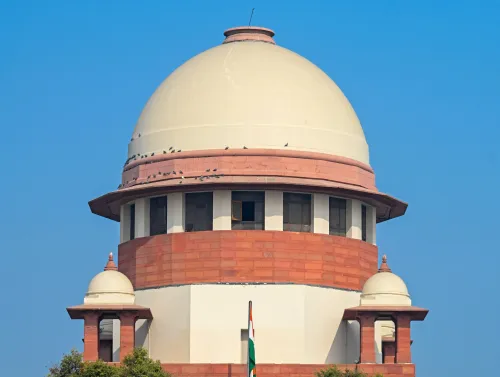
New Delhi, April 7 (NationPress) The Supreme Court has approved bail for an individual charged under the IPC and the Uttar Pradesh Prohibition of Unlawful Religious Conversion Act, 2021, noting that the Allahabad High Court failed to consider significant factors when denying his request.
A bench comprising Justices J.B. Pardiwala and K.V. Viswanathan ordered that the petitioner, Vishal Rana, also known as Tabish Asghar, be released on bail immediately, subject to conditions set by the trial court.
The apex court addressed a special leave petition (SLP) contesting a November 14, 2025, ruling from the Allahabad High Court, which had refused bail to the accused in a case filed at the Sector 113 police station in Gautam Buddha Nagar, Noida.
The FIR included charges under Sections 323, 506, and 313 of the IPC, along with Sections 3 and 5(1) of the UP Prohibition of Unlawful Religious Conversion Act, 2021.
Considering the progress of the trial, the Justice Pardiwala-led bench pointed out that the charge sheet had already been submitted and the case was currently before a sessions court in Noida, with only one witness having been examined thus far.
Furthermore, the bench noted that the petitioner had been in custody since December 3, 2024. “It is unfortunate that the petitioner remains in judicial custody as an under-trial prisoner for over one and a half years in this type of case,” the Supreme Court commented.
The Justice Pardiwala-led bench determined that some crucial elements had been ignored by the Allahabad High Court when it denied bail. It emphasized that the complainant had visited the accused in jail three times during his detention. “This speaks for itself,” the apex court remarked, mentioning that both parties had also submitted a joint petition to the Allahabad High Court seeking protection due to fears for their lives and safety, which was granted.
The order also referenced a Facebook conversation presented as evidence, indicating that the complainant was aware of the accused's religious affiliation. “This point was also not considered by the High Court while evaluating the overall situation,” stated the Justice Pardiwala-led bench.
In its contested ruling, the Allahabad High Court had denied bail, stating that “prima facie, the involvement of the accused in the present case cannot be dismissed” and that “no case for bail is established,” given the seriousness of the allegations.
The Allahabad High Court also noted the prosecution’s claim that the accused allegedly concealed his religious identity, entered into a relationship and marriage with the complainant, and subsequently pressured her to convert to Islam, alongside accusations of forced abortion and threats to her life.
Conversely, the defense contended that the relationship was consensual and maintained that the allegations arose from personal disputes following differences between the parties.
In granting the appeal, the Supreme Court clarified that the petitioner should be released on bail “immediately, unless required for any other case,” leaving it up to the trial court to impose suitable terms and conditions.
The apex court concluded the petition, making it clear that it was not expressing any views on the merits of the case, which would be determined during the trial.
Point of View
This ruling highlights the Supreme Court's commitment to ensuring justice and scrutinizing lower court decisions. It raises important questions about the legal framework surrounding religious conversions and the rights of individuals involved in such sensitive matters.
NationPress
19 Sept 2026
Frequently Asked Questions
What were the charges against Vishal Rana?
Vishal Rana was charged under various sections of the IPC and the Uttar Pradesh Prohibition of Unlawful Religious Conversion Act, 2021, including allegations of concealing his religious identity and coercing the complainant to convert.
What did the Supreme Court say about the Allahabad High Court's decision?
The Supreme Court criticized the Allahabad High Court for neglecting vital aspects of the case, emphasizing that certain evidence was not considered when denying bail.
How long had Vishal Rana been in custody?
Vishal Rana had been in custody for over one and a half years before being granted bail by the Supreme Court.
What factors did the Supreme Court take into account for granting bail?
The Supreme Court noted the progress of the trial, the filing of the charge sheet, and the fact that only one witness had been examined, alongside the complainant's visits to the accused in jail.
What implications does this ruling have for future cases?
This ruling may influence how courts handle similar cases involving religious conversions, ensuring that all relevant evidence is thoroughly examined.