Is Bangladesh Witnessing a Resurgence of Islamist Mobilisation?
Synopsis
A recent report highlights the rise of Tawhidi Janata, a loosely defined Islamist movement in Bangladesh, which is emerging not through traditional militancy but by leveraging moral coercion amid weakened institutions and political crises. This shift poses significant implications for the nation’s political landscape.
Key Takeaways
Tawhidi Janata is a grassroots movement emerging in Bangladesh.
The movement operates through moral persuasion rather than organized violence.
It gained prominence following the political collapse in August 2024.
Acts of violence attributed to Tawhidi Janata have occurred.
The rise of this movement poses significant challenges to existing political structures.
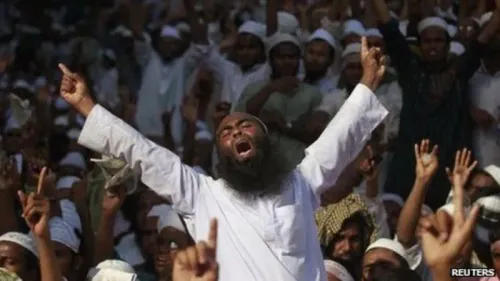
Canberra, Jan 17 (NationPress) The resurgence of Tawhidi Janata — an undefined Islamist movement in Bangladesh — does not stem from structured violence but instead signifies a morally motivated form of coercive populism thriving in environments where institutions weaken, law enforcement is inadequate, and questions about political legitimacy arise, according to a new report.
The report notes that by operating openly and framing the challenge to un-Islamic values as a religious duty, this movement navigates immediate repression while transforming the public sphere.
As detailed in a report from Australian publication The Interpreter, for almost 16 years, the Awami League government, led by Sheikh Hasina, has utilized elections, a robust security framework, and state-supported secular Bengali nationalism while suppressing, co-opting, or fragmenting Islamist factions and religious networks.
“Public expressions of religiosity were allowed, but political Islam outside state control was strictly managed. This approach, while reducing overt confrontations, did not eliminate religious politics; it merely pushed it into informal, depoliticized areas. The system's collapse in August 2024, following Hasina’s removal, revealed not only a political void but also a crisis of moral authority,” the report elaborated.
In the political vacuum left by Hasina’s removal, Tawhidi Janata emerged, invoking religious obligations to influence public life.
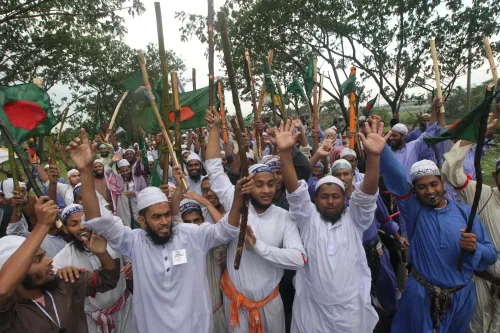
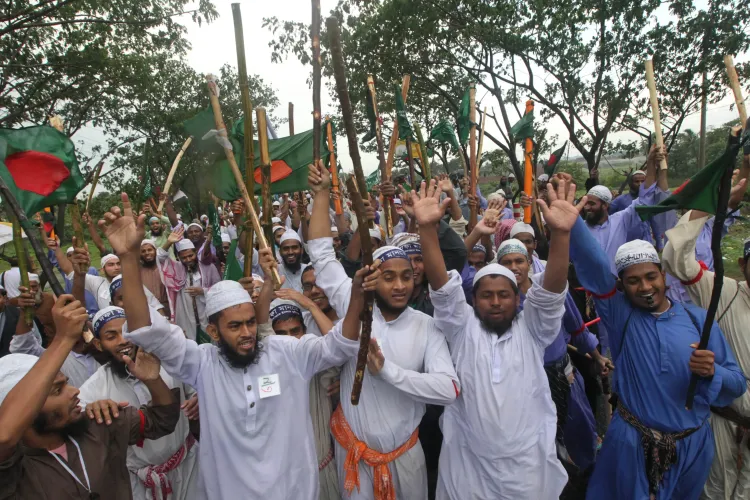
“This is not a structured organization but a term under which various actors unite, intervening in public realms, regulating behavior, disrupting cultural events, and targeting women-centric gatherings. Its strength lies in ambiguity: lacking formal leadership or structures, it operates through crowds, symbolism, and moral persuasion rather than institutional presence,” the report highlighted.
The report underscored that alleged affiliates of Tawhidi Janata have engaged in acts of direct violence throughout Bangladesh.
“In September 2025, a mob clashed with police in Rajbari, attacking a shrine and exhuming and burning a deceased individual, resulting in one fatality and numerous injuries. In Dhaka, a group took over a police station demanding the release of a man arrested for harassing a woman about her 'inappropriate' attire, all while broadcasting the incident live,” it detailed.
“These incidents signify a transition from clandestine to overt moral activism, with an emphasis on visibility — occupying streets, intimidating institutions, and testing the boundaries of state power. Economic hardships and declining trust in political systems intensify these occurrences, particularly among the youth,” it further asserted.
Stressing that the emergence of Tawhidi Janata is a cautionary tale for Bangladesh’s political evolution, the report concluded, “The challenge now transcends mere electoral or constitutional matters; it raises the question of whether authority will be restored via legal and democratic means or surrendered to those asserting moral supremacy through public influence.”
Point of View
It is crucial to highlight that the emergence of Tawhidi Janata reflects a broader crisis of legitimacy in Bangladesh, where traditional political structures are being tested. This trend emphasizes the need for a balanced approach to governance that accommodates diverse voices while ensuring law and order.
NationPress
19 Sept 2026
Frequently Asked Questions
What is Tawhidi Janata?
Tawhidi Janata is a loosely defined Islamist movement in Bangladesh that operates outside traditional political frameworks, focusing on moral activism and public engagement.
How did Tawhidi Janata emerge?
The movement emerged in response to political instability and the collapse of traditional governance structures following Sheikh Hasina's ouster in August 2024.
What are the key activities of Tawhidi Janata?
Tawhidi Janata engages in public interventions, behavioral regulation, and disruption of cultural activities, often targeting women-centric events.
What are the implications of Tawhidi Janata's rise?
The rise of Tawhidi Janata signals a potential shift in Bangladesh’s political landscape, challenging existing authority and raising questions about the future of governance.
Is Tawhidi Janata a formal organization?
No, Tawhidi Janata is not a formal organization but a label under which various actors collaborate, lacking structured leadership.